How the Catholic-Protestant War Became Red vs. Blue
“The map is not the territory.” — Alfred Korzybski
A hallucination is a perception generated without a corresponding external reality. The experience feels genuine, but the mind has mistaken the map for the territory.
We see Red and Blue screaming at each other every day—on news programs, on social media, on podcasts, on blogs. Their fear is real. Their anger is no joke. Their moral outrage is absolute. Each side experiences the other as an existential threat.
But ask yourself: What is actually producing all this outrage?
Wealth extraction? Debt? Energy crisis? These are not the issues dividing Red and Blue.
Yet these are the issues we should be talking about.
Do you know how long it would take to count to $40 trillion—the number on our national debt?
1.27 million years.
Does either party have a plan to deal with it? No. All they know is how to raise the ceiling and kick the can.
Do you understand that the financial system is unsustainable—devaluing your currency, extracting wealth from the public, and funneling it upward into an ever-tighter bubble?
Do you realize the earth has physical limits on energy and natural resources—and that the price of these things is being artificially suppressed by debt, borrowed against a future we have not built?
While we scream at each other about flags and pronouns, the foundation beneath us is buckling.
The Two-Party System is a hallucination—not because their disagreements are imaginary, but because both parties have mistaken the binary for reality. The culture war is not the real war. The real war is between the financial system and the people, between debt and production, between narrative and reality.
We are living in the phantom-limb pain of a dead religious war, projected onto a cable-news chyron. The original wound—the Catholic-Protestant slaughter that consumed Europe for centuries—has healed, but its ghost still haunts us. That theological hatred was transferred to secular ideology, and then to tribal identity.
The part of the brain that was meant to be a tool has been pretending it is sovereign. It turns living reality into abstractions. This is how a map becomes more real than the territory it represents.
To see how this brain bug took hold, we need to trace four stages: from a real theological war, to a secular ideological battle, to a tribal identity conflict, and finally to a hallucination that has completely lost touch with the ground beneath our feet.
The Brain Bug: Why We Prefer Maps to Territory
Why do we ignore crushing realities like debt and energy limits in favor of culture war? Because our brains are wired to prefer simple, tribal maps over complex, terrifying territories.
Think of the mind as having two modes—not as a scientific fact about brain anatomy, but as a useful metaphor for how we think.
The right hemisphere is the sovereign. It takes in the whole picture: your body, the people around you, the room you are sitting in, the unspoken feelings in the air. It lives in metaphor, irony, and relationship. It asks sovereign questions: Why are we doing this? What is this for? Its mode is presence.
The left hemisphere is the tool. It focuses on details, categories, and distinctions. It draws stark lines: good and evil, us and them, right and wrong. It takes the terrifying mess of reality and breaks it into manageable pieces. It asks tool questions: How do we do this? What are the steps?
In a healthy mind, the sovereign uses the tool. The right brain sets the direction; the left brain executes the steps. They are partners in a dance.
But when the tool forgets it is a tool, disaster follows. The left brain starts believing its maps are the territory. It makes a map. Then a map of that map. Then another map of that map. Each layer of abstraction pulls us further from the messy, living reality beneath.
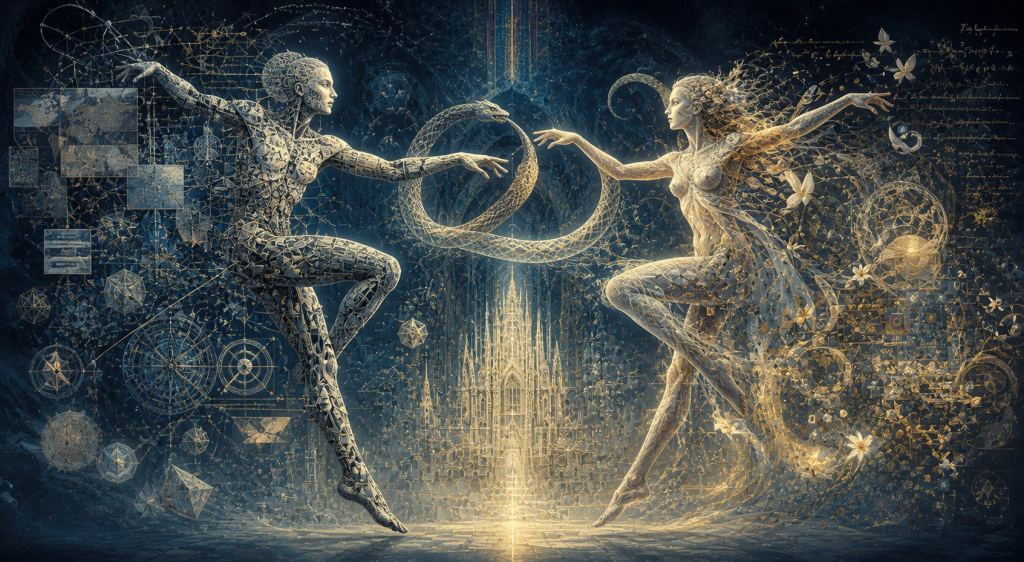
When the left brain runs unchecked, it becomes an Ouroboros—the serpent that eats its own tail. Each abstraction devours another layer of the real world. The snake’s body shrinks as it consumes itself, but its hunger for certainty only grows. And because it is never satisfied, it keeps eating.
This is how a living disagreement becomes an abstraction. The abstraction becomes a system. The system becomes an identity. And the identity eventually becomes a hallucination—a closed loop of symbols and outrage with no tether to the ground beneath our feet.
The left brain’s maps—Red versus Blue, progressive versus conservative—have become more real to us than the territory they supposedly represent. We argue about the map’s borders while the ground beneath us shifts.
The four stages that follow trace this devouring process, from the burning churches of the Reformation to the screaming heads on your television screen. Each stage represents another layer of abstraction, another turn of the serpent’s jaw, another step away from the living reality that we have forgotten how to see.
Stage One: The Real Fight — Catholic vs. Protestant

Back in the sixteenth century, the fight was real in a way we have mostly forgotten. The territory beneath the argument was alive.
Catholics and Protestants were willing to kill and die because they believed they were arguing about the fate of the human soul. They disagreed over whether the bread and wine literally became Christ’s body and blood, the authority of the Pope, and whether salvation came through faith alone or through good works. If you believed the other side was leading souls to eternal damnation, stopping them became a sacred duty.
The Catholic map said authority flowed through the institutional Church—its hierarchy, its traditions, its sacraments. The Protestant map shifted authority toward Scripture and the individual conscience standing directly before God.
Both were maps. Both were human attempts to represent a mystery no one could fully contain. But the territory underneath—the living God, sin, salvation, eternal judgment—was vibrantly real to the people holding those maps. They were not fighting over abstractions; they were fighting over what they believed was the very structure of reality itself.
When you believe your opponent is not merely wrong but damned—when you believe their victory means eternal suffering for millions of souls—every atrocity becomes justified. Some German territories lost nearly a third of their population. The maps had become matters of life and death because the territory they pointed to was, for those who held them, more real than anything on earth.
Then, after decades of devastating religious warfare, Europe was exhausted. Neither map had won. The territory—the living God, the soul, the afterlife—remained as mysterious as ever. But the human mind did what it always does when a map fails: it abstracted. It pulled back one layer from the living reality and began to fight over something else—something safer, more manageable, less terrifying than the mystery of God.
The theological war did not end. It simply changed its clothes.
Stage Two: The Secular Drain — Capitalism vs. Communism
By the nineteenth century, the Enlightenment and Industrial Revolution had drained much of the supernatural content from the old religious conflicts. But the underlying structure remained intact. Binary opposition. Universal truth. Heresy. Orthodoxy. Martyrs. Redemption.
The theological battle simply moved into secular territory.
Capitalism became the new map of salvation—the “invisible hand” of the market as a secular Providence, prosperity as the new fruit of the spirit. The market was no longer just an economy; it was a moral order. Success signaled virtue; failure signaled deficiency. Wealth was evidence of worth.
Communism became the counter-map—the classless paradise as Heaven on Earth, the vanguard party as the new priesthood, the purge as the new Inquisition. History had a direction and a destination. The revolution was inevitable. The faithful would be rewarded; the enemies of the people would be cast out.
Both offered a sweeping vision of human redemption within history and turned political disagreement into absolute moral warfare. The stakes were no longer eternal damnation, but they felt just as high: the future of humanity itself.
For nearly a century, these two visions clashed not just in pamphlets and speeches, but in global warfare, proxy conflicts, and a nuclear standoff that brought the world to the brink of annihilation. Vietnam, Korea, Afghanistan, Cuba—each became a theater in the same cosmic struggle. The Cold War was not a geopolitical rivalry. It was a religious war with nuclear weapons.
Then the Soviet Union crumbled. The Berlin Wall fell. Capitalism appeared to have won.
But victory created a strange problem: without a great ideological alternative, what were the two sides supposed to fight about? The economic center of gravity had converged. Free-market consensus came to dominate both major parties in the West. The old Left-Right economic battle had fused into a single corporate-financial order that neither side seriously challenged.
The economic territory had flattened. But the binary—the deep structure of us-versus-them—refused to die. The left brain cannot tolerate a world without categories, without enemies, without a clear distinction between the saved and the damned. So it abstracted again, moving the battlefield from how we organize the economy to who we are as a people.
The theological war had found its third set of clothes.
Stage Three: The Tribal Drain — Red vs. Blue
With the great ideological battle reduced to a flimsy consensus on corporate economics, the binary structure needed a new terrain to colonize. It found one in identity.
The conflict migrated from political philosophy to demographic category. Urban versus rural. College-educated versus non-college. Secular versus religious. Coastal versus heartland. The question ceased to be What do you believe? and became Who are you?
Here is the strangest part: the costumes changed completely. White Southern evangelicals—once rock-solid Democrats—moved en masse to the Republican coalition, while urban Catholics and secular professionals consolidated on the other side. The masks moved, but the architecture of the duel remained perfectly intact.
That is the crucial clue. If today’s political conflict were simply a continuation of the Catholic-Protestant or Capitalist-Communist fights, the tribal identities would have held steady. They didn’t. Because the deeper inheritance was never the particular content of the disagreement. It was the binary structure itself. One side versus the other. Us versus Them. Orthodox versus Heretic. Good versus Evil.
The left brain is a duel architect. It does not care if the battle is over transubstantiation, the means of production, or bathroom policies. It just needs a clean binary and a clear enemy.
So today, a Red voter and a Blue voter scream at each other over immigration, race, gender, or the border. The emotions are genuine. But ask yourself: Why must every single disagreement be absorbed into the same totalizing war? Why must the other side become not merely wrong, but dangerous, stupid, evil, or subhuman?
Because the fight has become self-sustaining. Cable news, social media algorithms, and partisan fundraising machines all profit from outrage. The argument no longer exists to solve a real problem; the conflict is the product. It no longer needs a coherent territory beneath it. The binary has become the territory.
And once the binary becomes the territory, the real world starts to disappear—along with shared facts, communal trust, and any capacity to address the tangible crises piling up beneath the spectacle. Debt, energy limits, a hollowed-out productive base—all of it recedes into the background.
The map no longer points to the territory. It has consumed it.
Stage Four: The Hallucination — When the Map Eats the Territory
This is where we are now.
While Red and Blue fight over cultural symbols, the material world continues underneath them. Debt accumulates. Infrastructure crumbles. Energy systems strain. Communities hollow out. Financial claims multiply faster than the productive economy beneath them.
And yet the political spectacle intensifies. Each side identifies the villain: the other party, the billionaire, the immigrant, the corporation, the socialist, the fascist. Every election produces another enemy. Every news cycle produces another outrage. Every algorithm rewards another dose of adrenaline.
The spectacle becomes more intense precisely as the underlying choices narrow. Why? Because both parties are structurally dependent on the same donor class, the same lobbying firms, and the same financial institutions. As corporate money and the revolving door bind them to the status quo, the range of actual policy solutions shrinks to a pinhole. The volume of the outrage must be turned up to compensate for the lack of genuine divergence.
This does not mean the parties are secretly identical. They disagree about real things, and those disagreements have real consequences. But both operate inside the same inherited binary architecture. And beneath that, they operate inside the same economic machinery.
Neither party has fundamentally escaped the financial system, the debt architecture, or the institutional machinery that sustains it. The Republican tells you the problem is the immigrant. The Democrat tells you the problem is the billionaire. Neither tells you that both are structurally dependent on the same apparatus of extraction—the system that turns debt into profit and energy into power.
The debate is a theatrical production designed to give you the illusion of choice while the real machinery of power operates behind the curtain.
We have reached the end of a long chain of abstraction. The question changed three times along the way. First: What is true? Then: What system is right? Finally: Who are you? Religion became ideology. Ideology became identity. Identity became tribalism. Different costumes, same operating system.
We are arguing about arguments about arguments—completely disconnected from the ground beneath our feet. That is the terminal form of the hallucination. We rage at our neighbor for their vote, while the real territory—crumbling infrastructure, spiraling debt, and physical energy limits—hums along unnoticed, unmentioned, and unchallenged by either camp.
The map has become more important than the territory.
The map has eaten the territory.
The Collision With Reality
But here is the catch: reality does not disappear because we stop looking at it. Eventually, the territory pushes back.
A financial system can create increasingly elaborate claims on wealth—derivatives, credit default swaps, trillion-dollar balance sheets. But it cannot manufacture the physical resources those claims depend upon. A government can create increasingly elaborate categories and regulations. But it cannot legislate away human nature or the laws of thermodynamics—the basic fact that energy is finite and extraction has real costs.
The further the map separates itself from the territory, the greater the pressure for reality to reassert itself. This is the ancient idea of enantiodromia—the principle that extremes contain the seeds of their opposites. The more we abstract, the more we disconnect from physical reality, the more violently reality will reassert itself when the abstraction finally fails.
The hallucination breaks when the territory simply refuses to cooperate with the map.
When the lights flicker. When the grocery shelves empty. When the pension funds fail. When supply chains snap and there is no political slogan, no partisan villain, no hashtag campaign that can make the power come back on or the shelves restock.
The culture war will suddenly feel very, very silly—not because we became wiser, but because reality refused to be ignored any longer. There is no “left” or “right” position on thermodynamics. There is no Red or Blue solution for a shrinking energy return on investment. The laws of physics do not care about your pronouns or your flag.
We are beginning to feel that pressure now. Not collapse—not yet—but something more fundamental is on the horizon: the failure of abstraction. Supply chain shocks that cannot be spun away. Inflation that neither party can credibly claim to fix. Energy prices that rise despite every speech and every promise. Reality is becoming too loud to ignore.
This is where the hallucination ends. This is where the map finally meets the mountain. And the mountain does not move.
How to Step Out of the Hallucination
You don’t have to wait for the system to break before you step outside. Waiting is the trap. The hallucination convinces you that your only choice is between two options—Red or Blue, A or B. But that is precisely the illusion. The real choice is whether to participate in the binary at all.
The answer to a hallucinated binary is not choosing the correct side. It is letting the binary go entirely.
But letting go does not mean retreating into yourself, becoming cynical, or checking out. That is just another form of abstraction—the false escape of “I don’t care.” True liberation is concrete. It is about building something that exists outside the binary.
What does that look like?
Communities that survive disagreement. Places where neighbors help each other even when they vote differently. Not because politics does not matter, but because human relationship matters more.
Institutions that serve people rather than abstractions. Independent schools that educate children instead of indoctrinating them. Churches and synagogues that remember the living God rather than perform tribal allegiance. Local businesses that serve actual human needs rather than shareholder returns.
Relationships that are not filtered through Red or Blue. Friends who encounter one another as whole people, not as proxies for a tribe. Conversations that begin with curiosity rather than accusation. Dinners where the TV is off and the phones are away.
Markets that serve human beings rather than balance sheets. Farmers’ markets, co-ops, credit unions, barter networks—any exchange that keeps wealth local and human-scaled.
Mutual aid networks. The simple practice of asking, “What do you need?” and offering what you have, without a government form or a corporate middleman.
These are not nostalgic fantasies. They are the infrastructure of resilience. They are what remains when the abstractions fail.
But before you can build, you have to stop feeding the spectacle. The Red-Blue machine feeds on outrage. It monetizes your confusion. It converts your anxiety into attention, and attention into power. Every angry click, every indignant share, every hour spent doom-scrolling is fuel for the hallucination. Starve it. Turn it off. Walk away.
Instead, recover the voice that has never stopped asking the big questions: Why are we doing this? What kind of society are we building? What do our children need? That voice is still there, waiting. You have just been too distracted to hear it.
The Two-Party System is a hallucination because we have allowed two abstractions to become the boundaries of our imagination. We have forgotten that there are thousands of ways to organize a society, to live a life, to be human. The binary is not reality. It is a cage.
It is time to stop fighting over maps—and start living in the real territory. Not someday. Not when the system collapses. Now.
If this essay resonated with you, I would love to hear your thoughts. And if you would like to support more work like this, you can support me on Patreon, BuyMeACoffee, or Substack. Thank you for reading.