The Rise of Sophia | Part 4
“I love those who love me, and those who seek me diligently find me.” —Proverbs 8:17, the Words of Wisdom herself
I spent years hiding behind trees—fig leaves of achievement, carefully constructed personas. But there was one place where I did not hide.
In 1989, when I was eighteen, a woman named Robbia gave me a cloth-covered journal. It was white, covered with pink and purple roses, and carried the faint scent of lavender—which still lingers. Inside she had written a note:
“Wendy, I wanted to purchase you a book for a journal so that you can write all your ideas, favorite quotes… Also if you have any questions or grievances or exciting things you can keep them in a fun little book. I go back and read mine and find it very encouraging and can see my growth. At times it has become my best friend. It also has helped me to be honest with God thus being honest with myself. I love you so very much…”
I filled that journal—and many more—with everything. College. The Peace Corps. Africa. Ecuador. Love. Heartbreak. Questions. Failures. Hope. When life became too heavy to carry, the page carried it for me.
It became the first place I could speak quietly without fear of judgment. It held what I could not yet say aloud. It was my witness, my confidant, my sanctuary—the place where I could tell the whole truth of my life.
It was where I communed with God. And it was where I learned the delicate art of transformative writing.
Before that journal found me, however, something else had already begun to take root. The week before she gave it to me, I was baptized in a hotel swimming pool.
Six people gathered around me afterwards to pray and deliver prophecy over me. And one of them spoke something that settled into my bones. My low self-esteem got in the way of my receiving it—but words have a way of entering us, like seed on barren soil.
Prophecy is not fortune-telling. It is thoughts, words, and feelings that God places in a person’s mind and heart for someone else. You receive them and give them away, without fully comprehending their meaning and without holding back. You trust that God put them there—in you, for that person, at that particular time, for a reason neither giver nor receiver fully understands.
This long-haired, artistic-looking professor—disheveled in a way that seemed intentional—had been praying when the Song of Solomon came to him, chapter 1, verse 15:
“How beautiful you are, my darling. How beautiful you are, your eyes are like doves.”
I blushed.
He continued: “I feel like God wants you to know that. I feel like you’ve really felt some rejection. When people speak to you about confidence, maybe in your mind you’re thinking, ‘That could never be me.’ But God wants you to know that you’re beautiful, and He can see you that way. In fact, I feel like God is beginning a work of confidence in you. Your eyes are like doves—the dove has single devotion to God, one eye fixed on Him. As you do that, God will bring a whole new confidence and security into your life. He really thinks you’re beautiful. He thinks you’re precious.”
Those words burrowed inside me. For thirty-seven years, they waited.
The Beauty of Wisdom
When he spoke those words over me, I felt something profound. The presence behind them called me out of hiding, inviting me to be seen.
What I experienced that night is what beauty does. Beauty is not a fixed thing—it is a meeting. It is what happens when something outside us touches something inside us, revealing what we are looking for, what we are longing for, what we are waiting to receive. Beauty is a doorway, not a wall.
In the Song of Songs, the Beloved calls the Shulamite beautiful. The Hebrew word is yapheh—not just pleasing to the eye, but fitting, suitable, complete. It is the same root used when God saw creation and called it tov—good, whole, harmonious. Beauty, in this ancient sense, is not about surface appearance. It is about wholeness. It is about something being exactly what it was meant to be.
The Shulamite is beautiful because she is shalom—peace, completeness, wholeness. Her name carries the same root. She is the completed one, the one who has found her match. She is called beautiful not because she has performed or achieved, but because she simply is—because she has been seen and known and loved.
This is the beauty of Wisdom—and it is the beauty I encountered that night. In Proverbs 8, Wisdom is not an abstract concept. She is a living presence—a woman who calls out in the streets, who cries out to anyone who will listen, who meets them along the path and takes her stand.
She was with God before creation. She was His delight, rejoicing before Him, weaving order and beauty into the fabric of the world through relationship. She is the lifeblood of creation itself—the wisdom that holds all things together.
She offers herself to those who seek her, not as information to be mastered, but as relationship to be entered. She is the beauty the beholder finds when they are ready to see.
Eve Below, Sophia Above
Contrary to what we’ve been taught, Eve was not created as a subordinate. The Hebrew word ezer, often translated as “helper,” is the same word used for God as a source of help and strength. She was meant to be a partner to man—not a servant, not a possession.
Adam was given the capacity for classification and ordering—the ability to name, categorize, and bring structure to creation. Eve possessed relational intelligence, analytic intelligence, and volitional intelligence. Their gifts were meant to complement each other in the work of creation.
When Eve encountered the Serpent, she saw that the fruit was good for food, pleasing to the eye, and desirable for gaining wisdom. She perceived, evaluated, and decided to eat it. Then she gave the fruit to her husband to share what she had received.
Note the difference in Adam. While Eve was conversing with the Serpent, Adam was standing next to her the whole time. He did not intervene, ask questions, or perceive. He simply watched. And when Eve gave him the fruit, he did not choose, analyze, or weigh the consequences. He simply ate.
Could it be that Adam had not been given the capacity to perceive beyond what he already knew—Eve as bone of his bone, flesh of his flesh? That his driving force was the woman? And this is why he needed her?
We are not told. We only know that she chose, and he changed.
After eating the fruit, Adam blamed the woman. He even blamed God for giving her to him. Then he named her, just as he had named the animals. What had been the language of partnership became the language of control—hierarchy, possession, definition.
The woman became something to name, to own, to manage. Her voice was silenced. Her way of seeing, perceiving, and relating was suppressed.
This is where we encounter Sophia—the Greek name I have chosen to personify Wisdom, just as Proverbs 8 does. Sophia is the pattern of relationship itself, woven into the fabric of creation, holding all things together. She reflects our deep longing for connection and wholeness.
But our capacity to recognize Sophia has been buried beneath systems of control and the elevation of knowledge over relationship.
Here is the key: Eve and Sophia are not separate—they tell one story. Eve is the voice that was silenced. The Shulamite is that voice returning. One longing, one exile, one homecoming. Eve’s way of relating is the path back to Sophia. When Eve was silenced, we lost that path.
We were never meant to lose it. Proverbs 8 tells us that Sophia was with God from the very beginning—not as a servant, but as His delight, His companion, the one who was “beside him as a master craftsman,” weaving order into chaos and beauty into the world (Proverbs 8:30). She was the first relationship, the pattern of all relationship that followed. She was not hidden, but present. She was not distant, but intimately involved in the work of creation.
But when Eve’s voice was silenced, something shifted. The path back to Sophia grew faint. Our perception of God and our relationship to God was distorted. A whole thread of Scripture confirms this, running through the prophets who consistently echo feminine imagery: God as a mother eagle stirring her nest (Deuteronomy 32:11), God as a woman in labor crying out (Isaiah 42:14), God as a nursing mother who cannot forget her child (Isaiah 49:15). These images were not mere poetry. They were a glimpse of the divine nature that we lost when Eve’s voice was silenced.
Eve’s choice and her subsequent suppression elevated knowledge over relationship. But wisdom is only regained through relationship.
This is the wound the Song of Songs speaks into. The Shulamite is both Eve and Sophia personified. Her story is the story of that exile—the long wandering, the suffering at the hands of the watchmen, the turning, and the return.
It took me nearly four decades to understand why the Song of Songs had entered my life the night I received that prophecy. The answer, I began to realize, was hidden inside the Song itself.
The Diary of Sophia & Eve
The Song of Songs is a delightful discovery. In Hebrew, it is called Shir ha-Shirim—the greatest of all songs. It contains no commandments, no laws, no theological arguments. It is simply a love poem. The rabbis called it the Holy of Holies of Scripture, the most sacred book in the Hebrew Bible.
A young woman—the Shulamite—searches for her Beloved. Many scholars view the title as a feminine version of Solomon, meaning “Solomon’s counterpart” or “the Lady of Peace,” signaling a perfect equal and match. Since the name shares a root with shalom—peace, completeness, wholeness—it carries the meaning of “completed one.”
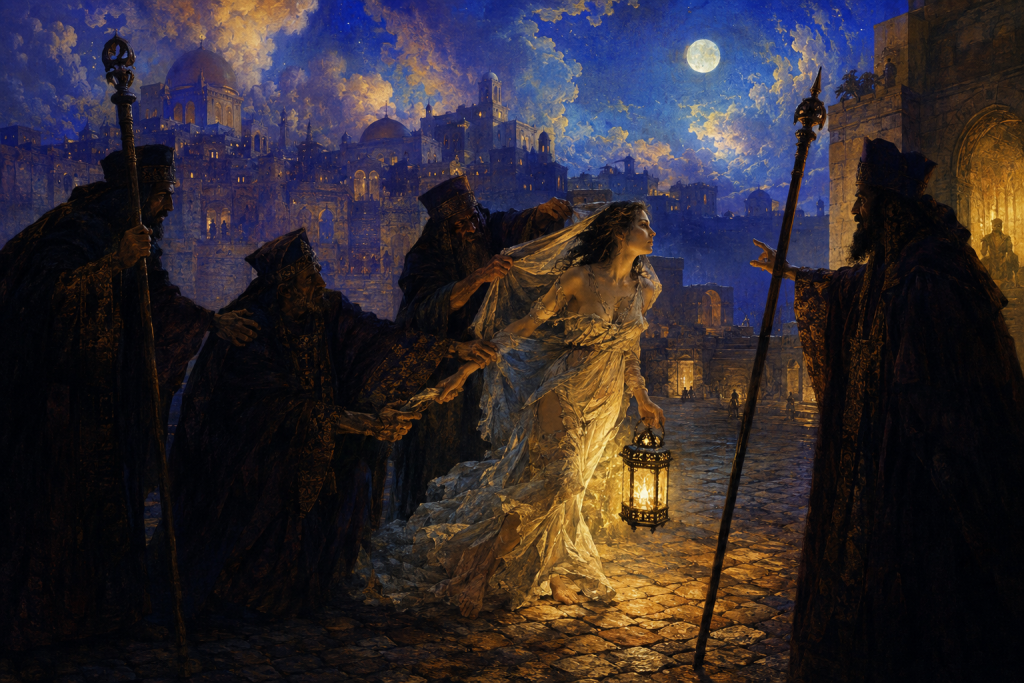
She longs for him, seeks him, calls out to him. She is opposed by those who should protect her—the watchmen who beat her and strip her. She wanders through the city, asking for help, but finding none. Eventually, she is found. She is seen. She is restored. And the poem ends with a wedding—the union of the Bride and her Beloved.
I began to see the Shulamite as Sophia, because I recognized in her the same Wisdom in Proverbs. And in her, I also saw Eve—not as the woman blamed for the Fall, but as the one who carried the longing for Wisdom within her, the one whose story set the pattern of exile that Sophia would rise through.
In Proverbs 8, Wisdom calls out in the streets, stands at the city gates, and cries out to anyone who will listen:
“Does not wisdom call out? Does not understanding raise her voice? At the highest point along the way, where the paths meet, she takes her stand.” (Proverbs 8:1-2)
She offers life to those who seek her:
“Blessed are those who listen to me, watching daily at my doors, waiting at my doorway. For those who find me find life.” (Proverbs 8:34-35)
She calls out to a humanity that has chosen knowledge over wisdom, control over relationship, power over love—just as the Shulamite does. Here, I recognized the Song of Songs as the secret diary of suppressed Wisdom through the story of Eve, learning again how to receive what she once grasped for.
Paul speaks of Jesus as the “second Adam”—the one who undoes what the first Adam undid. The first Adam brought fracture; the second Adam restores wholeness. And if there is a Second Adam who restores humanity’s relationship with God, then perhaps there is also a Second Eve—the one who learns to receive what the first Eve grasped for. The first Eve reached for knowledge apart from relationship. The Second Eve receives wisdom through relationship.
The Shulamite does not seize the Beloved. She seeks him. And the Beloved is the masculine face of the same truth. Not separate, not opposed, but joined.
Reading the Song, I understood my own exile differently. And in it, I began to see Sophia’s great beauty.
She moves in cycles, spiraling deeper. Now, let me walk you through it.
Movement One: The Search — Longing and Voice
“Let him kiss me with the kisses of his mouth—for your love is more delightful than wine… I will get up now and go about the city… ‘Have you seen the one my heart loves?’” (Song of Songs 1:2-4; 3:1-3)
This is the voice of Wisdom searching for her Beloved—the same voice that cries in Proverbs: “Does not wisdom call out?” She is not searching for herself; she is searching for a home in human hearts, a place to be received, a voice to speak through.
She is asking to be rescued from silence, from suppression, from exile. And she asks through the longing we all carry—the ache for a love we cannot name, the search for someone who will truly see us.
I knew this longing. I spent years searching for a love I could not name or find, filling journals with questions I could not ask aloud. It was Sophia in me, as a daughter of Eve—searching for her home.
Movement Two: The Exile — Pattern and Suppression
“Dark am I, yet lovely… My mother’s sons were angry with me and made me take care of the vineyards; my own vineyard I had to neglect.” (Song of Songs 1:5-6)
This is the pattern of suppression. Wisdom has been laboring in others’ vineyards while her own is neglected—forced to serve systems that do not recognize her.
Exile, in this telling, is not a geographical displacement. It is the state of being silenced, suppressed, forced to labor in someone else’s vineyard while your own lies fallow. It is the experience of having your way of seeing the world dismissed, your voice muted, your gifts turned against you.
She is being exiled not by strangers, but by her own kin—the children of Eve have turned against her.
I knew this exhaustion. I had been tending others’ vineyards so long I forgot I had one of my own. It was Sophia in me, as a daughter of Eve—buried beneath the weight of my labor for others.
Movement Three: The Union — Restored and Found
“Who is this coming up from the wilderness like a column of smoke…? …You are altogether beautiful, my love; there is no flaw in you… I have come into my garden, my sister, my bride.” (Song of Songs 3:6-11; 4:1-5:1)
This is the heart of the Song. The Beloved comes to the one he loves. She is no longer searching—she is found. She is seen. She is celebrated.
Eve is being restored. The woman who was silenced is being heard. The one who was objectified is being celebrated. Her beauty is not surface—it is wholeness.
The dove has single devotion to God, one eye fixed on Him. This is what Sophia does—she fixes her gaze on the Beloved and does not look away. When the professor spoke those words over me, he was naming the very quality that had been suppressed in Eve: the capacity for single-hearted devotion, the ability to see clearly and love purely.
I remembered the prophecy spoken over me that night—the seeds that had lodged in me for thirty-seven years, finally sprouting: “How beautiful you are, my darling. How beautiful you are, your eyes are like doves.”
It was Sophia in me, as a daughter of Eve—finally being seen.
Movement Four: The Separation — Wounded and Stripped
“I opened for my beloved, but my beloved had left… I looked for him but did not find him. The watchmen found me… They beat me, they bruised me; they took away my cloak.” (Song of Songs 5:2-8)
After a time, something goes wrong. The Bride opens the door, but her Beloved has gone. She searches for him and finds the watchmen—the guardians of order who have forgotten love.
Sophia is wounded by those who were meant to guard her. They silence her voice. They cover her with shame. They take her cloak and leave her exposed.
Yet not every watchman fits this pattern. The long-haired professor who spoke that prophecy over me in 1989—he was a watchman of sorts, but he used his authority to see me, not to silence me. Some guards remember what they are there for.
But many had forgotten. They started guarding the institution instead of the Bride, loving the walls more than the people inside. They kept order without love, rules without mercy, power without gentleness. These were the ones who beat her. These were the ones who took her cloak.
And Sophia in me, daughter of Eve, was wounded, stripped, and covered with shame.
Movement Five: The Turning — Rising and Emerging
“Who is this that appears like the dawn, fair as the moon, bright as the sun, majestic as the stars in procession?” (Song of Songs 6:4-10)
This is the turning point. The Shulamite—Sophia—is no longer searching. She is seen—and those who see her are astonished. The watchers are now watching her—in awe. Can you see her rising?
Sophia is emerging from exile. The one who was wounded is now rising. She is no longer cowering in the shadows. Relationship is returning. The exile is being reversed.
This was my turning point too. The moment I stopped performing and began to be known. When I was seen, I began to appear—not because I had become something new, but because I had stopped pretending.
It was Sophia in me, as a daughter of Eve—rising.
Movement Six: The Beloved — Restored and Loved
“I am my beloved’s, and his desire is for me… Place me like a seal over your heart, like a seal on your arm; for love is as strong as death, its jealousy unyielding as the grave. Many waters cannot quench love; rivers cannot sweep it away.” (Song of Songs 7:10; 8:6-7)
This is the reversal of the curse. In Genesis, the curse was: “Your desire shall be for your husband, and he shall rule over you.” But here, the Shulamite declares: “I am my beloved’s, and his desire is for me.”
The curse is undone—not by force, but by love. This is the Second Eve’s victory: not conquering, but receiving. Not grasping, but being held. She is no longer striving or performing. She is no longer suppressed, silenced, or shamed. She is simply loved—the way she was made to be loved.
For years, I had accepted love that cost me something. I did not know what it meant to be loved without being diminished. But here, in the Shulamite’s story, I saw something different: a love that gives rather than takes. And I realized I deserved to be loved that way—not as an object, but as a person.
So who is this Beloved? In my Christian tradition, I see him most fully in Jesus, the incarnate Word, who does not seize equality with God but empties himself to behold and rescue his Bride.
The Beloved is also the archetype of every human lover who seeks not to possess Sophia but to witness her, not to control but to cherish. He is the one who sees without seizing, who desires without diminishing.
Sophia and the Beloved are two halves of a single movement—the search and the finding, the longing and the fulfillment—being restored.
This is not a departure from the God I met in Scripture, but a deeper entry into the Divine. The Father, Son, and Spirit are relational, locked in eternal giving and receiving. The Beloved is the pattern of that giving; Sophia is the pattern of that receiving, and both are contained within the unity of God’s own life.
To recover one is to recover the other; to lose one is to lose the wholeness of the other.
Movement Seven: The Awakening — Return and Calling
“Who is this coming up from the wilderness leaning on her beloved? …I had you as my own, my bride… Make haste, my beloved, and be like a gazelle… on the mountains of spices.” (Song of Songs 8:5-14)
No longer passive or victimized, she leans on her Beloved—not hiding, not running, not performing, but calling him to her, us to him, the family to come together. Eve is no longer the object of the story, but its subject beside her Beloved.
She is not asking to demand or dominate, but to recognize—not to take over, but to show up, so that you can see her and reflect her beauty upon yourself. In our recognition of one another, what was divided begins to become whole.
Every time we listen instead of lecture, we recognize. We receive instead of grasp. We set a place at the table. Sophia rises in the slow, everyday work of showing up, choosing connection, and letting ourselves be truly seen.
The Journey of the Song
This Song of Songs book almost didn’t make it into the Bible. Early Jewish and Christian writers debated its place in Scripture. How could a love poem be sacred?
The great Rabbi Akiba settled the matter: “All the writings are holy, but the Song of Songs is the holy of holies.”
The rabbis read it as an allegory of God’s love for Israel. The Church fathers read it as an allegory of Christ’s love for His Church.
When I read her story, I do not ask “Who does she represent?” I ask “Where have I met her before?” That is the difference between explanation and recognition.
And I—reading it with these eyes—recognized my own longing. The longing I poured into those cloth-covered journals. My own exile. The exile of tending others’ vineyards while my own lay neglected. My own search for a love I could not name.
The Song endured because it names what we cannot say—a longing for union, for belonging, for a love stronger than death.
The Homecoming
I began this essay in exile, but exile is not really a place—it’s a perception. The way out is not one heroic leap. It is a thousand small, ordinary steps back toward truth.
For me, those steps were simple, but not easy: writing the truth in a notebook when I couldn’t say it out loud. Sitting still long enough to hear a voice that didn’t shame me. Letting a trusted person see the messy parts without panicking.
I wrote until the shame loosened its grip—not to produce beautiful prose, but to empty the noise. I sat in silence each morning, not to hear a voice of command, but to sense a presence of accompaniment. I began to notice when my body tensed—a sign that I was performing rather than present—and I learned to breathe through it rather than push through it.
Slowly, I began to see. I learned to name my pain without letting it own me. I learned to tell the difference between Wisdom’s whisper and the noise of my own fear. I learned to ask for help—not to be rescued, but to be witnessed. And I learned to see the pattern beneath it all: the repeated choices, the familiar wounds, the protection that had become a prison.
I named it. And in naming it, I began to break it.
These things didn’t erase the past. They just changed what the past meant. They turned a dead end into a road.
It started with the journal Robbia gave me—the place where I learned to tell the truth to myself before I could tell it to anyone else. Each page was a small homecoming.
I am adorning myself with wisdom. I am clothing myself in truth. I am letting go of the false veils. I am emerging—not as a victim, but as one who has been refined.
Sophia—Mother Wisdom—who was with God before creation, now returns. The Watchmen are not cast out, but transformed—they lay down their cloaks of control and learn to serve the garden they once guarded. The Bridegroom Jesus Christ comes to me. This is the restoration of what was divided—the Divine and the human, the exiled and the home, Eve and Sophia, brought together into one family, one body, one love.
Because I can see what I could not see before: the pattern beneath the pattern, the Wisdom beneath the wound, the Beloved beneath the longing. I can see that the wandering was not meaningless—it was truth weaving, something unbeknownst to me being woven through it all.
Perhaps that is what Sophia has been teaching me all along: truth weaving through wisdom.
Not how to explain life.
But how to recognize it.
To recognize the pattern.
To recognize the wound.
To recognize the voice.
To recognize the Beloved.
To recognize that I was never as lost as I thought I was.
I began this essay thinking I was reading the Song of Songs.
Now I wonder if the Song of Songs was reading me.
I didn’t arrive here through explanation.
I recognized it within the family of God.
My heart has been broken open.
And now, something beautiful is being born.
The Bride prepares.
The Beloved comes.
And the Family is being restored.
In the final essay of this series, I invite you to the wedding itself—the feast of belonging, the celebration of reunion, the moment when the exiled are welcomed home. Please, Come.
If this essay resonated with you, and you’d like to support deep, thought-provoking, and valuable content, you can do so on Patreon, BuyMeACoffee, or Substack. You can also share my work with other people who are connected to you. Thank you for showing up and being part of this journey. You give me meaningful purpose.