



“There is no means of avoiding the final collapse of a boom brought about by credit expansion.” — Ludwig von Mises
A mortgage is a claim on your future labor. A government bond is a claim on future tax revenue. A corporate bond is a claim on future profits.
The claim exists. What doesn’t exist is the future production against which the claim will be settled. And yet the entire financial system treats these claims as assets—things you can hold forever, assign value, trade with someone else, borrow against, and count on a balance sheet.
A pension fund holds bonds the way a farmer holds land.
The world’s largest asset class is not gold, or land, or equity. It is debt.
I’ve encountered some strange things in this world, but this is one of the strangest, and almost nobody notices. We have built our civilization on a belief that a claim on future production can function as wealth. The U.S. national debt alone is $40 trillion—a number so large it would take you 1.27 million years to count that high, one dollar per second.
What is the antonym of wealth? Debt. So how is debt as wealth even logical? The research isn’t conclusive, but it points in one direction: it’s not. Human beings aren’t wired to distinguish between a promise and the thing promised. We’re wired to trust.
Psychologists call it “promissory trust”—the willingness to treat a commitment as if it were already fulfilled. It is the same instinct that lets a child believe a parent’s promise, or a traveler hand over a bag to a stranger at an airport. The brain does not process a credible promise as a risk. It sees it as fact.
This is the foundation of every cooperative society. Without promissory trust, no contract would be signed, no handshake would mean anything, no marriage would last. But it is also the foundation of every bubble, every fraud, every financial crisis. The same instinct that lets us build a civilization on trust also lets us build one on promises that are impossible to keep.
But a claim is not the thing it claims. A promise is not the performance. A number on a ledger is not the wealth it represents.
To understand how strange this all is, we have to remember what wealth actually was before we decided that claims on the future could take its place.
The Foundations of Wealth
What is wealth? Genesis 13:2 says: “Abram had become very wealthy in livestock and in silver and gold.”
Notice, these three things all store energy.
Livestock is living energy. A herd turns grass into protein, labor, and more herd. It feeds you, works for you, and reproduces itself.
Silver and gold are stored energy. They do not corrode or decay. They took enormous human energy to pull from the earth, and they hold that energy in a form you can carry across a river or a border. In a global economy, gold functions as more than just wealth—it functions as a proxy for energy. This means if Brazil sells its coffee for gold, the labor it took to grow, process, and trade the coffee is preserved in real wealth, not in a claim on the future that another country continues to inflate away.
A dollar is not itself wealth. It is a monetary claim whose value depends on the productive economy behind it—a claim ultimately supported by goods, services, labor, energy, and trust.
Bitcoin is backed by nothing but belief. And Bitcoin burns energy at a terrifying rate to maintain itself. It doesn’t store energy in a form of tradable labor. It consumes it. The machines that “mine” it produce no food, no shelter, no warmth—only the continuation of the ledger. It is the purest example of finance detached from the physical world: energy spent for the sake of a claim, with nothing real produced at all.
So if Bitcoin isn’t wealth, and a dollar is only a claim on wealth, what is wealth? Real wealth comes from work—from the energy we contribute to the world and to each other. The purpose of work is to transform the earth’s resources into things that sustain life—food, shelter, clothing, tools, energy, care, knowledge.
Ask of any job: does it do this? If it does, it contributes. If it doesn’t, it extracts.
A farmer contributes. A builder contributes. A teacher, a nurse, a mechanic, an engineer—they take the raw material of the world and human energy and turn it into something that keeps people alive.
A financial asset trader does not directly produce those goods. He moves claims. He prices claims. He trades claims. Those activities can indirectly serve work, but only in a free market. In a managed one, they tend to serve gaming and extraction.
A ledger that takes the value created by real work and converts it into claims must be disciplined by free market forces—prices and losses—to ensure that production exceeds consumption.
A claim on the future is not work. It is a promise. It can be multiplied without producing anything. It can be traded without anything changing hands. It can be valued without the underlying production having yet occurred.
To treat a promise as though it were the underlying wealth is to confuse the claim with the thing claimed. It is to treat the menu as the meal. It is a category error—and it is the category error on which modern finance is built.
So how did this happen? How did debt—which every ancient civilization treated as a moral failure, a burden, something to be forgiven and escaped—become the foundation of wealth in the modern world?
The answer starts with a king who could not pay his bills.

The King’s Bad Credit
The year was 1694. William of Orange had invaded England in 1688, deposed James II, and taken the throne with his wife Mary. Then he dragged the country into his war against France. The war was expensive. The king’s credit was bad.
In 1672, Charles II had defaulted on debts owed to the goldsmiths who served as England’s bankers. The goldsmiths were ruined, and confidence in royal promises collapsed. No one wanted to lend money to a monarch who might refuse to pay it back.
This problem wasn’t new. For most of human history, an empire could expand only as far as its physical surplus allowed. Land had to be cultivated. Taxes had to be collected. Armies had to be fed. Gold and silver had to be acquired.
Wealth could be accumulated, but it could not be summoned from the future and spent in the present, until a Scottish financier named William Paterson came along.
Paterson proposed that a group of private investors lend £1,200,000 to the government. In exchange, the investors would receive three things.
First, 8% interest in perpetuity—not for a fixed term, but forever.
Second, a charter of incorporation—making them a permanent institution: the Governor and Company of the Bank of England.
Third, the right to issue banknotes up to the amount of their capital.
The subscription filled in eleven days. More than twelve hundred people subscribed.
And just like that, the debt became a permanent stream of interest payments, backed by the state’s taxing power. The principal did not have to be repaid on any fixed schedule.
This was intentional. The debt was designed to exist forever. And this idea revolutionized the world.
But here’s the question no one ever asks. Why would twelve hundred people, in eleven days, hand over the modern equivalent of hundreds of millions of pounds to a government that had recently defaulted on its debts?
The 8% return was generous. But a generous return is exactly what you expect from a borrower nobody trusts. The rate was high because the risk was high. That alone would not have been enough.
What changed the calculation was Parliament.
Parliament’s control of taxation was itself new. The Glorious Revolution of 1688 had transferred the power of the purse from the Crown to Parliament. The Bill of Rights of 1689 made it illegal for the king to levy taxes without Parliament’s consent. Now the men lending the money were the same men who controlled the taxes that would repay it.
A king is one man. He can default, flee, die, or start a new war. His promise is only as good as his character and his army.
Parliament was a body of men with property—and many of them were the very people lending the money. They would be taxing themselves to pay themselves back. The debt was backed not by one man’s word but by the self-interest of an entire class.
Two things sealed it.
First, the investors could sell.
They were not locked into a lifetime loan. If they lost faith or needed the money, they could sell their shares to someone else. Before 1694, a creditor to the crown held a personal claim that was almost impossible to transfer. He was stuck with it until the king paid—which might be never. Now he could walk away.
Second, the institution would not die.
A king is mortal. His debts die with him, or his successor repudiates them, or a war sweeps them away. The Bank was chartered—a legal existence that would outlast any monarch, any minister, any war. The investor was no longer betting on a man. He was betting on an institution.
That is why the money came in eleven days.
None of this was invented from scratch. Venice, Florence, and Holland had all experimented with government debt and public lending. What was new was the combination.
This combination is what made the sovereign’s debt permanently liquid. Before 1694, a holder of government debt was a creditor with a personal claim, difficult to transfer. After 1694, a holder of Bank of England stock or notes held an instrument that could be bought and sold in a market. It could be valued continuously and used as the basis for further financial activity.

The Inversion
The king’s liability had become the public’s asset.
This is the inversion. And it’s the hinge on which the modern financial world turns.
Before 1694, debt was a burden. It was something to be repaid, extinguished, escaped. In Babylon, it was sin. In Rome, it was personal. In medieval Europe, it was usury—condemned by the Church as a crime against God and neighbor.
After 1694, debt became a foundation.
The debt did not need to disappear. It could be held. It could generate income. It could be traded. It could be used as collateral for further lending.
And because it could be used as collateral, it could multiply.
This was the technology of permanence. And once it existed, the limits on what a state could do changed.
This is the conceptual leap, and it is easy to miss. Once debt could function as an asset, the financial system no longer had to wait for wealth to accumulate before expanding. It could bring expected future production forward into the present through credit—on an industrial scale.
The future could be borrowed against. It could be priced, traded, leveraged—and eventually consumed.
Let’s say a government wants to build a navy. Before 1694, it had to tax its people, accumulate the revenue, then spend it. The navy exists only after the wealth has been produced.
After 1694, the government can borrow against future tax revenue, spend the money now, and build the navy before the wealth needed to repay the debt has been produced. The future is brought into the present. The navy floats before it has been paid for.
This is not a small change. It is a change in the fundamental relationship between a civilization and time.
An empire that must earn before it can spend is limited by what it already has. An empire that can borrow against what it hopes to earn is limited only by belief—the belief that the future will deliver.
And belief, unlike silver, does not run out. It can expand indefinitely. It can be manufactured, shaped, sustained.
This did not abolish physical limits. It did something subtler and more dangerous. It allowed a civilization to temporarily outrun them.

Glubb’s Arc
Sir John Glubb studied eleven empires over roughly three thousand years. From Assyria to Britain, they followed the same arc.
Pioneers → Conquests → Commerce → Affluence → Intellect → Decadence → Decline
Each lasted for roughly ten generations, over approximately 250 years.
In the Age of Commerce, “the acquisition of wealth soon takes precedence over everything else,” and “the previous objectives of ‘glory’ and ‘honor’ are but empty words, which add nothing to the bank balance.”
In the Age of Affluence, “ambitious youth seek wealth instead of honor, fame or service.” Money becomes the measure of all things.
In the Age of Intellect, “wealthy merchants endow works of art, music, literature, colleges and universities.” But Glubb identifies the stage’s most dangerous feature: “the unconscious growth of the idea that the human brain can solve the problems of the world.” Abstraction becomes the norm. Models replace reality.
Then comes Decadence, and then Decline.
Here is what Glubb did not account for.
Every empire before 1694 ran on energy it had already captured. Wood. Muscle. Wind. Water. Solar agriculture. The empire could only grow as fast as it could convert those energy sources into food, goods, and soldiers.
Rome is the clearest example. Its energy base was wood—for heating, for smelting, for building. When the forests around the Mediterranean were depleted, the energy available to the empire declined. The conquests that had once brought in new energy—new land, new slaves, new silver—stopped paying for themselves. Rome had not run out of money. It had run out of the physical surplus that money represented.
1694 did not create new energy. It created something subtler and more deceptive: the ability to borrow against expected future production that would depend on energy and material resources.
The debt did not need to be extinguished. It didn’t depend on energy. It depended on belief. It could be rolled over, refinanced, expanded, as long as people accepted it. The state could borrow against its own future production and tax base in a way no previous empire could scale—bringing forward claims on the harvest not yet grown, the coal not yet mined, the oil not yet pumped, the labor not yet performed.
The result was an acceleration of Glubb’s middle stages.
The Age of Commerce became self-sustaining in a way no previous commerce had been. The Age of Affluence was funded not merely by accumulated wealth but by converting claims on future production into present purchasing power on an industrial scale.
And the Age of Intellect was funded by the perpetual surplus the financial architecture generated—a stream of interest payments that flowed to the financial class, which endowed the universities, the research institutes, the think tanks.
But the system that produces the surplus also shapes the intellectual output. Economics becomes the science of the ledger. The rational calculator becomes the model of human behavior. The analytical, mechanistic, measurable world becomes the only world that counts.
The ledger does not just fund the intellect. It directs it. And it directs it to serve itself.

Tainter’s Complexity Trap
Joseph Tainter explains the mechanism underneath the arc.
Civilizations solve problems by adding complexity—more institutions, more specialists, more regulations, more layers of administration. Every layer has a cost. Because societies solve their easiest problems first, each new layer produces diminishing returns.
Eventually, all available energy is required just to maintain the current structure. There is nothing left for anything new. At that point, even a modest shock—a drought, a plague, a war, a financial panic—can trigger a cascade of failures.
Tainter calls this collapse. He defines it precisely: a rapid, significant loss of an established level of sociopolitical complexity. It is not necessarily catastrophic. It is what happens when a system sheds the layers it can no longer afford.
Every layer of complexity is a claim on energy. A bureaucracy needs salaries. A road needs maintenance. An army needs feeding. A regulatory agency needs offices, staff, and time. The energy to support all of it has to come from somewhere—from the surplus of the productive economy.
Before 1694, that surplus was finite. You could only maintain as much complexity as your current energy could support. When the energy ran short, the layers came off. That was collapse.
1694 changed the constraint.
Now you could maintain complexity by borrowing against expected future production. The feedback loop was broken. The system no longer had to feel the limit in the present. It could feel it in the future—or never feel it at all, if the belief held.
The 1694 inversion intensifies Tainter’s spiral.
Every new financial instrument—the derivative, the securitized mortgage, the collateralized debt obligation, the interest rate swap—is a new layer of complexity. And each new layer can be monetized. It can be priced, traded, and used as collateral for further expansion.
In a pre-1694 economy, complexity was constrained by metal. You could not build a financial instrument without gold or silver behind it.
In a post-1694 economy, complexity is constrained by the credibility of the claims. You can build any instrument for which enough participants are willing to assign value and accept the associated risk.
The narrative itself becomes the collateral.
Tainter’s ancient empires added complexity at the speed of the energy they had already captured. The post-1694 civilization adds complexity at the speed of credit creation. And credit creation is not limited by the energy captured in the current period. It is limited by the willingness to believe that future production will support the claims created against it. Or to forget the limit exists altogether.
This is why the spiral accelerates. The system adds more debt, more instruments, more layers to solve the problems created by the previous layers. Each solution requires more energy, more belief, more future claims. The marginal return declines.
The Chain of Belief
To understand how our beliefs became so broken, we have to go back to the chain of belief that 1694 created.
The banknotes were backed by the government’s promise to pay interest. The promise was backed by Parliament’s power to tax. The power to tax was backed by the English economy—by what the country could actually produce. And the economy was backed by the English people: their willingness to work, to pay, and to trust the government with the power it claimed.

Every link was real. But the whole chain depended on something that could not be audited, only trusted.
Every central bank since has been a repetition of the same move. The Federal Reserve, created in 1913, was the Bank of England’s template applied to the world’s largest economy—a private corporation with a government license, empowered to create money out of nothing and lend it to the state. In 1971, Nixon closed the gold window. The dollar would no longer be redeemable in gold. For the first time in history, the world’s reserve currency was backed by nothing but belief.
Now consider where we are.
Glubb places us in Decadence. Tainter explains why the sequence is so hard to reverse: the complexity is too expensive to maintain, and the debt that financed it cannot be repaid without collapsing the system that depends on it.
The chain of belief is still intact. The notes are still accepted. The bonds are still rolled over. The assets are still valued.
When new credit is created, it still flows into asset markets—stocks, bonds, real estate. Asset prices rise. The public sees their home values climb and their retirement accounts grow. They feel wealthier. They spend more.
But what has actually happened is that claims on the future have been multiplied. The wealth is not new production. It is the pricing of expectations about production that has not yet occurred.
The public does not notice that the debt now funds consumption rather than production, because their asset values are rising. They feel richer even as their real position deteriorates.
The ledger has become more important than what the ledger records.
The Reckoning
The world treats debt as wealth because we are wired to trust. Because the claims have become invisible. Because no one teaches us what money actually is.
That is all it takes. A belief. A story.
The ancient world understood this. The rulers of Mesopotamia periodically cancelled debts, released debt-servants, and restored land—because they understood that the ledger existed within a social order, not the other way around. A debt that could never be discharged was not merely a private obligation. It threatened the stability of the entire society.
The ledger had to serve the territory. We have reversed that relationship.
The story is still working. The notes are still accepted. The bonds are still rolled over. The assets are still valued. But the gap between the claims and the territory is gigantic. At some point, the story stops.
When that happens, it will not look like Rome with legions at the gate. It will be a sudden recognition that the claims cannot all be settled against something real.
The repricing will not be an event. It will be a process—a slow recognition that the claims cannot all be settled, followed by a faster one.
The future is not a ledger entry. It is the farm producing next year’s harvest. The factory producing tomorrow’s goods. The energy that powers the machine. The worker who shows up. The trust that makes a contract meaningful. The natural world that supplies what the system ultimately consumes.
The ledger is a tool. It was never meant to be the master.
A claim on the future is not the future itself.
We have forgotten. We will be reminded. Guaranteed.
References & Sources
Glubb, Sir John. The Fate of Empires and Search for Survival. Blackwood, 1978.
The Holy Bible. Genesis 13:2.
Horsefield, J. Keith. British Monetary Experiments, 1650–1710. Harvard University Press, 1960. (On the founding of the Bank of England.)
Mises, Ludwig von. Human Action: A Treatise on Economics. Yale University Press, 1949.
Tainter, Joseph. The Collapse of Complex Societies. Cambridge University Press, 1988.
If this essay resonated with you, I would love to hear your thoughts. And if you would like to support more work like this, you can support me on Patreon, BuyMeACoffee, or Substack. Thank you for reading.

A Note on the Art
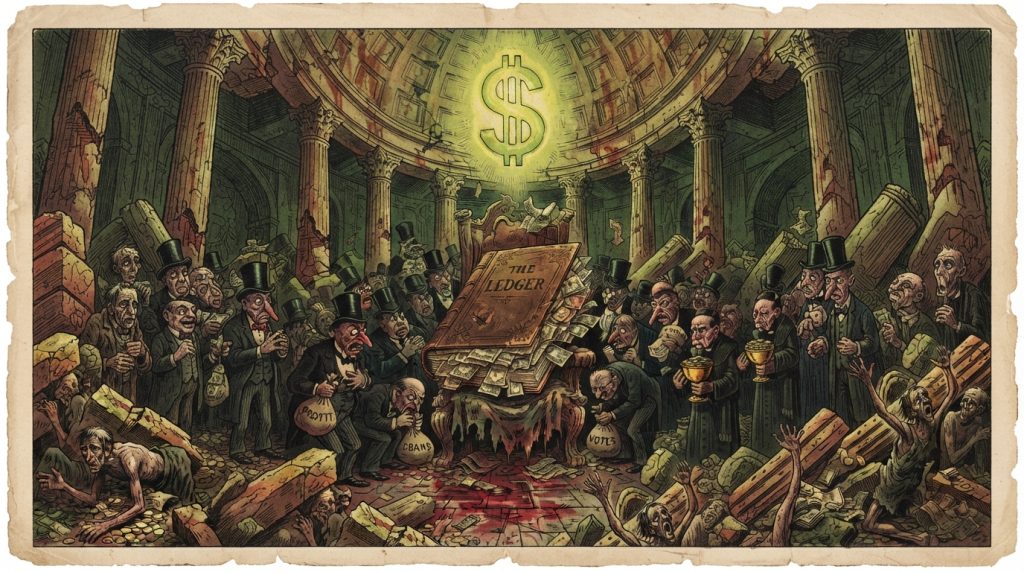
The images in this essay are inspired by George Grosz, the German painter and Dadaist who worked in Berlin between the wars—a city that lived through the 1694 template’s most extreme expression. Grosz watched the German mark collapse into wheelbarrows of paper in 1923. He watched the claims multiply while the currency turned to ash. And he drew what he saw: profiteers with fat faces, generals with medals, priests with rings, and behind them the wounded, the hungry, and the poor. He did not paint saints, and he did not paint villains. He painted men who treated other men as line items. His line was thin and sharp because sentiment would have softened the diagnosis. He understood that the ledger does not rage or weep. It simply records. That is why his vision belongs here. The men in top hats bowing to the throne of the ledger are not monsters. They are participants in a structure that rewards them for not looking down. Grosz looked down. His work is not a warning. It is a witness statement. And it is still being taken.


 “Outstanding, sophisticated, and mesmerizing…a spiritual intrigue similar to Dan Brown’s The Da Vinci Code.” —ForeWord Reviews