



“The rich rules over the poor, and the borrower is the slave of the lender.” — Proverbs 22:7
Wealth is not a number. It is not a currency. It is not a claim on someone else’s promise. Wealth is energy captured in physical form—human effort stored across time, transformed into something that can be traded for something else.
Consider what that means. A herd of cattle is wealth because it took energy to raise—the grass, the water, the labor of the herder—and it stores that energy in the form of living animals. The cattle can be traded for grain, for tools, for land. The energy is still there, waiting to be used. Gold and silver are wealth because they took enormous human effort to pull from the earth, and they hold that effort in a form that does not decay. They can be carried across a border. They can be exchanged for anything someone else has produced. Land is wealth because it captures sunlight and rain and turns them into food. Livestock, grain, silver, gold—these are not symbols of wealth. They are wealth itself.
This is what makes something tradable in the real world. It stores human energy. It does not disappear when you use it. It can be exchanged for other things that also store energy. And it does not depend on anyone’s promise to make it valuable. It is valuable because it took effort to create and because it can sustain life.
Now consider the other kind of tradability—the kind that exists only in the illusory world. A dollar bill is not wealth. It is a claim on wealth. It says: someone, somewhere, will give you something real in exchange for this paper. A stock certificate is not wealth. It is a claim on future production. A Bitcoin is not wealth. It is a claim on the belief that someone else will pay more for it later. The Token Dollar is not wealth. It is a claim on a claim. These things can be traded, yes. But they can only be traded because enough people agree to treat them as if they were real. Their value depends on trust. And trust can vanish overnight.
Real wealth does not depend on trust. A cow does not care whether you believe in it. A field of wheat does not care whether the market is up or down. A bar of gold does not care what the Federal Reserve says. Real wealth is physical. It exists whether or not anyone believes in it. And when the claims fail—when the trust evaporates—real wealth is what is left.
This is why cheap energy has been the anesthesia of abstraction. When energy is abundant and cheap, the claims can multiply without anyone noticing the gap between the paper and the foundation. When it wears off, the claims will still be there—and the foundation will not.
Nature has run this experiment many times. The results do not vary.
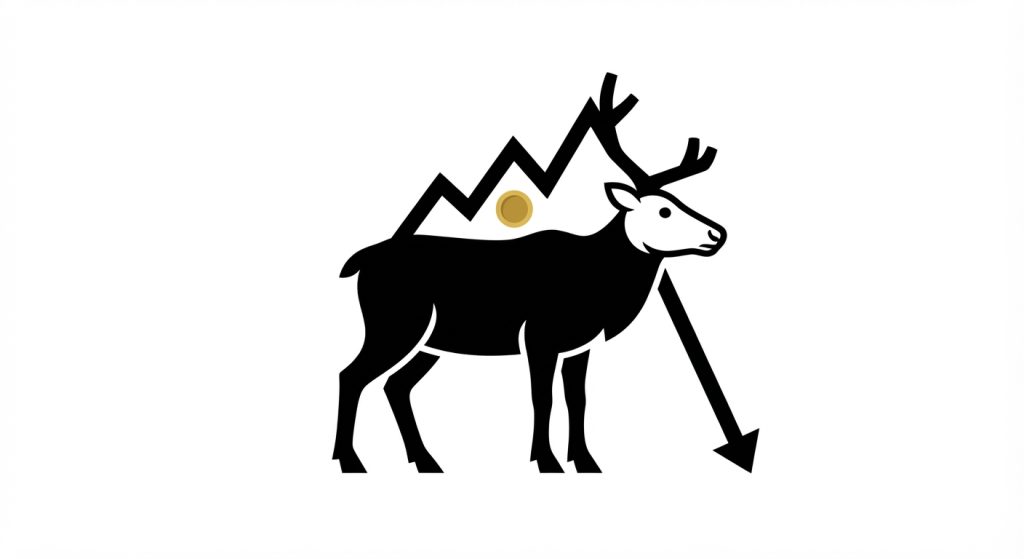
In 1944, the Coast Guard introduced twenty-nine reindeer to St. Matthew Island, a remote outpost in the Bering Sea with no predators and an abundant supply of lichen. By 1963, the herd had grown to six thousand. Then the herd outstripped its food supply. In a single winter, the population collapsed. When biologists returned in 1966, only forty-two remained. The herd never recovered. Within a decade, it was gone.
The reindeer did not have a printing press. They could not create claims on future lichen. They could only eat what was there. And when it ran out, they died.
We have a printing press. We can create claims on the future. We can borrow against tomorrow. We can treat a promise as if it were wealth. But the printing press does not create energy. It creates claims on energy. And claims are only as good as the foundation beneath them.
Human civilizations have run this experiment too. And they have failed the same way.
Pax Silica is the latest system to forget this. It is framed as a plan to secure supply chains. In practice, it is a plan to control them with a financial system that runs on abstractions. It assumes that compute is the new oil—an indispensable input that everyone must buy.
But compute is not wealth. It is a tool. It is a means of production, not a store of value. To understand why the system will fail, we have to understand what wealth actually is. And to do that—to make America understand wealth again—we have to go back to Rome, to Babylon, to the oldest traditions that thought carefully about what makes a civilization rich.

Three Peaces
Pax Silica is the latest iteration of a very old pattern. Every peace rests on a resource. Every resource is physical and finite.
Pax Romana means “Roman Peace.” It describes roughly two centuries of stability across the Roman Empire, beginning under Rome’s first emperor, Augustus Caesar—the man who ended a century of civil war—around 27 BC. Augustus made peace his brand. He stamped it on coins. He raised an altar to it in the center of Rome. He hired the best poets of the age to sing about it. And he told the empire that peace was his gift—and proof that he should rule.

The peace was real. It lasted two hundred years. It gave ordinary people a stability their grandparents had never known.
But it wasn’t really peace. It was dominance—enforced by legions, funded by conquest, maintained by the swift and brutal suppression of any rebellion. To the peoples Rome conquered, it was subjugation. To the senators who lost their power, it was tyranny. To anyone who resisted, it was the edge of a sword.
And underneath all of it lay a foundation of energy. The Romans could not print it. They could only grow, mine, cut, and burn. What they burned was wood, for heating, for smelting—extracting metal from ore—for building, and for the baths that defined Roman life. By the late empire, the forests around the Mediterranean were depleted. Wood had been the foundation of Roman energy—roughly 90 percent of consumption. Timber had to be imported from farther and farther away. Wood prices rose sharply, feeding the inflation that plagued the late empire. The soil was exhausted.

The historian Joseph Tainter, who studied why complex societies collapse, has argued that Rome maintained its complexity—the layers of administration, infrastructure, and military that held the empire together—by capturing treasure outside its borders: new lands, new slaves, new silver. When the conquests stopped paying for themselves, the empire was thrown back on its own energy base. That base was the forest. And the forest was gone.
The cost of holding the empire together—the legions, the roads, the grain fleets, the bureaucracy—exceeded what the land could supply. The emperors reduced the silver content of their coins. People fled the cities for the countryside. The complexity collapsed.
Rome did not fall to a single enemy. It fell because the cost of maintaining its complexity exceeded the energy available to support it.
Like Pax Romana, Pax Americana—the American peace that began after World War II—also stood on energy, but one step removed from the physical world. In 1974, after the gold standard collapsed in 1971, the US dollar became the dominant currency for global oil transactions. Every country that wanted oil needed to hold dollars. The dollar was a claim on oil. But the oil itself was still real, still finite, and still critical to the global economy. America borrowed against its own future for fifty years, and American military power guaranteed the flow.

But here is what changed. Rome needed wood. America needed oil. Both were physical. Both were finite. But America’s claim on oil was mediated through the dollar—a piece of paper that stood between the empire and its energy base. For a time, that paper worked. The world needed oil, so the world needed dollars, so the world financed American debt. The system was self-reinforcing as long as the oil kept flowing and the trust kept holding.
And because of the debt, we don’t just need oil. We need it cheap. The financial-industrial complex—the banks, asset managers, and energy companies that profit from the system—needs it burned. Because every barrel consumed is a claim that gets paid. The system runs on debt. The debt is serviced by growth. Growth requires energy. And the energy that powers the system is oil. And the faster it burns, the more claims get paid.
So Pax Silica is the next attempt to keep the dollar system alive.
The name is new, but the structure is old. Three peaces, each resting on a different foundation. Wood. Oil. Compute—the processing power that runs AI. Each one resting on a physical base that is always, eventually, finite.
Rome ran on wood until the forests were gone. America ran on oil until the easy oil was gone. Now America proposes to run on compute. But compute is not energy. Compute is what energy allows you to do. Every AI model, every data center, every query depends on electricity—and electricity comes from coal, gas, nuclear, hydro, solar, and wind. Each of those has a physical base. Each is finite in some way. None can be conjured from a ledger.
The pattern is the same. The resource is different. And the end is the same: a peace that rests on a physical foundation eventually discovers that the foundation cannot support it forever.
The Romans believed their peace would last forever. It did not.
The Americans believed their peace would last forever. It is not.
Pax Silica is the next attempt to build an empire on a resource that is already running out. And the pattern does not care who is in charge. It only asks one question: what happens when the foundation fails?

What the Traditions Knew
Genesis 13:2 says: “Abram had become very wealthy in livestock and in silver and gold.”
Notice what these three things have in common. They all store energy—human effort captured and preserved in physical form. Livestock is living energy: a herd turns grass into protein, labor, and more herd. Silver and gold are stored energy: they took enormous human effort to pull from the earth, and they hold that labor in a form you can carry across borders and exchange in trade.
Genesis is not the only tradition that understood this. The same insight appears wherever humans have thought carefully about what wealth actually is. And the fact that it appears everywhere—across continents, across centuries, across religions and philosophies that had nothing to do with each other—tells us something important. This is not one culture’s opinion. It is a discovery about reality.

In Babylon, one shekel—a small unit of silver—was worth exactly one month of a man’s barley ration. Money was a claim on human energy. The claim was real because the grain was real. A shekel was not valuable because Babylonians agreed it was valuable. It was valuable because it could be exchanged for food that had been grown by human hands and stored against the winter.
The Romans called money pecunia, from pecus—cattle. Wealth was the herd. The herd stored energy, produced offspring, fed the family. The word itself remembered what wealth was. Even after Rome had coins and banks and contracts, the language still carried the memory of a time when wealth had a face and a heartbeat.
Aristotle drew the distinction most clearly. He separated oikonomia—the management of a household, which has a natural limit—from chrematistike—the unlimited pursuit of money for its own sake. A household manages what it needs. It grows food, raises children, cares for the old. It has a ceiling, and the ceiling is life itself. But chrematistike has no ceiling. It seeks money for the sake of more money, forever. Aristotle saw that this was a different kind of activity entirely—and a dangerous one. Use value is what something is worth when you use it. Exchange value is what it is worth when you trade it. True wealth lies in use value, not exchange value.
The Chinese named the principle directly. Vital energy—qi—is not gold, silk, pearls, or jade; it cannot be obtained from others. It is not cloth, grain, or the five cereals either; it cannot be purchased through trade. Wealth flowed from qi. It was not a substitute for it. A society could have all the gold in the world and still starve if the qi—the vital energy of the land and the people—was exhausted.
The Indian tradition gave the pattern two names. Kubera is stored wealth—accumulation, hoarding, extraction. Lakshmi is circulating wealth—generation, flow, enrichment of the whole. A society organized around Kubera eventually collapses the foundations of its own prosperity. Circulation must dominate accumulation. The goddess of wealth is not a miser. She is a river.
Every tradition that thought carefully about wealth arrived at the same distinction. Real wealth either stores energy across time or produces life directly. Abstract wealth is a claim—useful, but not foundational.
This is the test for any claim of wealth: Does it store energy? Does it produce something real?

The traditions knew what real wealth was. And the physical world still does. Livestock, grain, silver, gold, land, oil—things that store energy, produce food, sustain life.
The claims built on top of them are another matter.
The dollar does not store energy and does not produce anything. It is a claim on wealth. It represents value, but it does not contain it. The value is somewhere else—in the goods and services and labor that the dollar can be exchanged for. Take those away, and the dollar is paper.
Stocks and bonds do not store energy and do not produce anything directly. They are claims on future production—claims on claims. A share of stock is a claim on a company’s profits. A bond is a claim on interest payments. Both depend on the real economy beneath them. If the real economy fails, the claims become worthless.
Bitcoin does not store energy. It consumes it. It is a belief system. It takes enormous amounts of electricity to maintain a ledger that produces nothing but the continuation of the ledger. It is a claim on the belief that someone else will pay more for it later. When that belief falters, there is nothing underneath.
The Token Dollar does not store energy and produces nothing. It is an abstraction built on abstractions—a belief system built on belief systems. It is the latest layer in a tower that has been growing for centuries. And the higher the tower, the further the fall.
Real wealth is physical. It stores energy, and it can be held across time. Livestock feeds you. Land grows your food. Gold cannot be eaten—but it holds the labor that was spent to mine it, and it can be traded for anything that sustains life. It is not a claim. It is the thing itself.
Everything else is a claim—useful, but not foundational.
The system runs on claims. And the system is running out of foundation.
The Energy Gamble
Every system that runs on claims assumes cheap energy. And every system that assumes cheap energy eventually discovers that energy is not free.
Every AI model, every data center, every AI query—what the industry calls an inference—requires enormous amounts of electricity. Training a single large language model can consume as much power as a small town uses in a year. The data centers that power AI require power grids, transmission lines, cooling systems, and fuel. All of it is physical. All of it is finite. None of it can be printed.
The International Energy Agency projects that global data center electricity consumption could more than double by 2030, with AI as a central driver. Jensen Huang, the CEO of Nvidia—the company that makes the chips that power most AI systems—describes the AI stack as a “five-layer cake”: energy, chips, infrastructure, models, and applications—with every application pulling on each layer beneath it down to the power plant. The key metric, he says, is not tokens per dollar. It is tokens per watt. How much AI output you get for each unit of electricity.
Now, let’s be precise about what “running out of energy” means. It does not mean the planet is running out of energy in an absolute sense. The sun delivers more energy to Earth in an hour than civilization uses in a year. The issue is not the total supply. The issue is the energy return on investment—the ratio of energy harnessed to energy invested in getting it.
EROI is a simple idea. If you spend one barrel of oil to drill a well that produces ten barrels, your EROI is ten to one. If you spend one barrel to produce three, your EROI is three to one. The higher the ratio, the more surplus energy a society has to do things other than just getting more energy. That surplus is what builds cities, funds armies, raises children, writes books, and runs data centers. When the ratio falls, the surplus shrinks. And when the surplus shrinks, everything that depends on it shrinks too.
The EROI of fossil fuels has been declining for decades. In the early 20th century, oil and gas returned 30 to 40 units of energy for every unit invested. Today, the useful-stage EROI of fossil fuels is closer to 3.5 to 1.
That figure comes from a 2024 study in Nature Energy by Emmanuel Aramendia, Paul Brockway, and colleagues. Earlier pioneers like Charles Hall laid the groundwork by measuring EROI at the wellhead. The useful-stage calculation goes further. It measures the ratio of useful energy delivered to society against the energy invested in getting it—accounting for the conversion and thermodynamic losses that occur when fossil fuels are burned for actual work, such as mechanical drive or heating.
A ratio of 3.5 to 1 sounds workable until you realize what it means. Most of that surplus has to go to maintaining the system itself—extracting, refining, and delivering the fuel. What is left over for everything else—for food, for housing, for medicine, for defense, for art—is a fraction of what it once was. The easy oil is gone. What remains takes more energy to extract, refine, and deliver.

The United States could build nuclear power plants. It has the technology. The physics is understood. And in purely thermodynamic terms, nuclear power is a strong performer. A nuclear plant can achieve an energy return on investment as high as 50 to 1, far better than the 3.5 to 1 for fossil fuels today. It is one of the few energy sources with the density and reliability to replace what oil and gas provide.
But building a nuclear plant is a massive undertaking, and it requires an enormous upfront investment of energy and capital before it produces a single watt. The equivalent thermal energy required to build a nuclear station and provide its initial fuel is substantial—significantly more than that of a coal-fired plant. Construction is measured in years, not months. The average construction time for reactors that began operation in 2023 was ten years, and the lead time from planning to operation can stretch to nineteen. In Western countries, it can take a decade or more.
There is also the question of what happens after the plant stops running. High-level nuclear waste remains dangerous for hundreds of thousands of years. The scientific consensus is that it must be isolated in deep geological repositories, encased in multiple barriers of steel, glass, and host rock. Finland is currently commissioning the world’s first such repository at Onkalo, and France has plans for one at Cigéo. But the United States has indefinitely stalled its only long-term underground repository at Yucca Mountain, leaving spent fuel stored in pools and casks at reactor sites across the country. The waste problem is not solved. It is deferred.
And there is the question of pace. The Trump administration has called for a nuclear renaissance, aiming to quadruple nuclear capacity by 2050. But since 2013, the United States has built just two nuclear reactors. Over the same period, China has built thirteen, with thirty-three more in the works. Even restarting an already-built plant, like the reactor at Three Mile Island, is not expected to generate power until 2027. A nuclear buildout at the scale required to replace fossil fuels would take decades—decades we may not have. The idea that we can simply build our way out of the energy problem with nuclear power is a form of magical thinking.
That is not to say nuclear is impossible. It is to say that it is a choice, and a costly one, and that the system has so far chosen not to make it. The next door, the one that promises a free lunch, does not exist.
Some have proposed that empty space itself contains limitless energy—a “zero-point field” that could be tapped for power. The idea is appealing. But physics disagrees. Zero-point energy is the lowest energy state a quantum system can have. It is the floor, not a reservoir. You cannot draw power from a floor. Mainstream physics holds that while zero-point energy exists, it cannot be cyclically extracted to do net work without violating the laws of thermodynamics—the same laws that govern every engine, every battery, every living thing. There is no free energy. There never has been.
The system has been able to pretend energy is cheap because debt has subsidized it. Cheap credit built the infrastructure of the fossil fuel age. Cheap credit let the system ignore depletion. Cheap credit made it possible to treat energy as a background assumption rather than the foundation it actually is. As long as credit was cheap and energy was abundant, the gap between claims and foundation could be ignored. But credit is not free forever. And energy is not abundant forever.
But energy is not a background assumption. It is the foundation. Rome ran on wood. America ran on oil. AI runs on electricity. And electricity has to come from somewhere—coal, gas, nuclear, hydro, solar, wind. Each has a physical base. Each is finite in some way. None can be conjured from a ledger.
Step back from the engineering, and the picture changes. The real game was never about compute. The real game is keeping the debt going. Because debt is how the system buys time. But you cannot buy time with energy. You can only convert one form of energy into another. And the conversion has costs. Every system that runs on claims assumes cheap energy. Remove it, and the claims collapse.
So the abstraction is built on sand.
The Abstraction Hits Reality
Pax Silica is one plan. The pattern it depends on is older—and larger. The dollar system runs on credit, derivatives, futures, bonds—the financial instruments that trade claims on future production. But the supply chain it is trying to control runs on lithium, cobalt, oil, and the energy to run data centers—resources that must be dug out of the earth, refined, transported, and assembled. None of these can be printed. All of them are finite. And China currently dominates the processing of rare earths—the elements used in magnets, batteries, and military hardware—and many critical minerals.
Reality is different from abstraction. The reindeer of St. Matthew Island learned this. So did Rome. So will we, unless something changes.
Physical wealth is the foundation. Everything above it is a claim on the foundation. But not all physical wealth is the same. Some physical things are consumed by their use. Oil gets burned. Lithium goes into batteries. Grain gets eaten or rots. Livestock dies. Land produces food but cannot be carried across a border. These things store energy in one sense—but their energy is released through use. They cannot hold value across time because they do not survive the transaction.
Gold and silver are different. They have industrial uses—silver in solar panels and electronics, gold in circuitry and dentistry. But they are not consumed by those uses the way oil is burned or grain is eaten. The metal persists. It can be recovered, refined, and returned to circulation. It does not disappear into heat or waste.
This is the property that makes them money. A physical thing that is consumed by industry cannot serve as money, because its value is tied to industrial demand and its supply is consumed. A physical thing that has no other use can sit, unchanged, for centuries. It can store energy across time and space without being consumed.
What makes them money is not that they have no other job. It is that they survive the job. Their one monetary function, going back to Biblical antiquity, is to hold value across time because the thing itself endures.
Now consider Bitcoin. It is not physical. It has no form you can hold. It exists only as a ledger entry on a distributed network—a number maintained by machines that must run, and run, and run. It consumes enormous energy to do this. Not to produce food. Not to build shelter. Not to power a factory or move a ship. To maintain a number on a screen. When energy becomes scarce or expensive—and it will—anything that burns energy to maintain a claim will be the first to be abandoned.
Bitcoin is an entropy accelerator. It burns electricity to produce nothing—no food, no shelter, no warmth. What remains is a ledger that must be fed still more energy just to persist. Gold is the opposite. Energy went into it once and stayed. It holds what Bitcoin spends. Bitcoin is not digital gold. It is digital fool’s gold.

In a world that has forgotten what wealth is, this is the final blasphemy: burning the substance of real wealth to maintain a substitute for it.
Money is the technology that allows energy to be traded across time and space. But the medium of that trade must be physical—because only physical things store energy. And it must be non-industrial—because industrial things are consumed by their use. Gold and silver are the only things that have ever met both tests.
The test holds. Real wealth either stores energy across time or produces life directly. Gold stores it. Livestock and land produce it. The dollar does neither. It is a claim. A token dollar is a promise about a promise.
Pax Silica is an attempt to avoid the reindeer’s fate. It is a plan to lock up the physical resources before the reckoning arrives. But you cannot lock up what has already been mortgaged.
References & Sources
Aramendia, E., Brockway, P.E., Taylor, P.G., Norman, J.B., Heun, M.K., & Marshall, Z. (2024). Estimation of useful-stage energy returns on investment for fossil fuels and implications for renewable energy systems. Nature Energy, 9, 803–816. https://doi.org/10.1038/s41560-024-01518-6
Hall, C.A.S., Balogh, S., & Murphy, D.J.R. (2009). What is the minimum EROI that a sustainable society must have? Energies, 2(1), 25–47. https://doi.org/10.3390/en20100025
Han Shi Wai Zhuan. Han dynasty text. Quoted in Roger T. Ames, The Art of Rulership: A Study of Ancient Chinese Political Thought. SUNY Press, 1994.
The Holy Bible. Genesis 13:2; Proverbs 22:7.
International Atomic Energy Agency. (2026). A sustainable solution for spent fuel and high level waste disposal. https://www.iaea.org
International Energy Agency. (2025). Energy and AI. Paris: IEA. https://www.iea.org/reports/energy-and-ai
International Energy Agency. (2026). Key Questions on Energy and AI. Paris: IEA. https://www.iea.org/reports/key-questions-on-energy-and-ai
International Energy Agency. (2026). Global Critical Minerals Outlook 2026. Paris: IEA. https://www.iea.org/reports/global-critical-minerals-outlook-2026
Klein, D.R. (1968). The introduction, increase, and crash of reindeer on St. Matthew Island. Journal of Wildlife Management, 32(2), 350–367. https://doi.org/10.2307/3798981
Nuclear Engineering International. (2025, December 10). French regulator backs Cigéo repository licence. https://www.neimagazine.com
Nuclear Engineering International. (2026, September 1). Onkalo takes first step to disposal. https://www.neimagazine.com
Reuters. (2025, June 25). Three Mile Island nuclear plant reboot fast-tracked to 2027. https://www.reuters.com
Sheehan, D.P. (2018). Maxwell zombies: Conjuring the thermodynamic undead. American Scientist, 106(4), 234–241.
Spiro, D.E. (1999). The Hidden Hand of American Hegemony: Petrodollar Recycling and International Markets. Cornell University Press.
Tainter, J. (1988). The Collapse of Complex Societies. Cambridge University Press.
U.S. Department of State. (2026, June 26). United States Hosts Second Pax Silica Summit in Washington, DC. https://www.state.gov/releases/office-of-the-spokesperson/2026/06/united-states-hosts-second-pax-silica-summit-in-washington-dc/
U.S. Geological Survey. (2026). Mineral Commodity Summaries 2026. Reston, VA: USGS. https://pubs.usgs.gov
World Nuclear Industry Status Report. (2025). Table 3: Duration from Construction Start to Grid Connection, 2015–2024. https://www.worldnuclearreport.org
If this essay resonated with you, I would love to hear your thoughts. And if you would like to support more work like this, you can support me on Patreon, BuyMeACoffee, or Substack. Thank you for reading.

A Note on the Art
The images in this essay are inspired by Noma Bar, the Israeli-British illustrator who reduces complex systems to a single deceptive image. His work depends on the double-take: what you see first is not all there is. A shape carries two meanings. A negative space becomes the subject. He has applied this method to economics, power, and the stories that hide in plain sight.
This essay works the same way. The official framing says one thing. The mechanism underneath says another. Look twice.


 “Outstanding, sophisticated, and mesmerizing…a spiritual intrigue similar to Dan Brown’s The Da Vinci Code.” —ForeWord Reviews