



How the Law of Reversal Is Remaking the Middle East
“The Middle East is no more. Welcome to West Asia.” —Mohammed Soliman
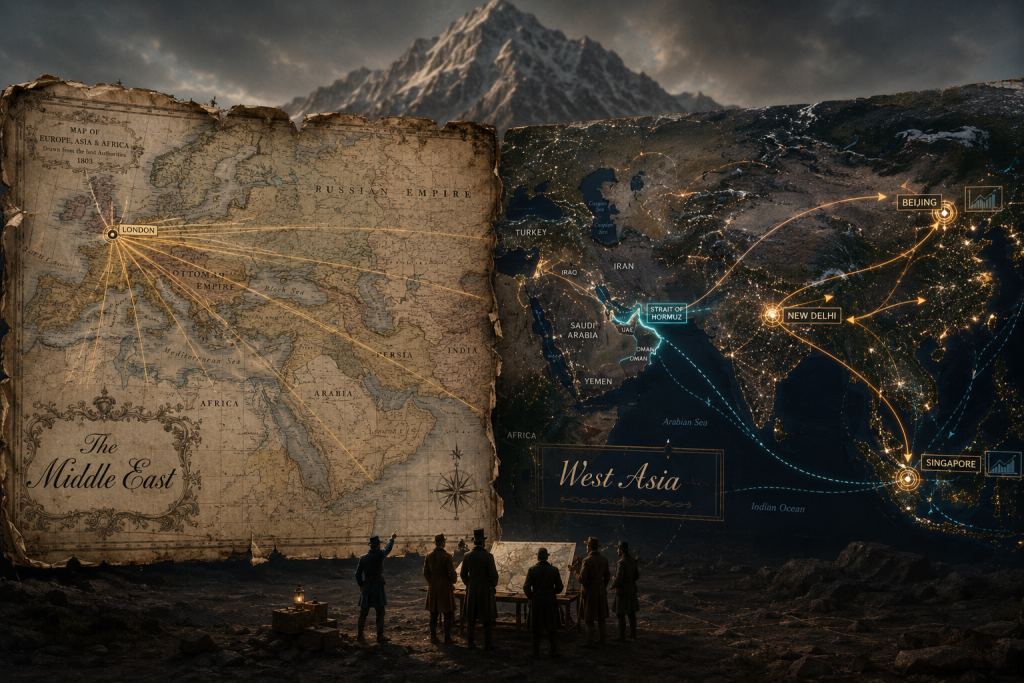
The post-Cold War regional order has entered a period of systemic collapse.
That’s the verdict from Mohammed Soliman, a senior fellow at the Middle East Institute and one of the more provocative thinkers on Middle East strategy and its implications for American policy. He is not alone in sensing a historic rupture. In fact, a growing chorus of analysts frames the current turmoil as something deliberate—a controlled demolition of the broken petrodollar system and the American-led financial order.
To me, however, this is a distraction. Whether it is a controlled demolition or an emergent process is mere noise surrounding the larger issue: a broken order. Knowing who broke it does not fix it. Consider the 2008 financial crisis. When the housing market collapsed and banks began failing, no one stopped to ask who had deliberately broken the banking system. The question was irrelevant. The urgent task was to stabilize the system.
This essay argues that the remaking of the Middle East into “West Asia” is a logical response to the deeper fiscal and geopolitical pressures mounting around a broken order. America’s role in this new development is profoundly uncertain, but it can be understood through the Law of Reversal (enantiodromia)—the principle that any extreme, pushed far enough, turns into its opposite. This is not mysticism. It is a pattern so fundamental that even Einstein’s most famous equation obeys it. E = mc² is not just a formula for energy—it is a formula for reversal itself.
The Order Being Replaced
Soliman’s diagnosis begins with a history lesson.
“At the end of the twentieth century,” he writes, “the United States birthed a new Middle East order built on realpolitik and a stable balance of power.” This was the post-Cold War settlement—a period when American power was unchallenged, when the dollar reigned supreme, and when the region could be managed through military bases, security guarantees, and oil-for-dollars arrangements.
That order, Soliman argues, has been destroyed. “America’s disastrous invasion of Iraq along with the failed Arab Spring created a vacuum that has allowed revisionist powers to extend their influence across the region.”
Nation-building in Iraq and Afghanistan consumed trillions of dollars and thousands of American lives—producing neither stable democracies nor reliable allies. The Arab Spring toppled dictators in Tunisia and Egypt, but Libya fractured into civil war and Syria descended into a brutal proxy war that has now dragged on for over a decade.
The old order failed, but the failure was more than strategic overreach. It was intrinsic to the system’s internal design—a structural fragility baked into the post-1973 bargain. The petrodollar was never meant to last. Nixon’s 1971 decision to sever the dollar from gold created a crisis, and the 1973 deal with Saudi Arabia was a temporary fix: oil priced in dollars, Saudi surpluses recycled into U.S. Treasuries, U.S. security guarantees in return. But temporary became permanent. The arrangement created a closed loop—the world needed dollars to buy oil, accumulated reserves, and reinvested them in U.S. debt, allowing America to run deficits that would have crippled any other currency.
As of June 2026, the United States’ total gross national debt stands at $39.20 trillion—over 120 percent of GDP. The federal budget deficit totaled roughly $1.2 trillion in the first eight months of fiscal year 2026 alone. Meanwhile, the annual cost of servicing the national debt has surged to approximately $1.2 trillion—now exceeding the entire defense budget. Every dollar spent on interest is a dollar not spent on diplomacy, military readiness, foreign aid, or infrastructure. The debt constrains every strategic choice Washington makes.
And here is the deeper irony: the same arrangements that reinforced American power also created new strategic dependencies. Dependent on oil-producing regimes for the stability of the dollar. Dependent on the uninterrupted flow of oil through narrow straits. Dependent on foreign central banks continuing to buy U.S. debt. The system has flipped American power into American slavery.
Call it the triple squeeze: debt, energy, and the dollar—locked in a feedback loop that makes American overextension inevitable and retrenchment painful. The institutions that have grown fat sustaining the post-Cold War order have been progressively undermined by the strategic assumptions on which they were built.
This is the first face of enantiodromia. The very arrangements that amplified American power have curdled into constraints. American influence has not merely been checked by rival powers; it has been hollowed out from within by the mechanical logic of its own creation. The zenith of unipolarity contained the seeds of its own inversion. What follows is not a retreat, but a transmutation.
Soliman’s most provocative move is changing the name itself. He rejects “Middle East” entirely. “The Middle East encodes a worldview in which Europe is the center and everything else is defined by its distance from it,” he argues. Start from that assumption, and you “consistently misread the region because you are looking at it from the wrong direction.”
Instead, he proposes “West Asia”—a region stretching from the Mediterranean to the Indian Ocean, “the western anchor of a rising ‘Asia-minus-China’ geopolitical order.”
This is not wordplay. It is a reorientation. For centuries, the “Middle East” was treated as peripheral, resource-rich but culturally backward—something to be managed, not understood. The name itself places the observer in London or Washington and defines everything by its distance from us. That one-point perspective breeds blindness.
“West Asia” forces us to look at the map from outside an ethnocentric perspective. It asks us to see the region as it actually is: anchored to the Asian continent, pulled by Beijing and New Delhi, not by NATO or the Atlantic. No longer a peripheral battlefield, it is becoming the western anchor of a rising Asian order.
What is striking is that this shift is not being argued in op-eds or negotiated at summits. The map is being redrawn by the numbers—debt, trade flows, interest rates, oil shipments. The analytical mind can see the new reality. But the American establishment cannot bring itself to say the words. The map is already redrawn.
Soliman’s central prescription follows from his diagnosis: “it is time for the United States to move decisively away from nation-building and get back to the business of order-building.” He distinguishes nation-building—imposing American ideals—from order-building—maintaining a regional balance. His strategy rests on “three layered coalitions” with partners from India to the UAE to “lock in a new balance of power.” He believes America can still succeed—but only if it stops trying to do everything and focuses on the Indo-Pacific.
But America cannot afford to fight a war with Iran and pivot to Asia. Washington’s own decisions—overreach in Iraq, entanglement in Syria, direct confrontation with Iran—have drained its resources. The region is reorienting around it, pulled eastward by Asian trade, Chinese investment, and a diversifying currency landscape. The United States is not the driver of this transformation; it is the object of it. The new order is not waiting for America’s resources. It is already forming without them. The system is not pivoting with America. It is inverting around it.
The Left Brain’s Map and the Law of Reversal
To understand why Soliman’s map is both brilliant and insufficient, we need to understand how the brain operates.
According to the psychiatrist and philosopher Iain McGilchrist, the left and right hemispheres offer two fundamentally different ways of experiencing the world. The right hemisphere sees the bigger picture—connection, breadth, living wholeness. It is open to new experience and recognizes its own limits. The left hemisphere, by contrast, is detail-oriented. It prefers mechanisms to living things. It is the hemisphere of narrow, focused attention, designed for grasping and manipulating objects.
McGilchrist argues that, despite its inferior grasp of reality, the left hemisphere is increasingly taking precedence in the modern world—with potentially disastrous consequences. He describes the dynamic wryly: the left brain loves maps, perfecting them endlessly, convinced of its own superiority, yet never actually stepping outside to check the terrain. When reality fails to conform, it does not revise the map—it scolds the mountain for being in the wrong place.
The shift from “Middle East” to “West Asia” is exactly this kind of map-making. It is a left-brain operation: abstract, categorical, a redrawing of boundaries to fit a new strategic logic. Soliman’s framework is a left-brain solution to a left-brain problem. It is elegant, logical, and mapped. But it is also, in its way, a continuation of the same thinking that created the problem.
The right brain asks not “What is the correct category?” but “What is actually happening?” It sees the living system beneath the categories—the relationships, the dependencies, the patterns that resist classification. It recognizes that no map, however elegant, captures the messiness of reality. The left brain mistakes the map for the territory. The right brain reminds us that we are not dealing with a mechanical system that can be fixed by redrawing boundaries. We are dealing with a living system that has reached its limit—and that limit is now forcing a reversal.
This is where the Law of Reversal, or enantiodromia, comes in. Carl Jung defined it as “the emergence of the unconscious opposite in the course of time.” It is the principle that any extreme, pushed far enough, turns into its opposite.
Even the laws of physics submit to this pattern. E = mc² reveals that mass and energy are convertible—one becomes the other under the right conditions. The condition is c²—the speed of light squared. Push mass to its limit, and it becomes energy. The reversal is not gentle. It is explosive, then implosive.
This pattern governs how systems behave when pushed to their extremes—pressure builds, thresholds are crossed, and at the breaking point, the system flips. This is not mysticism. It is how living systems behave when their internal contradictions can no longer be contained.
Consider the opening of the Gospel of John: “In the beginning was the Word… and the Word was God.” Here, the “Word”—or Logos—serves as the organizing blueprint of reality.
This idea, however, is far from exclusive to Christianity. Across Islam, Hindu and Tantric traditions, Daoism, and Greek philosophy, we encounter a remarkably consistent pattern: ultimate reality stirs with intention, which finds expression through uttered sound or vibration, eventually crystallizing into the tangible world we perceive. Scholars have long debated whether these parallels reflect a universal shared insight or a chain of historical influence. Yet this framing often overlooks a third possibility—genuine Revelation—and the very resistance to this idea highlights the analytical rigidity we are examining here.
Returning to the Genesis account, we read: “Let there be light.” Notably, this is phrased not as a forceful demand, but as an invitation—a condition set in motion by the Word. Light becomes the visible manifestation. Within this creative sequence, the square—c²—is the intensification, the threshold at which potential tips into actuality; the reversal is the transformation; and the letting is the condition that allows the whole to unfold.
The left brain’s dominance—its obsession with control, categorization, and mechanical solutions—has reached an extreme. Society’s formal structures have become shackled by rigidity, bureaucracy, and a mechanistic worldview. Now, according to enantiodromia, the opposite is emerging. Connection over control. Relationship over mechanism. Living systems over dead maps.
The remaking of the Middle East into West Asia is not just a geopolitical shift. It is a manifestation of the Law of Reversal—the extreme of left-brain dominance turning into its opposite. The old order was the left brain’s masterpiece: a system of rules, categories, and mechanisms designed to control a chaotic region. But the extreme has been reached. The system has turned into its opposite. And now, in the wreckage, something new is emerging—not because a new map was drawn, but because the living system beneath the map could no longer bear the weight of the old one.
The square is the breaking point. The reversal is the transformation. And the letting is the condition for both.
Now let us apply it.
What Happens to America?
The pattern we have just described is not confined to maps and metaphors. It plays out on the geopolitical stage. History offers a clear example: the Roman Empire.
At its height, Rome was the left brain’s masterpiece—a system of laws, roads, legions, and bureaucracy designed to impose order on a chaotic world. It was the petrodollar of its age. The empire expanded until it could expand no further, extracting resources from the periphery to sustain the center. It created dependencies that eventually became liabilities. And when the system reached its limit—when the cost of maintaining order exceeded the benefit—the empire did not collapse all at once. It turned inward. It became what it had once conquered. The barbarians at the gate were not foreigners. They were the empire’s own soldiers, unpaid and abandoned, now fighting for themselves. The center could no longer hold. The extreme had inverted.
This is the formula: extreme dominance → overextension → resource depletion → internal fracture → inversion.
Now apply the formula to America.
The United States, at its peak, built a global system of military bases, financial institutions, and trade agreements designed to impose order on the world. The petrodollar was the engine. Debt was the fuel. It extracted resources from the periphery—oil, cheap labor, foreign capital—and created dependencies that became liabilities: allies who could not defend themselves, regimes that could not survive without U.S. support, economies that could not function without U.S. consumption.
Then the system reached its limit—and then its square.
Think of it this way: the debt is the mass—accumulated weight. America’s global power is the energy—the force it projects. The dollar is the speed—the velocity of capital. But reversal does not happen at speed alone. It requires the square. It requires intensification.
The system reached a tipping point in the early 2000s—debt-to-GDP at 58 percent, interest payments at $330 billion. But it did not stop. It intensified. It squared.
Now, at $39.2 trillion, the debt-to-GDP ratio is over 120 percent. Interest payments are $1.2 trillion. The cost of servicing the debt exceeds the defense budget. The square is not a mathematical proof. It is a metaphor for intensification.
The reversal is not coming. It is already here.
What does the inversion look like?
Phase 1: The Collapse of Dollar Dominance. The petrodollar system is breaking. The world is already diversifying—BRICS, China’s digital yuan, local-currency trade pacts. This will accelerate. The dollar will remain a major currency, but it will no longer be the uncontested reserve currency.
Phase 2: The Collapse of American Overextension. The United States can no longer afford its global military footprint. Bases will close. Alliances will fray. The wars will end—not because America wins, but because it can no longer pay for them. This is not retreat. It is inversion.
Phase 3: The Emergence of a Multipolar Order. The new order is already taking shape—defined not by the Atlantic but by the Indian Ocean, not by Washington but by Beijing, not by the dollar alone but by a multipolar currency landscape. This is not the end of America. It is the end of American dominance.
Phase 4: The Reassertion of the Right Brain. The left brain’s project of total control has generated its own opposite: chaos, unpredictability, the return of the repressed. The right brain’s values—connection, relationship, living systems—are reasserting themselves. Not because anyone planned it, but because the extreme has forced the reversal. This is not collapse. It is correction.
This is not conspiracy. This is not “controlled demolition.” This is enantiodromia playing out on the geopolitical stage. The United States is being inverted—not because anyone planned it, but because the extreme always inverts.
We have reached c².
Conclusion
Mohammed Soliman’s declaration is not a prediction—it is a diagnosis. The old order, built on American power and the petrodollar, has been destroyed by strategic overreach and systemic decay. In its place, a new order is emerging—defined not by the Atlantic but by the Indian Ocean, not by the dollar alone but by a multipolar currency landscape.
The remaking of the Middle East is consequence—the result of a debt-backed dollar that can no longer sustain the American empire. The debt trap, the energy bottleneck, the dollar’s fragility—these are not choices. They are constraints. They shape what is possible. America is not being deprived of choice; it is confronting the fact that the choice was never America’s to make.
The region is pivoting eastward regardless of Washington’s resources—or its consent. The system is not pivoting with America. It is inverting around it.
This is where enantiodromia offers its verdict. Every extreme, pushed far enough, turns into its opposite. The United States has reached that extreme. The architect of the old order has become its dismantler. The center is becoming the periphery. The driver has become the passenger.
Einstein gave us the mechanism—E = mc²—but the formula itself points to a deeper logic: the Law of Reversal. The pattern is older than physics, older than any map. It is in Genesis: “Let there be light.” The Word is the pattern. Light is the manifestation. The square is the limit. And the reversal is the release.
The United States has reached its square. The mass is converting. The system is inverting. It is a letting—a release of the old form so that the new can surface.
The shift to “West Asia” captures a transformation already underway. What remains to be seen is whether America can relinquish its obsolete map and face the new reality—whether it can stop yelling at the mountain and start walking toward it. West Asia is already here. It is not asking for permission.
Will America be welcome within it? Or will it, like Rome before it, discover that empires do not so much collapse as become what they once conquered—their power ended, but their influence woven into the fabric of the new order?
History offers no guarantees. Only patterns.
If this essay resonated with you, consider supporting my work through Patreon, BuyMeACoffee, Substack. And if you have thoughts, questions, or opportunities to collaborate, I’d love to hear from you. Thank you for reading.
Bibliography
McGilchrist, Iain. The Master and His Emissary: The Divided Brain and the Making of the Western World. Yale University Press, 2009.
Sachon, Alex. “The Iran War Is a Controlled Demolition of the Petrodollar.” The Wisdom Tradition (podcast), March 27, 2026.
Soliman, Mohammed. West Asia: A New American Grand Strategy in the Middle East. Polity Press, 2026.
“National Debt Reaches $39.20 Trillion.” Joint Economic Committee, United States Congress, June 5, 2026.


 “Outstanding, sophisticated, and mesmerizing…a spiritual intrigue similar to Dan Brown’s The Da Vinci Code.” —ForeWord Reviews