



“The way up and the way down are one and the same.” — Heraclitus
Most religions acknowledge humanity’s shortcomings and expect something in the future: a reset, a restoration, a judge, a new age, or an event or place that makes this life worthwhile. But only one central figure in all of history said he’d return, in person.
Ever wonder why Jesus needs to come back? He gave his life so that we might live. He sealed the covenant with his blood. He said, “It is finished.” So what’s this business about returning? And why is it such a focal point?
With all that’s going on in the world right now, that’s the question that’s been circling in my mind lately. I don’t know of any other major spiritual figure who placed his own personal return at the center of his message. (I say “he” and “his” because I don’t know of any female spiritual figures that fit this category. Gurus always seem to be men.)
The Dalai Lama has spoken of his future incarnations—his lineage continuing—but not his own return. Confucius left no such promise. Krishna didn’t either. Nor did Zoroaster, Lao Tzu, or Guru Nanak.
Buddha laid out a path to liberation. But he never promised to come back. Quite the opposite—the whole point of Buddhism is to escape the cycle of rebirth entirely, not to re-enter it.
Muhammad is the final prophet in Islam, the “Seal of the Prophets.” His revelation is complete. After him, no more prophets.
But here’s something many people don’t know: two major religions agree that Jesus will return—even though they appear to be rivals. Would it surprise you to learn that Islamic scripture places Jesus at the climax of history?
The Quran teaches that God raised Jesus to Himself. And the Prophet’s own words promise, “Jesus will descend amongst you as a just ruler.” Muslims call him Isa. They revere him as the Messiah, born of a virgin, a healer of the blind and the leper, a raiser of the dead—by God’s permission, not his own power. They do not accept the Trinity.
What’s more, Islam holds that Jesus did not die on the cross. God raised him bodily to heaven before that could happen. Someone else—or so it appeared—took his place. And at the end of days, he will return to defeat the false messiah and establish justice.
To be a Muslim, one must believe in and respect Jesus. Did you know that? Most people don’t. Most people look at Christianity and Islam like NFL teams, taking a stake in one or the other as if it’s a game and the goal is to win.
The differences between Christians and Muslims often seem absolute. But I’ve come to wonder whether they are more a matter of perspective—two ways of seeing the same mountain from different sides.
If you’re Christian and you’re honest, you have to admit that the Trinity is so abstract that even you struggle to explain it. I once had an encounter that brought that abstraction down to earth.
When I moved to Cameroon, my host family was Muslim. My host mother, Iya, was writing with a piece of bamboo carved like a pencil, dipping it into ink and forming symbols on a small wooden board. I asked her friend Samedi what she was doing.
“Writing her prayer to Allah,” he said.
Iya washed the board in a bowl and drank the inky water. Then she knelt, closed her eyes, and began chanting softly.
I watched closely, pondering the meaning of consuming prayers, of taking the written words of them into her body like that—a symbolic tradition with great significance. I contemplated the natural laws behind praying, consuming, and more. For in the church, we consume the flesh and blood of Jesus (bread and wine) in a similar way.
Her friend was looking at me, picking up on my deep thought, when he broke the silence with a question. Our conversation went something like this:
“Do you pray?” Samedi asked.
“Yes, but not like her,” I replied.
“Sure, I understand. To whom do you pray?”
I paused, thought before I spoke. “To God, of course.”
“To God, yes. But to which one?”
Suddenly, I was whipped into my analytical brain. “In Christianity, there’s only one God: the Father.”
“And what about the mother and the son? You don’t pray to them, too?”
He had a good point. I tried to see Christianity for a moment from a Muslim perspective. “We pray to the Father through the Son. But it’s not a god family. The Father and the Son are one.”
“So you honor the Father and the Son—and what about the mother? And isn’t there another holy ghost?”
He had me. How was I to explain something I didn’t even understand, but had chosen to believe and just follow? I had no choice but to try.
“The mother was human. A vessel—to allow the living God to come to earth and save humankind…”
I felt confused. Maybe that was his point. The poor man watched me in silence as I tried to untie the knot of my oblivious beliefs.
“But the Son was also human, no?” he asked.
I took a deep breath. “Yes…” I didn’t know what else to say but “It’s a mystery.”
Do you see how strange this sounds from another worldview? A god father, a human mother, a hybrid son, and a Holy Ghost—and yet the Trinity leaves out the mother entirely. Something tells me it shouldn’t be so complicated.
As I’ve grown up, I’ve come to believe more in simplicity, in nature. Leonardo da Vinci once said simplicity is the ultimate sophistication. So I check my facts not in a fact-checker, but in the workings of nature.
The simplicity I’m getting at today is that both religions agree on Jesus’s return. That’s a point of focus—something we can grab onto and dissect more deeply.
So we have two major Abrahamic faiths that both say Jesus must come back. And a third—Judaism—still waiting for the first Messiah.
That’s a compelling—and strange—idea: the three major Abrahamic faiths all believe a Messiah is coming. If Muhammad is the final prophet, why isn’t he the one who returns? Why does Islam place Jesus at the climax of history rather than its own founder? Why didn’t the Jews see Jesus the way the other two peoples did? And what does that mean for what’s coming?
I won’t be able to cover all of these questions today, but I will start the process with one very important one:
What is it about Jesus that places him at the center of history’s final reversal?
The answer lies in a hidden law built into the fabric of reality—a law that Jesus saw, embodied, and predicted would bring him back.
The Hidden Law
That hidden law is woven into how we think, how civilizations rise and fall, and how our very brains are structured.
The ancient philosopher Heraclitus called it enantiodromia—the principle that anything pushed to an extreme eventually turns into its opposite. I’ll call it the Law of Reversal.
Night becomes day. Winter becomes spring. The oppressed become the oppressor. The empire that seems invincible becomes rubble. Build becomes collapse. You see the Law of Reversal everywhere in Scripture: Joseph in the pit becomes Egypt’s ruler. David the shepherd becomes king. The exile meant to destroy Israel becomes the forge of its deepest identity. Peter the denier becomes the rock of the church.
If this is true—and I’m quite certain it is—then the Second Coming may not be a theological exception to reality. It may be a new expression of reality’s deepest mechanism. In other words, it may better explain why we exist, who we are, how we can evolve, and where we are headed.
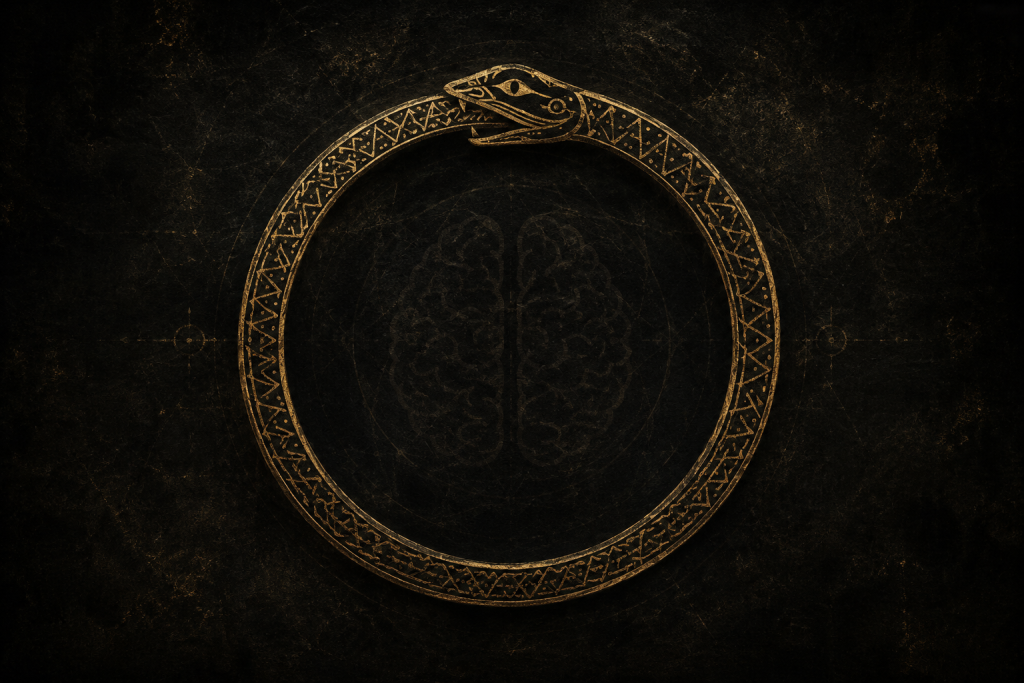
It may also be the reason so many religious traditions anticipate some form of restoration, redemption, or deliverance. They recognize life as a journey, and civilization as the main vehicle of that journey—going in the wrong direction. If civilization is an ouroboros (the serpent consuming its own tail), then a Messiah would save us from ourselves.
Here’s what makes Jesus truly unique in this journey—and no one has seen it this way. He embodied the Law of Reversal.
He reversed glory into humility, wealth into poverty, power into service, life into death, then death back into life. He turned the cross into a throne, and his departure will turn into his return. He didn’t bypass the Law of Reversal—the trajectory of human civilizations that always end in collapse. He walked straight through it and provided a way out of our civilizational death into eternal life. And because he entered the pattern fully, he can intercede for us from within it.
Jesus said something that makes this idea come alive. “Do not think that I have come to abolish the law,” he told his followers. “I have come to fulfill it.”
What does it mean to fulfill a law? If a musician fulfills a musical score, the music comes to life. If an architect fulfills a blueprint, the blueprint becomes a building. Jesus became the law’s living embodiment: not a list of rules, but a person. The apostle Paul put it this way: “Christ is the end of the law”—not a dead end, but a doorway through it. He saves us from our self-destructive path, allowing our species to go on for a higher purpose.
Think about that. What if “the law” that biblical scholars speak of is not a list of rules—commandments, moral codes, religious obligations? What if the law is the rhythm of consciousness itself? That would mean the Law of Reversal is not something you obey; it’s something you are part of. Jesus offers a new kind of reversal—counter to the system yet within the existing Law—that begins in the mind and ends in transformation.
Every person Jesus touched experienced this reversal—Mary Magdalene, freed from seven demons, became the first witness of the resurrection; the paralyzed man at Capernaum stood up and walked home, carrying the mat he had just been lying on; Matthew, the despised tax collector, left his money behind to follow Jesus; the Samaritan leper, an outcast, returned to worship, receiving not just healing but salvation; and Saul, a violent persecutor of Christians, was transformed into Paul, the most influential apostle in history.
Jesus gave us an alternative to the direction we are heading. And he showed us the mechanism through relationship.
But why should reality be structured around reversal in the first place? Why does history seem to move through cycles of ascent and collapse instead of progressing in a straight line?
To answer that, we need to look at the hidden architecture of consciousness itself—starting with the fact that your brain has two hemispheres.
Why the Law Exists
The Law of Reversal is built into our brains—by design, through two hemispheres.
The two hemispheres are not identical. They are partners that operate through relationship. Each plays a different role in how we experience reality. The left hemisphere specializes in logic, language, categories, and certainty. It breaks things down. It draws boundaries. It loves efficiency and closure. The right hemisphere handles the big picture: intuition, mystery, relationship, and the whole. It sees connections.
For us to be fully conscious, functional human beings, both hemispheres must work together—one leads, then yields to the other, then leads again. That dance, that alternation, that pendulum swing of which side leads the way is the engine of consciousness itself. This pendulum swing is the Law of Reversal.
But the left brain has a fatal flaw: it doesn’t know how to stop dominating. It builds systems—cities, empires, doctrines, purity laws—and then mistakes those systems for reality. When the left brain runs things too long, it becomes extreme: rigid, proud, exclusive. It creates global hegemonies and monocultures, which strangle creativity and life. That’s the Law of Reversal at work: Build becomes Collapse.
You see this cycle everywhere. But the clearest example is the biblical story from Cain to the Tower of Babel: building civilization, then collapse.
Babel is often read as a story of punishment. It may be better understood as a story of rescue.
Humanity had become a single project. A single system. A single way of seeing. One language. One vision. One tower. A civilizational monoculture.
If God had not intervened, humanity would have destroyed itself. Notice: God does not smash the tower. He does not strike the builders dead. He performs the one act that saves humanity from its own success: He reintroduces difference. He fractures the monolith. He breaks the closed logical loop. Diversity becomes salvation.
That’s the Build/Collapse cycle in one story. Its symbol is the ouroboros—again, the serpent eating its own tail. The same serpent appears in the Garden of Eden, tempting humanity toward the very knowledge that traps us in this cycle.
So why did God design us this way? Why build an engine that so easily breaks?
Because without the left brain leading—at least for a time—we would never have become selves. We would never have said “I” instead of just “we.” We would never have chosen, never loved, never grown. The Garden story is exactly this: eating the fruit of the knowledge of good and evil was the reversal of our own consciousness, from right-hemisphere wholeness to left-hemisphere separation. Suddenly, Adam and Eve saw themselves as separate from God, from nature, from each other.
That split was painful. But it was also the birth of choice, responsibility, and the possibility of genuine love.
Now think about timing. Jesus did not arrive in the Garden. He arrived deep into human history—after we had become sovereign selves, after we had learned to speak, read, write, build civilizations, and make terrible mistakes. He arrived into a well-established left-brain world that had built itself up and collapsed many times over.
Imagine that world. Deep power structures, much like today. In his day, it was the Romans. Now zoom in on people’s brains: a left-brain world with no fix from within. The left brain cannot evolve its way out. Eventually, it consumes itself, as the ouroboros shows.
Now imagine Jesus—perhaps the only fully right-brained human thinker to ever walk the earth—showing up in this logic-obsessed, law-focused, left-brain world. He showed us how to surrender: how to let the right brain lead, how to truly love. Love cannot be achieved through left-brain ego. It cannot be calculated, categorized, or enforced. Love requires right-brain leadership: openness, presence, the willingness to hold the other as mystery rather than problem.
To see why this matters, consider what happens when the right brain leads. It doesn’t reject logic or planning; it just refuses to let them become gods. The right brain holds the big picture: that you are part of a whole, that rules serve people (not the other way around), that certainty is sometimes a trap. When the right brain leads, the left brain becomes a servant instead of a tyrant. It can still build, categorize, and plan—but it builds for love, not instead of love. That is what Jesus demonstrated in every encounter. He didn’t abandon reason or law; he fulfilled them by reconnecting them to their purpose: relationship, mercy, and life.
And the Resurrection? It did something brilliant. It rewired the trajectory for anyone who embraces it. The normal human pattern is Build/Collapse: we build, we harden, we crash. But the Resurrection introduced a new possibility: Build/Eternal Life. Not endless building without collapse—that’s just the left brain’s fantasy of control. Instead, Build/Eternal Life means that each collapse can become a transformation, each ending a new beginning. When a human brain surrenders to the right hemisphere’s lead, following Jesus, the cycle doesn’t stop—but it changes. Death becomes a doorway. Failure becomes a classroom. The ouroboros stops devouring itself and starts becoming something new. That is the power of resurrection consciousness.
Now look where the left-brain project has brought us today. We can split the atom, edit genes, and wipe out civilizations with a plethora of weapons. To even conceive of these weapons, let alone build them and make them available to investors, is inhumane from the perspective of Jesus. We possess unprecedented power and remain unable to solve our most basic human problems. This is not a civilization that will survive itself. The gap between intelligence and wisdom has become a chasm. The Build/Collapse cycle has reached its most dangerous stage.
Jesus knew this would happen. He knew that even with his example, even with his teaching, human systems would keep rebuilding the tower. And this is why he had to return. The collective left brain of civilization cannot make the choice to surrender as he taught us to. It will always rebuild, always harden, always collapse—until it collapses once and for all and doesn’t get back up.
That is why Jesus came and why he’s coming back. Not to crush us, but to bring us—through separation, collapse, and reunion—into the full image of God, which is love. To help us through what is coming. Love, to be real, must be chosen. Choice requires the left brain. And the left brain, left alone, is simply unable to submit. It needs only to yield to the right brain, and then it finds its way. And the only way it yields is through the mechanism that Jesus lived.
That is what the Second Coming addresses: the moment when a civilization built entirely on its own logic reaches its limit. The same project that gave us nuclear weapons, world wars, concentration camps, killing fields, AI, and a million ways to surveil, predict, and commodify human behavior—all engineered with brilliant left‑brain efficiency—is the cycle Jesus will return into, to finish, with us.
Jesus himself was asked what signs would mark the end of the age. His answer—recorded in Matthew 24—sounds less like ancient prophecy and more like the evening news: wars and rumors of wars, nations rising against nations, famines and earthquakes, the love of many growing cold. The apostle Paul added his own description of the “last days” in 2 Timothy 3: people obsessed with themselves and money, boastful and proud, abusive and ungrateful, lacking self-control and compassion. What once sounded like hyperbole now reads like a job description for our century. These aren’t just random misfortunes. They are the natural symptoms of a world running entirely on left‑brain logic—a civilization building so hard that it has forgotten how to surrender. And according to the text, this convergence of signs is precisely the moment when the pattern reaches its breaking point, and when Jesus prepares to return.
Jesus will not return through institutions. Institutions can preserve wisdom, but they cannot make the choice that only individuals can make. He will return through kenosis—self-emptying love, the kind described in Philippians 2:5-11—love that flows against the grain of systemic power, subverting it from within.
Going Away and Coming Back
The Gospels record Jesus saying: “In my Father’s house are many rooms. I am going there to prepare a place for you. … I will come back and take you to be with me.” The early Christians built their entire hope around this. They even had a prayer in their original language: Maranatha — “Our Lord, come.”
Notice what Jesus is doing here. He is not announcing a schedule or a do‑over. He is describing the Law of Reversal—the hidden rhythm of reality itself: going away and coming back, departure and return, ascent and descent, birth and death.
Why leave at all? Why not stay? Why “go to prepare a place” instead of just creating it on the spot?
Because separation must come before reunion. A seed falls into the ground and dies before it bears fruit. A son leaves his father’s house before the prodigal can return home. Jesus understood that the spiritual journey—and the journey of human consciousness—requires a going‑out and a coming‑back.
Now consider a question that rarely gets asked: If Jesus said, “It is finished,” why does history continue?
The cross accomplished redemption. But redemption is not the same as completion. What remains unfinished is not the work of salvation—it is the work of choosing.
Salvation was offered. It was not forced, because love cannot be forced.
So history continues because human beings, generation after generation, must make that choice for themselves. Institutions cannot make it for them. In fact, institutions—including the church—are left‑brained by nature. They build systems, harden doctrines, and inevitably reverse into the opposite of what they were meant to serve.
That reversal is not a failure of God’s plan. It is proof that the Law of Reversal operates everywhere—even inside the religion founded in Jesus’ name.
Consider what happened within a few centuries of Jesus’ departure. God’s promise to Abraham was that through Israel, all nations would be blessed (Genesis 12:3). Jesus, a Jew himself, was the fulfillment of that promise: the path to God opened for everyone, Jew and Gentile alike. As he told the Samaritan woman, “Salvation is from the Jews” (John 4:22).
But the church gradually reversed this. By the 15th century in Spain, it had invented the doctrine of “purity of blood” (limpieza de sangre)—declaring that even if a Jewish family converted to Christianity, their bloodline permanently disqualified them from true belonging. Jesus welcomed everyone. The church barred the very people through whom he came.
That is the Build/Collapse cycle in religious clothing. The institution that claimed to follow Jesus became the opposite of everything he stood for.
And that is why Jesus knew he would have to return. The collective left brain of civilization cannot make the choice to surrender. It will always rebuild, always harden, always collapse. He saw it coming—even in the church that would be founded in his name.
Humanity, now possessing self‑consciousness and the knowledge of good and evil, must choose: keep riding the left‑brain loop down to collapse, or follow the way of surrender, love, and self‑emptying. Jesus is not forcing anything to reverse. He is waiting for the Law of Reversal to finish its work—for the ouroboros to take the last bite of its own body, for the left‑brain loop to consume itself. And when it does—when the left‑brain project reaches its final, inevitable dead end—he will return to gather those who chose the only alternative path.
That is why even Islam, which does not accept the divinity of Jesus, affirms his return. The witness of Muhammad—who did not promise his own return, but promised the return of Jesus—shows that this pattern extends beyond Christianity alone. The hidden law is woven into creation, not just into one tradition.
Carl Jung defined enantiodromia as “the emergence of the unconscious opposite in the course of time.” Jesus explained the result of that emergence at his return:
What is hidden will be revealed.
What is low will be raised.
What is wrong will be made right.
Death will be reversed into eternal life.
The Second Coming is not a divine do‑over.
It is the final reversal.
The completion of the Law of Reversal that has been unfolding since Eden.
The moment when separation becomes reunion.
When the journey away becomes the journey home.
When the way down becomes, at last, the way up.
Jesus is not returning to begin something new.
He is returning to complete what has been unfolding from the beginning.
If you’ve read this far, thank you. I put a lot of time and thought into these essays. For a long time, I’ve wanted to make a living as a thinker and writer—but honestly, I’m not even close. So I’m praying for direction, asking God to show me the way forward. I’m open to all possibilities, including employment opportunities.
If you have ideas, leads, or just want to help, you know where to find me. And if you’re able to support my work, you can do so on Patreon, BuyMeACoffee, Substack, or anywhere else you wish (just message me).


 “Outstanding, sophisticated, and mesmerizing…a spiritual intrigue similar to Dan Brown’s The Da Vinci Code.” —ForeWord Reviews