
How the Fed Bails Out the World With Your Savings
“How did you go bankrupt? Two ways. Gradually, then suddenly.” — Ernest Hemingway, The Sun Also Rises
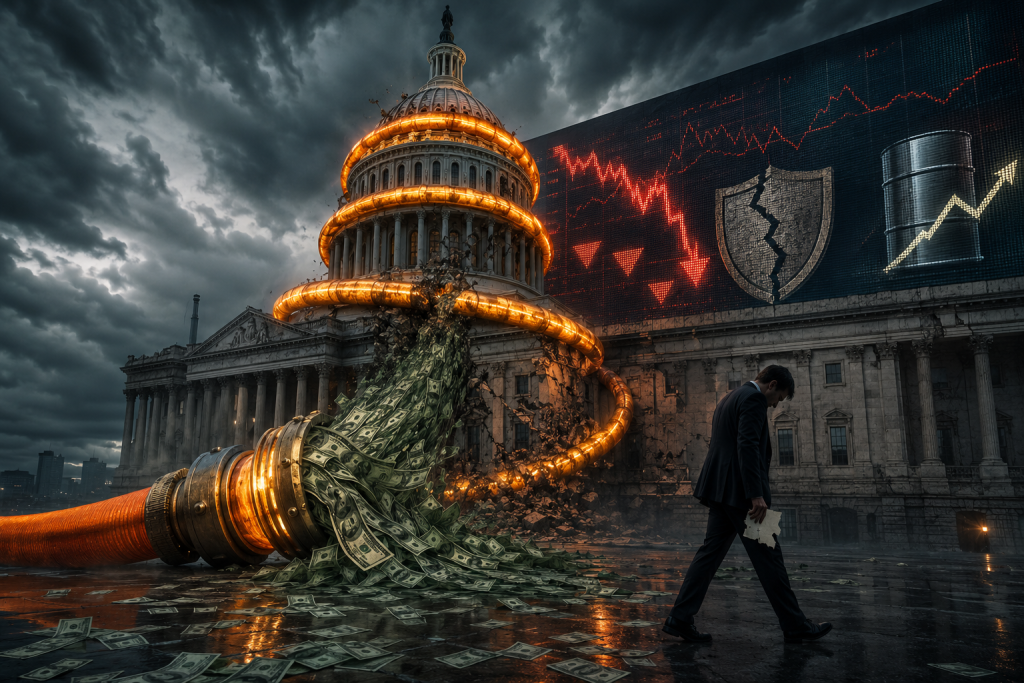
The Man Who Downgraded America
In August 2011, Deven Sharma did something unprecedented.
As president of Standard & Poor’s—one of the three major agencies that assess the creditworthiness of governments and corporations—he stripped the United States of its AAA credit rating and downgraded it to AA+.
This signaled to the world that America had become a slightly riskier borrower, which over time could force the U.S. government to pay higher interest on the trillions of dollars it borrows.
Eighteen days later, Sharma announced he was stepping down. Perhaps challenging the financial standing of the world’s dominant superpower carried consequences.
Was he wrong? No. Over the next fourteen years, every major credit-rating agency reached the same conclusion. Fitch downgraded the U.S. in 2023. Moody’s followed. The national debt climbed to 122 percent of GDP.
But here’s the puzzle. If these agencies have credibility, why haven’t markets punished the U.S.? Why haven’t rates exploded?
The Threefold Answer
First, the dollar is the world’s reserve currency. Foreign central banks, sovereign funds, and global corporations need dollars for trade, debt service, and reserves. This creates permanent demand for U.S. Treasury debt, keeping borrowing costs low even as the debt grows.
Second, the world is structurally dependent on dollars—but chronically short of them. Here’s how that works: A German automaker sells cars in Europe for euros, but it borrowed billions in dollars to build a factory. A Japanese pension fund receives yen from its members, but it bought U.S. bonds that pay out in dollars. A Brazilian company exports soybeans for reais, but it took out a dollar loan to expand. None of them earn dollars in their daily operations—they earn local currency. When they need to repay those dollar debts or make dollar-denominated payments, they have to go out into global markets and buy dollars with their local currency.
Now imagine everyone needs to buy dollars at the exact same time—that’s a dollar shortage. Banks, corporations, and governments outside the U.S. have stacked up over $18 trillion in these dollar liabilities. When financial stress hits, they all scramble for the same currency, and the system seizes up.
Third, the Federal Reserve stands ready with a permanent backstop: dollar swap lines, which we’ll unpack shortly.
This is why markets have not punished the United States, and why interest rates haven’t exploded.
But here’s the part you may have missed: Reserve currency + structural dollar shortage + permanent swap lines = the permanent bailout.
Reserve status creates permanent dollar demand. That demand fuels global dollar borrowing. That borrowing creates recurring dollar shortages. The only cure? The Fed prints more dollars. But printing devalues the dollar—making the debt even harder to repay.
The system creates the problem. Then it creates the solution. Then the solution makes the problem worse.
Think of it as an Ouroboros—the ancient symbol of a snake eating its own tail. The loop continues until the snake runs out of tail.

Why the World Never Has Enough Dollars
The global economy runs on dollars. German automakers pay Saudi Arabia in dollars; Japanese pension funds buy bonds in them; Brazilian companies borrow in them.
More than three-quarters of international trade outside Europe is invoiced in dollars. The dollar accounts for roughly 60 percent of cross-border deposits and loans, 70 percent of international bonds, and 90 percent of foreign-exchange trades.
In normal times, it works. Banks lend, corporations borrow and repay. In a crisis, it breaks. Banks stop lending. Investors hoard cash. Everyone scrambles to repay dollar debts at once. The chase for dollars sends borrowing costs sky-high; banks can’t roll over; the system seizes.
Non-U.S. banks hold $18 trillion in dollar liabilities, and dollar FX swaps top $80 trillion—larger than the entire stock of U.S. Treasury bills.
This is the dollar shortage. It’s not a flaw—it’s a feature. Necessary for survival. Enter: swap lines.
Here’s what that actually looks like in practice. The European Central Bank says to the Fed, “We have banks over here desperate for dollars.” The Fed literally types new dollars into existence—creates them out of thin air—and hands them to the ECB. In exchange, the ECB hands the Fed an equivalent amount of euros as collateral. The ECB then lends those newly created dollars to its struggling banks. When the panic passes, the European banks pay back those dollars to the ECB with a little interest, the ECB returns them to the Fed, and the Fed deletes those dollars from existence.
The official story is that this “costs taxpayers nothing” because the loan gets repaid. But while those dollars were circulating, they were real money chasing real goods—and that’s what slowly erodes the purchasing power of your savings.
These started as emergency measures. The emergency stuck. In 2013, the Fed made them permanent with five central banks: the ECB, Japan, England, Switzerland, and Canada.
Think of them as a permanently installed fire hose. Usually, the valve is shut. When dollar funding locks up, the Fed opens it—and the snake keeps eating its tail.
Bernanke insists it costs taxpayers nothing—technically true; the loans return with interest. But critics call that myopic. By permanently backstopping foreign banks, the Fed encourages even more global dollar borrowing, inflating asset prices abroad. When those freshly printed dollars eventually wash back into the U.S., they erode the purchasing power of American savings—a hidden inflation tax levied to stabilize foreign balance sheets.
What If the Dollar Lost Its Crown?
What happens if the dollar loses its crown? To the system? To you?
If that transition happened suddenly, it might look something like this: you wake up one morning to a global financial crisis.
A dollar shortage emerges, but this time foreign central banks don’t turn to the Federal Reserve. The Fed opens its swap lines, but demand for dollars has faded. The Treasury can’t find buyers for its debt, sending rates soaring. Confidence unravels, markets seize, trading halts, and the system freezes.
The fallout would hit in four ways:
- Your money buys less. The dollar’s strength hinges on foreign central banks, investors, and companies holding trillions in dollars and Treasuries. If that demand collapsed, the dollar would sink. Imports—oil, medicine, electronics—would get pricier, raising the cost of living.
- Borrowing costs rise. The U.S. has long enjoyed low rates thanks to insatiable global demand for Treasuries. Without it, higher rates would balloon the $1 trillion annual interest tab, squeezing the federal budget.
- Financial markets buckle. Decades of foreign investment have inflated U.S. stocks. If that capital fled, retirement accounts would crater, dragging the economy toward recession or worse.
- The economy rebalances. For decades, the U.S. has imported far more than it exports, financing that gap because the world accepts dollars. A weaker dollar would make American goods more competitive abroad, reviving U.S. manufacturing, but rebuilding supply chains and factories would take years of painful disruption before new opportunities emerged.
Britain went through something similar when the pound gradually ceded its reserve status—over decades, not overnight, as U.S. power eclipsed its own. The United States isn’t Britain—its economy is larger and more diverse. But no reserve currency lasts forever.
Pain forces adaptation—and losing the crown could ultimately strengthen America. A weaker dollar would make domestic production competitive again, rebuilding industrial jobs. Higher borrowing costs would pressure Washington to curb deficits—though whether it would act is a political question, but the pressure would be greater. And fragile global supply chains—as the pandemic and geopolitical conflicts have shown—might give way to local resilience, turning a fragile system into a robust one.
The system always evolves. The real questions are how the transition unfolds—and who bears the cost.
“I Don’t Know”
When Representative Alan Grayson questioned Bernanke about the Fed’s emergency lending, one exchange stood out:
Grayson: “So who got the money?”
Bernanke: “Financial institutions in Europe and other countries…”
Grayson: “Which ones?”
Bernanke: “I don’t know.”
Grayson: “Half a trillion dollars and you don’t know who got the money?”
Bernanke called the dollar’s 20 percent spike a “coincidence.” Grayson laughed.
Alan Grayson grills Ben Bernanke on foreign lending. Watch the video here:
The public doesn’t see the swaps. The public doesn’t understand the dollar shortage. And the Fed chairman can’t—or won’t—say who got the money.
Imagine the dollar loses its reserve status. The same people who can’t explain half a trillion dollars in swaps would be steering the transition. The same secretive institutions would be managing the collapse. The same Fed chair—or a successor—would face the question: “What happened? Who’s responsible? What comes next?”
And you’ll get the same answer.
“I don’t know.”
Or worse—they’d point elsewhere. The Chinese. The Russians. The Saudis. The City of London. The algorithmic traders. Anyone but the system itself. Anyone but the extraction machine they built and maintained for decades.
This is the trap the Fed is already walking. Even with the dollar’s reserve status intact, it faces an impossible choice: raise rates to save the currency but crush the budget, or lower rates to save the budget but crush purchasing power.
Remember, the U.S. government doesn’t just borrow money once—it constantly rolls over its debt, selling new Treasury bonds to pay off old ones. The interest rate it pays is set by the bond market. If the Fed raises rates, the government pays higher interest on all new debt, adding hundreds of billions to the federal budget each year.
That’s the “crush the budget” part—and we already spend over a trillion a year on interest alone.
To keep rates low, the Fed prints new money to buy Treasury bonds. The more bonds the Fed buys, the higher their price goes. Counterintuitively, higher bond prices push yields down for new buyers. That keeps the government’s borrowing costs cheap. It saves the budget today—but steadily erodes the value of every dollar you hold.
If the dollar loses its reserve status, that trade-off just becomes infinitely harder.
The consequence is the same: bankruptcy of your savings, your wages, your purchasing power. Or, more gently, a gradual erosion of what your dollar buys—and the trust it commands.
Deven Sharma was right. He was just early.
The snake eats its tail gradually—day by day, swap by swap, dollar by dollar. But Hemingway knew the end doesn’t arrive with a whimper. It comes suddenly, when the circle finally breaks and the permanent bailout becomes a permanent collapse.
And when it does, the question is not just what replaces the dollar. It’s what replaces the system that depended on it.
Plato observed that every regime carries the seeds of its own decay. When the old rules no longer hold, the vacuum does not remain empty. Something always takes their place.
That something is the subject of the next essay.
If this essay resonated, share it with someone who needs to see behind the curtain. Support this work on Patreon, BuyMeACoffee, Substack. And if you have thoughts—or opportunities—I’d love to hear them.
Thank you for reading.