



“Forgive us our debts, as we also forgive our debtors.” — Matthew 6:12
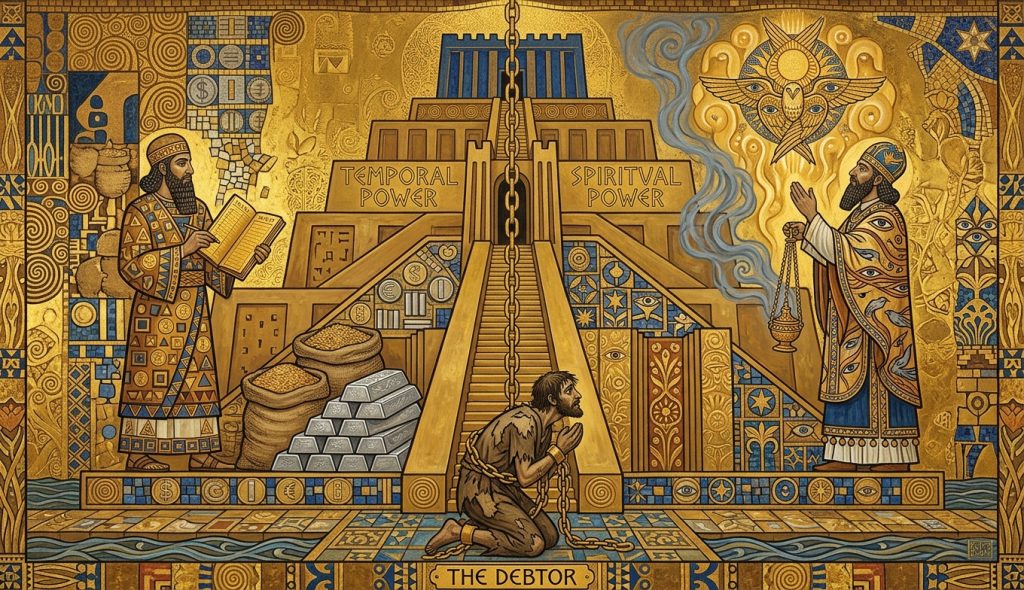
When we look into antiquity, we tend to see primitive people. But ancient Babylon (c. 2000–539 BCE) and our world today are not that far apart.
Consider the temple. It was a colossus: a divinely sanctioned corporation that served as the central bank, the treasury, and the landlord of an entire civilization. The temple was the state. And the god it served was the ultimate creditor—the legal owner of land, wealth, and debts.
The temple’s wealth flowed from every direction. Kings donated land and prisoners of war. The populace paid mandatory tithes and offerings. Tenants farmed the temple’s vast estates. And the temple lent.
It lent silver—the currency of large transactions—at rates as high as twenty percent. It lent grain—the currency of daily life—at rates that could reach thirty-three. A farmer who borrowed against his harvest was borrowing money in the form he would use to repay it.
Every loan was recorded on clay tablets—legally binding contracts detailing the amount, the interest, the repayment date, and the witnesses. Nothing was forgotten or forgiven.
Here we can see an early institutionalized fusion of debt and sin.
By making the god the official creditor, the temple transformed a financial obligation into a spiritual and moral one. Defaulting was not merely a bad business decision—it was an act of defiance against the divine.
The Akkadian word ḫiṭṭu and its Sumerian counterpart nam-tag reveal how closely concepts of wrongdoing, obligation, and guilt could be intertwined.
To owe was to be guilty. To repay was to be redeemed. The borrower was the sinner. The temple was the judge.
Repayment dates were set to coincide with the harvest. If a farmer had a bad season, the debt rolled over, accumulating interest. A cycle of debt began from which there was no exit. Those who could not repay could be forced into servitude—their labor and future claimed by the institution that had extended them credit.
This was debt-slavery under divine law. You could not contest its power. You could only pray for mercy—and mercy came with a price.
The City Moves
Before we follow the pattern westward, a word on what I mean by “the City.” I do not mean London alone. I mean the recurring financial pattern that moves from one institutional host to another: temple, merchant network, church, bank, central bank, and international financial institution. It is not a place. It is a pattern—one that survives every empire that hosts it.
The pattern did not stay in Babylon.
Phoenicia built a network of maritime city-states—Tyre, Sidon, Byblos. Merchants, contracts, and credit moved across political boundaries. Rome added scale and legal codification. Tax-farming, public debt, and debt-slavery became mechanisms of imperial control. When Rome fell, the City did not die. It changed its address.
The forms changed. The institutions changed. But the pattern remained: financial power concentrated in institutions that stood between ordinary people and the forces governing their material lives.
But then a figure appeared who disrupted the pattern.
Jesus of Nazareth drove the money-changers from the temple—shattering the alliance between spiritual authority and economic power. He told the Pharisees: “You search the Scriptures, because you think that in them you have eternal life; and it is they that bear witness about me, yet you refuse to come to me that you may have life.”
He taught his followers to pray: “Forgive us our debts, as we also forgive our debtors.” He declared the Jubilee—the ancient practice of debt cancellation—as a way of life. He said: “I am the Temple. I am the sacrifice. The debt is settled in me.” No longer would release be tied to a place. The Temple was now a person—and the person could be everywhere.
For a moment, the pattern was interrupted.
And then the institution founded in his name became the City’s most durable host.
The City had put on a cassock.

The Church Recreates the Pattern
The Christian Church inherited Rome’s administrative tradition, accumulated vast landholdings, and became Europe’s largest economic actor. Monasteries administered property, collected tithes, and participated in networks of credit.
The medieval doctrine of indulgences mirrored the temple: sin created an obligation; the Church administered the means of release. Indulgences were certificates that purported to reduce the temporal punishment for sins. Over time, they could be purchased, donated, or traded, creating a market for spiritual release.
The economic and the spiritual occupied the same institutional space once again. The debt Jesus had canceled was reinstated—now owed to the Church. The gift had become a product.
This was not a failure unique to the Church. It is the pattern of every institution that forgets its purpose—the pattern of the temple, repeated across a thousand years.
And the language of finance still carries the vocabulary of salvation. Credit comes from credere, “to believe” or “to trust.” Redemption comes from redimere, “to buy back.” Mortgage is Old French mort gage—literally “dead pledge.” Interest comes from interesse, “to be between.” The language of finance is haunted by the language of salvation. Deeper than economics, it penetrates the soul.
But the Church’s wealth was not portable. It was tied to land—monasteries, cathedrals, estates. The Church had solved one problem: how to monetize spiritual obligation. But its wealth was immobile.
The next problem to solve was making it mobile.

From Trust to Institution
How do you move wealth across distance without moving the wealth itself?
The Knights Templar solved it. Founded to protect pilgrims, they became the wealthiest military order in Europe. Because their houses stretched across the continent, a pilgrim could deposit wealth in one city and withdraw it in another.
Wealth was separated from physical possession. Value moved without the coins themselves moving. What moved was debt—claims on future payment, transferred from one party to another. This was banking before banking had a name.
By the 12th century, Venice and Genoa refined the system. Double-entry bookkeeping, bills of exchange, and marine insurance transformed trust into an institution. The contract, the ledger, and the court now stood between merchant and merchant. Debt—once a personal obligation between two people—had become an instrument that could be bought, sold, and traded.
You did not need to know the person on the other side of the Mediterranean. You only needed to trust the mechanism. The City had evolved from a place into a network into a system. And with each step, it required less relationship and more contract.
London became a financial center because state power and private financial power learned to work together. The state needed credit; the financiers had it. In exchange, the state offered legal privileges, military protection, and enforceable contracts.
The connection between commerce, war, and finance was visible during England’s struggle with Spain. Privateering allowed privately financed ships, operating under government authorization, to attack enemy shipping. Privateering helped enrich investors, some of whom later financed the institutions that would become pillars of the financial system.
But the masterstroke came with London.
1694: The Great Inversion
In 1694, the Bank of England was created to lend £1.2 million to King William III to fund a war against France.
Here is what made it different.
The loan was permanent. The king did not promise to repay the principal. He promised to pay interest—forever. The debt was a perpetual annuity.
The lenders became a corporation. The people who provided the capital received shares in the Bank of England—a privately organized institution operating under a royal charter and granted the exclusive right to issue banknotes.
The Bank issued notes that circulated as money. Because its notes circulated widely and were accepted in payment, the Bank could extend credit beyond the coin it held in reserve. This was a new kind of institution—one whose liabilities could function as money.
The state’s debt became the Bank’s asset. The king owed the Bank £1.2 million. That debt was an asset on the Bank’s balance sheet. The Bank could use that asset to issue more notes, make more loans, and expand its operations.
The public paid the interest. The king levied taxes on the public to pay the interest on the debt. The public worked. The Bank collected. The debt was serviced. And it would never stop.
This was the inversion that launched the modern financial system. The same piece of paper—the loan contract—was a liability to the borrower and an asset to the lender.
Before 1694, debt was something to be repaid and extinguished. The borrower was the slave of the lender—and the goal was to become free.
After 1694, the state’s debt became a permanent asset—generating interest forever, backed by the taxing power of the state.
The king’s liability became the Bank’s asset. The public’s taxes became the Bank’s income. The nation’s debt became the City’s fuel.
Debt was no longer a burden to be escaped. It was a foundation to be built upon. Sin became an asset.
The borrower was no longer the slave. The borrower was the source of the lender’s wealth. And the lender had no interest in freeing the borrower. The lender had an interest in keeping the borrower in debt—forever.
The Bank of England became an institution whose fortunes were bound to the state’s own survival. If the Bank failed, the state’s finances were endangered; if the state failed, the Bank’s assets were endangered. They were bound together in a perpetual embrace.
This is the design. The fusion of sovereign borrowing and private finance. The state needs credit. The financiers supply it—for a price. The state offers legal privileges, military protection, and enforceable contracts. The financiers offer money, and in return, they receive a permanent claim on the nation’s future.
Here, the modern financial system was born. Not with a single invention, but with a single inversion: the transformation of government debt into a permanent, tradable, privately owned asset.
From London to Basel to Washington
The Bank of England became the model for central banks worldwide. Government debt became the foundation of the global financial system. The future—future tax revenues, future production, future growth—could be monetized, brought into the present, and assigned a value.
In 1913, the United States created the Federal Reserve—a public-private hybrid that gave private banking interests a powerful role in the nation’s monetary system while placing the institution within a framework of government oversight.
When the government needs money, the central bank creates it. That new money flows first to the banks, the government contractors, and the financial elites. By the time it reaches the public in the form of wages, prices have already risen. The public’s purchasing power has been diluted. The elite’s assets have inflated. This is the Cantillon effect: the first receivers of new money benefit. The last receivers are robbed.
The entire system now ran on debt. Bank deposits were liabilities—a form of debt owed to depositors. Federal Reserve notes were liabilities—a form of debt owed to holders. The money in your pocket was not wealth. It was a claim—a debt—that someone else would accept it in turn.
But if the central bank could create money without limit, why didn’t prices explode? Because the newly printed money was funneled into asset markets—stocks, bonds, real estate. These assets absorbed the liquidity that would otherwise have crashed the currency. The public saw their home values rise and their 401(k)s climb—and did not notice that their wages were stagnant and their debt was growing.
In 1930, the Bank for International Settlements was established in Basel to facilitate international settlements. After World War I, Germany owed massive reparations to France, Britain, and other nations. The BIS was created to coordinate these payments.
But the BIS was no mere administrative clearinghouse. It was built with a legal status unique among international institutions: immunity from the laws of its host country and from national courts. Owned by central banks yet operating as a private institution, it answers to no electorate and no parliament.
Over the decades, it evolved into the central bankers’ central bank—a crown above the crowns of nations. Through the Basel Accords, it develops international capital standards that national regulators incorporate into their own banking rules. The process operates largely outside ordinary democratic politics, giving the institution an influence far beyond its formal role.
The BIS coordinates the debt. It sets the standards for how much debt banks can carry, how much governments can borrow, and how the whole apparatus manages the debt that never goes away. The debt is permanent. It is the engine. It is the architecture.
The BIS does not merely facilitate. It helps govern the governors.
When Nixon closed the gold window in 1971, the dollar lost its formal link to gold. Yet dollar demand persisted, reinforced by the growing role of oil markets, which were overwhelmingly denominated in dollars. The pattern would continue, even without gold.
Babylon gave the City sacred authority. Phoenicia gave it mobility. Rome gave it imperial scale. The Church gave it spiritual legitimacy. The Templars gave it institutionalized trust. Venice gave it financial technology. London gave it the fusion of private finance and sovereign power. Basel gave it transnational coordination.
The forms change. The abstraction increases—from grain to coin to paper to digital code. But the geometry remains the same.

The Invisible Temple
This is the paradox of the modern financial system. It is extraordinarily powerful, yet it has no single face. It can create credit, price risk, and transform future promises into present purchasing power. It converts life into liquidity.
Because the system is distributed across millions of decisions and thousands of institutions, its effects appear almost impersonal. No one person needs to intend the outcome. The system reproduces its own logic through the incentives built into it.
That is what makes it invisible. The ancient temple has disappeared. But its function has not. It has simply taken a new name.
The name is Mammon.
The word appears in the Gospels as wealth personified as a false god. But Mammon is not merely wealth. It is a principle: the belief that everything, including human beings, can be valued, traded, and controlled. Babylon began it with debt and sin. We have continued it with credit, derivatives, and futures. We have priced everything—including the future, including each other.
Mammon is the City’s god. It demands what the system demands: measurement, control, accumulation. It cannot see what cannot be quantified. It cannot love what cannot be priced.
And Jesus named it directly. In the same sermon where he taught his followers to pray for the forgiveness of debts, he said: “No one can serve two masters. Either you will hate the one and love the other, or you will be devoted to the one and despise the other. You cannot serve both God and Mammon.”
He did not say that money was evil. He said something more troubling: that money and God are competing masters. You must choose.
The choice is not between having money and not having money. It is between serving the living God of relationship and serving the invisible god of the ledger.
It does not demand worship through rituals or temples. It demands our attention—through organization, accumulation, and ceaseless activity. It keeps us busy, distracted, and fragmented, making it harder to see the whole.
Mammon is not merely the god of debt—it is also the god of war. The same system that turns debt into wealth turns death into profit. Human suffering fuels the machine.
It is a trap we have built for ourselves, brick by brick, contract by contract, debt by debt. But it is also a trap we have built in ourselves—a pattern of perception that has become so dominant that we can no longer see it.
The first step toward liberation is to see it for what it is. And the first thing to see is the choice that Jesus named: you cannot serve both God and Mammon.
That is not a political act. It is a cognitive one. It is a turn of the heart—the place where seeing and choosing are one.

References & Sources
Bank of England. “Why was the Bank of England founded?” Bank of England Museum, 2021.
Bank for International Settlements. “BIS History – Overview.” https://www.bis.org/about/history/overview
Bromberg, Benjamin. “The Origin of Banking: Religious Finance in Babylonia.” The Journal of Economic History 2 (1942): 77–88.
Cartwright, Mark. “Trade in the Phoenician World.” World History Encyclopedia, April 1, 2016.
Fratianni, Michele and Spinelli, Franco. “Italian city-states and financial evolution.” European Review of Economic History, Cambridge University Press, 2006.
Graeber, David. Debt: The First 5,000 Years. Melville House, 2011.
Harris, Rivkah. “Old Babylonian Temple Loans.” Journal of Cuneiform Studies 14, no. 4 (1960).
López-Ruiz, Carolina. Phoenicians and the Making of the Mediterranean. Harvard University Press, 2024.
Mills, Geoffrey T. “Early accounting in northern Italy: The role of commercial development and the printing press in the expansion of double-entry from Genoa, Florence and Venice.” Accounting Historians Journal 21, no. 1 (1994).
Nicholson, Helen. The Knights Templar: A New History. Sutton Publishing, 2001.
The Avalon Project. “Babylonian Law—The Code of Hammurabi.” Yale Law School. https://avalon.law.yale.edu/ancient/hamframe.asp
If this essay resonated with you, I would love to hear your thoughts. And if you would like to support more work like this, you can support me on Patreon, BuyMeACoffee, or Substack. Thank you for reading.



 “Outstanding, sophisticated, and mesmerizing…a spiritual intrigue similar to Dan Brown’s The Da Vinci Code.” —ForeWord Reviews