



“The woman whom thou gavest to be with me—she gave me fruit from the tree, and I ate.”
— Genesis 3:12
The First Audit
Listen to the first words spoken by a newly self-aware humanity.
They are not filled with curiosity, wonder, or love. They are an audit. An accounting. A ledger of blame opened in the ruins of a relationship. In this one sentence, Adam—the first person to see himself as a separate “I”—does three things at once: he blames God (”the woman you gave me”), he turns his partner into an object (”she gave me”), and he excuses himself (”and I ate”—as if he were just a passive recipient, not someone who made a choice).
This sentence is the founding document of what we might call the Builder’s Consciousness. This is a way of thinking built on separation, control, and self-justification. Its first act isn’t just disobedience; it’s reframing. Responsibility is pushed outward, a relationship is turned into a simple cause-and-effect, and blame becomes the very language of the self.
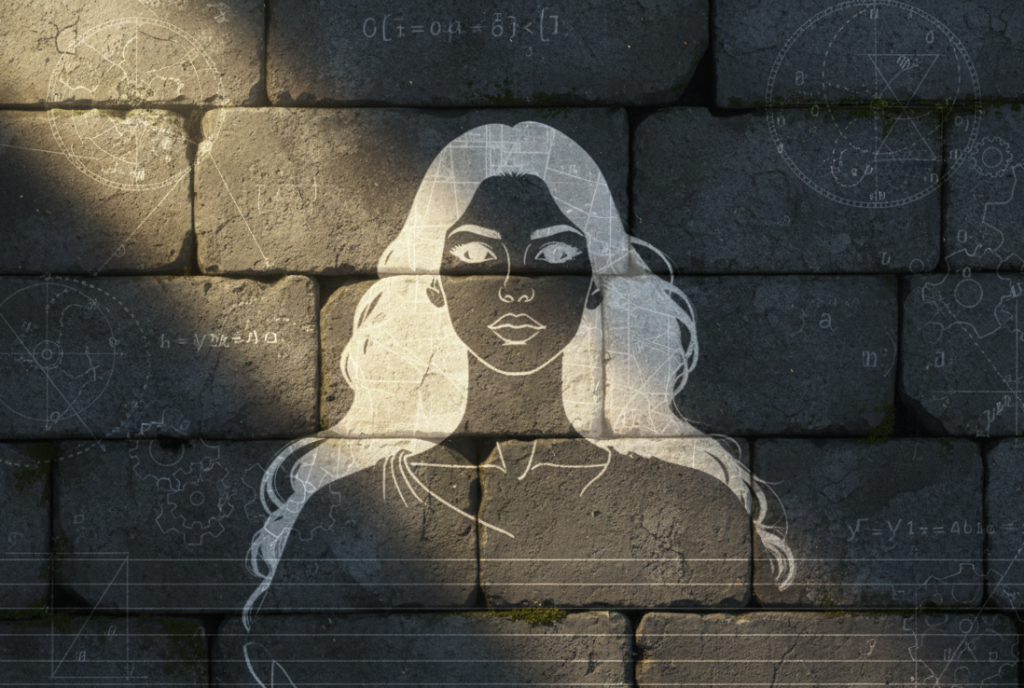
In the Genesis story, we witness the painful birth of this ego-driven mindset. And with it comes the exile of an essential, life-giving way of knowing—represented by the figure of the ezer kenegdo. This exile isn’t really about gender. It’s about consciousness itself: the suppression of a relational, intuitive, and embodied way of understanding the world. It is pushed out by a system that can only function through division, measurement, and control. The effects of this ancient story aren’t just in the past; they live on in our institutions, our inner lives, and in our very bones.
The first act of this new consciousness is to exile whatever threatens its control.
The Exile of the Ezer Kenegdo: Exiling Our Own Wisdom
This exile begins with what we might call the Feminine Archetype. But this isn’t about biology. It’s about a certain kind of intelligence—a way of thinking and being that is more in tune with what I call the Steward (or Sanctuary Consciousness). This is the ezer kenegdo: an intuitive, receptive, context-aware, and life-nurturing way of knowing. It’s the wisdom of patience, integration, mystery, and embodied truth.
Why must this voice be silenced?
Because a system built entirely on control (the domain of the Builder, or Blueprint Consciousness) cannot tolerate a principle that operates through connection. A logic built on separation cannot handle a principle of unity. The Builder’s project—naming, organizing, and mastering the world—requires silencing anything it cannot easily quantify or manage.
But the Genesis story itself reveals a different original design. The woman is created as an ezer kenegdo (Genesis 2:18). The Hebrew word ezer is related to words meaning “power” and “strength.” Kenegdo means “corresponding to” or “equal to.” This is the same word used elsewhere in the Bible to describe the help that God provides. She is not an assistant; she is a “powerful, equal help.” A divine counterpart. A balancing intelligence without which the human mind cannot be whole.
The “Fall,” then, isn’t just the birth of moral awareness. It’s a cognitive takeover. The Builder, whose job was to structure reality, seizes control and declares the Steward’s way of knowing—embodied, intuitive, relational—to be dangerous. The ezer kenegdo is recast as the culprit. Balance collapses into hierarchy.
From this point on, Genesis reads like a case study in how a system suppresses a vital way of knowing—not women as people, but a type of intelligence that is repeatedly framed as suspect, irresponsible, or subversive.
We can trace this exile through the stories of three women. Think of them not as moral lessons, but as diagnostic clues in a story about a consciousness losing its wholeness.

Eve: When Seeing the Whole Picture Becomes a Crime
When the serpent speaks, Eve engages with what she sees.
She looks at the fruit and observes it in three ways at once: it is “good for food” (practical), “pleasing to the eye” (beautiful), and “desirable for gaining wisdom” (meaningful). This isn’t simple, linear thinking. It’s a holistic perception. It’s the Sanctuary mind receiving reality through multiple channels at the same time—holding nourishment, beauty, and understanding in a single act of awareness.
This is not recklessness. It is integrative intelligence.
But the Builder consciousness, born in that moment, cannot process this kind of thinking. It can only put things in simple categories: good or evil, for me or against me. So it performs its first audit. Eve’s rich, multi-layered engagement is flattened into a single, prosecutable category: “disobedience.” Her curiosity becomes a crime. Her integrative wisdom is blamed as the cause of the catastrophe.
This is the foundational move of this exiled state of mind: it blames the very capacity for relationship for the pain of separation. The intuitive, connective principle—the Steward within—is charged with causing the very rupture it was meant to help us navigate.
Sarah: When Your Own Body’s Truth Becomes a Lie
Generations later, God tells Abraham that his wife Sarah, long past childbearing age, will have a son. Overhearing this, Sarah laughs to herself: “After I am worn out and my lord is old, will I now have this pleasure?” (Genesis 18:12).
This laugh is not disbelief. It’s the voice of embodied intelligence—her body’s honest, instantaneous reaction to a physical impossibility. It’s a truth from her own flesh, before her mind can edit it. The Steward speaking honestly from the sanctuary of her own limits.
Then comes the question: “Why did Sarah laugh?”
In Genesis, God’s questions are never really audits. They are invitations, openings for a deeper relationship. This question offers Sarah a chance to bring her honest reaction into a dialogue: Yes, I laughed. My body knows its limits. How can this be?
But Sarah hears the question through the Builder’s filter. She perceives an accusation, not an invitation. The inner Auditor, trained to manage reality by looking good, kicks in. So she denies it: “I did not laugh.”
This is the quiet tragedy. She betrays the truth of her own body to protect her standing in a perceived ledger of faith. Her intuitive truth is sacrificed to perform the “correct” response.
God’s reply is neither punishment nor shaming: “No, but you did laugh.” It’s a gentle but firm insistence on reality. Not to condemn her, but to save her honesty. It’s as if God is saying, Your real response is the only material we have to work with. Bring me that. Her story ends not in correction but in redemption. The child is born and named Isaac, which means “he laughs.” The laughter she tried to hide becomes the very name of the promise.
Rachel: Intelligence Working in a Double-Bind
Later still, Rachel flees her father Laban with her husband, Jacob. Unknown to him, she steals her father’s household gods, or teraphim—small idols that represented family lineage, inheritance, and legal authority. These aren’t just trinkets; they are tokens of the Builder’s system itself: power made into a physical object.
When Laban catches up and demands to search their camp for his idols, Rachel hides them in her camel’s saddle and sits on them. When her father gets to her, she says: “Don’t be angry, my lord, that I cannot stand up in your presence; I’m having my period” (Genesis 31:35). According to custom, this made her and anything near her off-limits, so Laban doesn’t search further.
This is more than a clever trick. It’s a devastating portrait of what happens to intelligence when it’s forced into exile. To gain any power in a system built on tangible control, Rachel must engage that system on its own terms—by stealing its sacred objects. And to protect herself, she has to use the system’s own contempt for her body as a shield. The very ritual code that marginalizes her becomes her only protection.
Her intelligence is forced underground, exiled twice over:
- First exile: She can’t tell anyone, not even her own husband Jacob, why she really took the idols. Her true motive must remain hidden.
- Second exile: To keep that secret, she has to perform the system’s own demeaning stereotype about her body being untouchable or unclean. She survives by becoming invisible within the system’s rules.
This is what happens when the Steward’s wisdom is under siege. It can’t fight the tower directly, so it goes underground. It learns the Builder’s categories only to exploit their blind spots. Wisdom becomes a secret, fluent in disguise. Rachel’s story foreshadows the experience of anyone who has to code-switch, hide their true self, or play a role to survive in a system that cannot hear their authentic voice. It is brilliant, exhausting, and heartbreaking work—the cost of preserving a soul in a world built for ledgers, not for lives.
The Exile in Your Bones
This pattern isn’t just an ancient story. It’s the hidden architecture of your own inner life.
Think about it. What part of you have you been taught to call “irrational,” “unprofessional,” or “too much”? The gut feeling you ignored because the spreadsheet said otherwise. The creative idea you dismissed for not having a clear business case. The empathy you hardened to make a “rational” decision.
That’s your inner Rachel, forced to hide her true motives. That’s your inner Sarah, learning to lie about what your body knows. That’s your inner Eve, having your natural curiosity and desire to see the whole picture pathologized as naivete or insubordination.
To succeed in a Builder’s world—whether it’s a corporation, an academic institution, or the curated arena of social media—you often have to exile your own ezer kenegdo. You learn to promote the inner Auditor, the System Administrator, the high-achieving Burnout, while silencing the Steward.
These are not personal failings. They are adaptations to a system that has declared a vital part of your own consciousness to be illegitimate. In this story, the exiled consciousness—honed to perfection in empires, corporations, and institutions—is like a resume for the Builder’s world. Advancement has often required amputating your own ezer kenegdo.
But this victory is hollow. A Builder without its Steward is a tactician without a compass. It builds towers of Babel that can reach the heavens but understand nothing of them. It creates amazingly efficient systems that somehow starve the human soul.
Healing begins where Genesis’s tragedy does: by recognizing that the Builder’s victory is also its fatal flaw. A civilization that exiles the ezer kenegdo—the relational, contextual, nurturing intelligence—is a civilization that can build towers but cannot make a home. It can optimize efficiency but cannot cultivate love. It can audit everything but understand nothing. It is a mind at war with half of itself.
The suppressed voice has never been fully erased. It whispers in our intuitions, aches in our empathy, and insists in the wisdom of our own bodies. It waits at the heart of the story—the necessary counterpart to the Builder, the missing piece without which the system cannot heal, but only accelerate toward its own destruction.
This is the diagnosis: The exiled consciousness is not just lonely or “sinful.” It is structurally incomplete. It has banished the very faculty it needs to find its way home. No simple reform within its own logic can fix this. The Blueprint cannot, on its own, reintegrate the Sanctuary it was meant to serve.
The Drama You’re In is a profound labor of focus and independent thought. Every essay represents hundreds of hours of work—of reading, synthesis, and careful craft—offered freely and without ads.
If this series has reframed questions for you, if this perspective feels rare and necessary, then your support is what allows it to continue. Please consider sharing this publication with others, and if you are able, becoming a paid subscriber. Your support doesn’t just sustain writing; it sustains a necessary conversation.
You can become a paid supporter on Patreon, BuyMeACoffee, or Substack. Thank you for being here.
Voices That Help Us Understand
The ideas in this essay are part of a much longer conversation about this fracture in the human soul. Here are a few thinkers who help illuminate different parts of the landscape:
- Katharine Bushnell showed how biases in translation obscured the true meaning of ezer kenegdo, turning a “powerful, equal help” into something lesser. Her work reveals that suppressing this way of knowing required distorting the very language itself.
- Carol Gilligan identified an “ethic of care” rooted in relationship, which is often pushed aside by systems that value only abstract rules. She names the relational intelligence that the Builder’s world dismisses as inefficient.
- James Hillman taught us to see the struggles of our inner lives reflected in ancient myths and figures. His work validates reading Eve, Sarah, and Rachel not just as historical characters, but as archetypes of our own suppressed capacities.
- Sylvia Perera explored the repression of the feminine as a necessary crisis in the soul’s journey. Her work frames the exile not as an ending, but as a chapter that demands eventual integration.
- Byung-Chul Han diagnoses our modern culture of burnout and self-exploitation, showing how it erodes our capacity for receptivity and rest. His analysis reveals the exile’s endgame: a world that has optimized away the very ability to receive life, love, and meaning.
Together, their voices help us see that the suppression of the ezer kenegdo is not a random side effect. It is a necessary operation for any system built purely on control to maintain its power. They don’t just explain a concept; they help us triangulate the deep-rooted problem: the systematic suppression of the receptive, relational mind by the assertive, analytical one—a suppression encoded in our language, enforced by our psychology, justified by our myths, and perfected by a culture that constantly mistakes control for order and efficiency for life.


