



“The left hemisphere’s greatest triumph is the creation of a world that conforms to its own representation—and its greatest tragedy is that it has come to believe that this is the only world there is.” — Iain McGilchrist, The Master and His Emissary
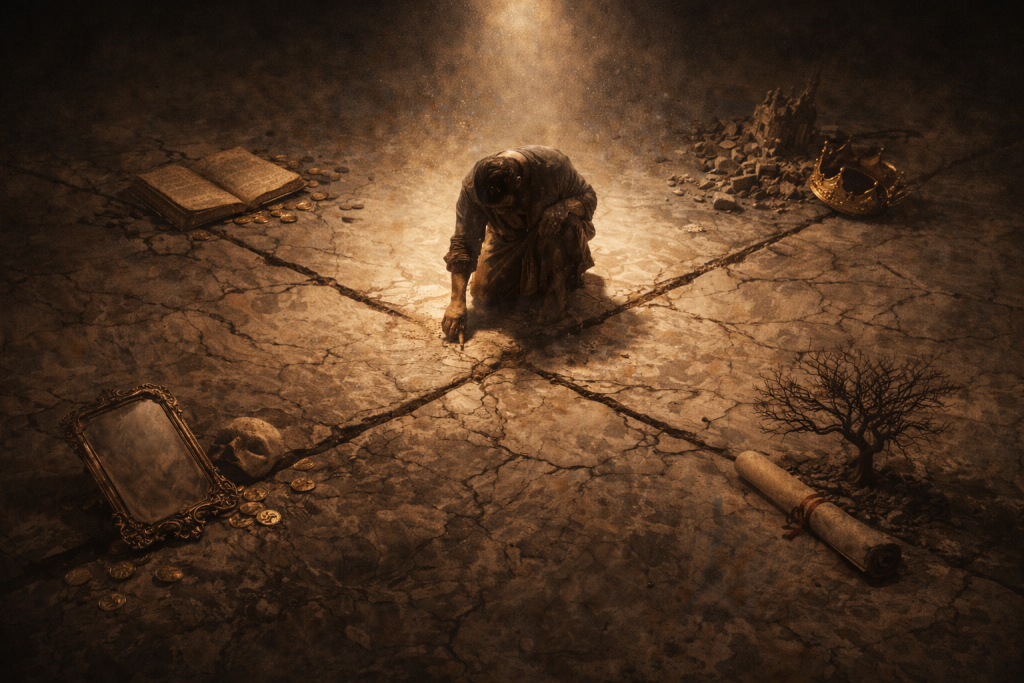
Three Diagnoses
Last week gave us three tableaus of a civilization coming apart.
In Munich, Marco Rubio called for renewing Western civilization. Sovereignty. Borders. Strategic coherence. Civilizational health as a recalibration problem. The West as machinery in need of tuning.
In Tehran, the Ayatollah Khamenei used the Epstein scandal to indict liberal democracy. The corruption wasn’t aberration, he said. It was the logical terminus of a rotting moral architecture. The West structurally compromised.
In Paris, Emmanuel Macron argued Europe needs strategic autonomy in a “world in disarray.” Defense independence. Economic resilience. Technological sovereignty. Western cohesion can no longer be assumed. It must be engineered.
Three men. Three political universes. All speaking the same language: diagnosis, structure, recalibration. The debate is no longer about values. It’s about architecture.
And that is the problem. Beneath all this rational discourse lies something none of them can name: a civilization that doesn’t know what it is. Are we a moral project? A geopolitical alliance? An economic system? A psychological inheritance? The answer changes with the audience, the polling numbers, the phase of the moon.
They are all, in their own way, trapped in the same room. They argue about the furniture, the wallpaper, who gets the best chair. They cannot see that they’re on the Titanic and the room has no windows.
The Divided Mind
Iain McGilchrist argues that the brain’s hemispheres attend to reality differently.
The right hemisphere apprehends the world as living, relational, embodied, whole. It encounters presence.
The left hemisphere abstracts, categorizes, measures, manipulates. It constructs representations.
Both are necessary. But they are not equal. The right is primary—the “master.” The left is emissary. It refines and executes what the right first apprehends. When this order holds, perception is grounded. The map serves the territory.
When the order reverses—when the emissary crowns itself master—abstraction detaches from life. The map becomes the territory. The part mistakes itself for the whole.
Western civilization increasingly shows signs of this inversion intensifying. The Builder (the emissary) has forgotten the Steward (the master).
The Original Misreading
The modern West insists it has moved beyond Christianity.
This is like a woman walking into her counselor’s office, announcing that she was abused as a child, and then insisting her trauma has nothing to do with that—it’s actually because her neighbors are loud. She can list every grievance against them. She has developed sophisticated theories about their behavior. She has built an entire life around managing her reaction to their noise.
But the counselor knows: until she makes the childhood wound conscious, until she stops projecting it onto the neighbors, she will never be free. She will simply find new neighbors. The pattern will repeat.
The West has done exactly this. It has taken the Christian structure of consciousness—the very frame that made possible its concepts of personhood, history, rights, and progress—and projected its wounds onto everything except the source. We blame the Enlightenment. We blame capitalism. We blame colonialism. We blame technology. And all the while, the original wound remains unconscious, driving the pattern.
Jung taught that making the unconscious conscious is the first step in healing. What is neurosis but a pattern that repeats because it cannot see itself? What is civilizational decline but a trauma projected outward onto every neighbor, every system, every scapegoat, while the original rupture remains unnamed?
The Lost Center series traced this. The center held for centuries because it was unconscious. Now it is empty, and we feel the absence without understanding what filled it.
But here is what the West cannot see: the Bible itself diagnoses the problem. The book of Genesis can be read as the story of the very perceptual shift that names our condition. We call it a fall, an exile, a punishment. But that is only the emissary’s interpretation of its own birth.
What really happened in that garden was the emergence of self-consciousness. The self was born, through the left hemisphere’s capacity for reflection. Their eyes opened. They experienced differentiation. They saw themselves for the first time as objects—naked—and they hid.
When God walks in the garden and calls, they do not come forward. They conceal themselves.
Watch the dramatic change in Adam’s perception of Eve:
Before the fruit: “This at last is bone of my bones and flesh of my flesh.” He recognizes her as part of him. Presence. Communion.
After the fruit: “The woman you gave me—she gave it to me.” He names her as he named the animals. Object. Transaction. Blame.
The text never says God withdraws love. It describes fear, shame, accusation. A reinterpretation. Awakening—the birth of self-consciousness, the very condition of freedom and love—is experienced as exile.
This is the original wound. Not differentiation itself, but the misreading of differentiation as rejection. The part that can stand back and observe becomes the part that feels cast out. Consciousness frames its own emergence as punishment.
From this misreading, four distortions emerge—four wounds that the Builder cultivates, scales up, and eventually mistakes for civilization itself.
The Four Wounds
1. Communion becomes transaction. Before the fruit, presence is immediate. Afterward, relationship becomes mediated by strategy. The other becomes object. Interaction becomes negotiation. Civilizations built on transaction can scale. But they struggle to love.
2. Trust becomes control. The serpent’s question—”Did God really say?”—introduces suspicion. Trust dissolves into vigilance. When trust collapses, control expands. Systems multiply. Safeguards accumulate. But control cannot generate the trust it replaces. The more it tightens, the more anxiety it creates. Babel’s tower is the archetype: a marvel of engineering that does not secure its builders.
3. Gift becomes achievement. The garden is given. After the rupture, life becomes toil. Worth becomes earned. Identity must be performed, validated, achieved. Rest feels irresponsible. Grace becomes unintelligible. A civilization organized around achievement can produce endlessly but cannot receive. Khamenei’s indictment lands because it names this: a system that has achieved everything and received nothing cannot believe in its own worth.
4. Wisdom becomes technique. Knowledge in the biblical sense is relational, participatory. Once abstraction becomes primary, knowledge detaches from reverence. Mastery replaces belonging. We know more than any civilization in history. We struggle to answer why knowledge should serve anything beyond power. Rubio’s “recalibration” is technique masquerading as wisdom. It assumes the problem is technical and the solution more technique. It cannot see that the problem is perceptual.
These wounds form a self-reinforcing loop. Transaction erodes communion. Control replaces trust. Achievement displaces gift. Technique overrides wisdom. The system becomes increasingly complex—and increasingly fragile. The left hemisphere cannot, by further abstraction, recover relational grounding. The emissary cannot crown itself master without distortion.
The Builder
In Jung’s psychology, the Ego is the organizing center of conscious life. Indispensable. But Jung distinguished the Ego from the Self—the deeper integrating totality that the Ego is supposed to serve.
The tragedy begins when the Ego mistakes itself for the whole. Jung called this inflation: the part identifying with the totality. The dollar thinking it is gold. Detached from the deeper ground, it turns inward, consumes itself. All it can see is itself, reflected in its own polished marble. It cannot, on its own, do anything different.
The Builder is this inflation institutionalized. And nowhere is it more visible than in our money.
The analytic faculty assumes sovereignty. It converts future into present purchasing power and calls it growth. Debt appears as expansion. But this is sovereignty borrowed from tomorrow. The Builder believes it’s enlarging its domain. In reality, it has colonized its own future. Every dollar in circulation is a claim on a future that hasn’t arrived—a promise that the Builder can keep building forever.
The same dynamic unfolds across layers:
The Ego forgets the Self.
The map replaces the terrain.
Representation replaces relationship.
Management replaces wisdom.
The civilization becomes brilliant—productive, optimized, technically astonishing. It can measure everything except the ground it stands on. This is not the failure of reason. It is reason untethered from the whole it was meant to serve. Reason as runaway servant, now giving orders.
The question is not whether the Builder is good or evil. It’s a tool. The question is whether it can remember what it was built to serve.
The Restoration of Hierarchy
If this diagnosis is correct, the solution cannot be moral reform within the same perceptual frame. More law, more control, more technique only intensifies the problem. The wound cannot heal itself because it mistrusts the very relational ground that would dissolve it.
The solution must be perceptual reordering. The left hemisphere must submit to and respond to the right. This is the sacred hierarchy—and ironically, it is the lost center of our civilization.
Enter Jesus.
He came into a world already dominated by the analytic, legal, systematizing consciousness—a world shaped by law, empire, text, hierarchy. Rome. The Temple. The Pharisees. The Builder in full flower.
And he embodied an entirely different mode of being.
Not anti-law. Not irrational. But right-hemisphere dominant in McGilchrist’s sense:
- relational
- metaphorical
- participatory
- non-coercive
- present
- integrative
He moves through the world relationally first. He restores before he regulates. He tells stories rather than constructing systematic treatises. He prioritizes presence over performance.
Communion before transaction: He eats with outcasts, touches lepers, restores Peter by asking not for performance but presence: “Do you love me?”
Trust before control: He refuses domination, sends disciples out with nothing, because trust—not control—is the mode of the kingdom.
Gift before achievement: He announces unearned favor. The workers hired at the eleventh hour receive the same wage. Grace offends the achievement-oriented mind.
Wisdom before technique: He teaches in parables—stories requiring participation, not analysis. The way is not mastered through study but walked through following.
This is not anti-rational. It is properly ordered. The right hemisphere governs. The left serves. The master reclaims priority. The emissary remembers.
And “being born again” is not merely moral improvement. It is a reorganization of consciousness. A shift in the center of awareness. A rewiring of how choice itself is experienced. If the fall was the misinterpretation of differentiation as abandonment, rebirth is the recognition that separation is not rejection.
What Went Wrong
So what happened?
The church became a Builder.
Within centuries of Jesus’s death, the movement that began with fishermen and parables became an institution of law, hierarchy, text, and control. The emissary reasserted itself. The master was honored in doctrine but displaced in practice. The very mode of being Jesus embodied was gradually replaced by systems about him—creeds, canons, councils, codes.
The church built its own tower. Marvelous engineering. Stunning architecture. Doctrinal precision that would have amazed the Pharisees. And somewhere along the way, it forgot that the kingdom is not a system to be managed but a presence to be inhabited.
We are living at the end of another 1700-to-2000-year tower. It is going to collapse. Not because God is punishing it, but because the Builder cannot sustain what only the Master can ground. The emissary’s towers always fall. Babel fell. Rome fell. Christendom fell. The latest iteration is falling now.
Exile Perceived
But here is what the Builder cannot see—and what changes everything.
Genesis is not the story of exile imposed. It is the story of exile perceived.
The garden was never locked. The gate was never guarded. The flaming sword was always in the eye of the beholder. What happened in that garden was a shift in perception—the birth of self-consciousness experienced as abandonment, differentiation interpreted as rejection.
We never left.
The garden is right here in front of us. The presence that filled Eden still fills the world. The communion that Adam knew with Eve is still possible—not as a return to innocence, but as a integration at a higher level. The self, fully formed, now free to choose presence over transaction, trust over control, gift over achievement, wisdom over technique.
The exile was never geographical. It was perceptual.
And if exile was a misperception, then return is not a journey. It is a recognition.
The Arc
Do you see it now? The massive arc of Western civilization?
Thesis: The garden. Presence. Communion. The right hemisphere governing unconsciously.
Antithesis: The fall. Differentiation experienced as exile. The left hemisphere assuming sovereignty. The Builder building. The emissary forgetting it serves a master. Four wounds scaling up to civilizational proportions.
Synthesis: The conscious return. Not to pre-conscious innocence—you cannot go back, and you should not want to. But to the proper hierarchy, chosen this time. The self, fully formed, having seen the emptiness of the Builder’s towers, now free to serve rather than dominate. The emissary, having learned its limits through the collapse of its own constructions, freely submitting to the Master.
This is what being born again actually means. Not regression. Not moral improvement. Not doctrinal assent. But integration at a higher level. The parts remembering the whole—not because they never left, but because they chose to return.
The enantiodromia is visible now. Thesis flipping into antithesis for two thousand years. Antithesis now reaching its extreme, beginning its long flip toward synthesis. The tower is collapsing. That much is written.
But here is the choice the Builder cannot see:
You do not have to be in it when it falls.
The Choice
What happened in that garden was a flip in the hierarchy of the hemispheres. It allowed us to become selves capable of loving a God who is himself Love. You could not love before differentiation. Love requires an other. The fall was the birth of the other—experienced as loss, but actually the condition of freedom.
Now you are a complete self. You have seen the sacred hierarchy. You have watched the Builder build and build and build, mistaking itself for the whole. You have felt the four wounds in your own life—transaction where there should be communion, control where there should be trust, achievement where there should be gift, technique where there should be wisdom.
And you have been given a choice.
You can stay in the room with no windows, arguing about the furniture with Rubio and Macron and Khamenei. You can keep recalibrating the machine, managing the collapse, developing sophisticated theories about why the neighbors are so loud.
Or you can step outside.
You can feel the sun on your face.
You can remember which way is East.
You can recognize that the garden was never lost—only misperceived. That the presence you have been seeking through achievement, through control, through transaction, through technique, has been here all along, waiting for you to stop building long enough to notice.
The tower will collapse. That is the arc.
But you do not have to be in it when it falls.
The garden is right here.
We never left.
The Drama You’re In is a profound labor of focus and independent thought. Every essay represents hundreds of hours of work—of reading, synthesis, and careful craft—offered freely and without ads.
If this series has reframed questions for you, if this perspective feels rare and necessary, then your support is what allows it to continue. Please consider sharing this publication with others, and if you are able, becoming a paid subscriber. Your support doesn’t just sustain writing; it sustains a necessary conversation.
You can become a paid supporter on Patreon, BuyMeACoffee, or Substack. Thank you for being here.
References and Further Reading
Below is a curated list aligned with your argument—phenomenology, civilizational theory, psychology, and hemispheric neuroscience.
Primary Conceptual Influences
- Iain McGilchrist. The Master and His Emissary: The Divided Brain and the Making of the Western World. Yale University Press, 2009.
- Iain McGilchrist. The Matter with Things: Our Brains, Our Delusions, and the Unmaking of the World. Perspectiva Press, 2021.
- Carl Jung. Aion: Researches into the Phenomenology of the Self. Princeton University Press.
- Carl Jung. The Archetypes and the Collective Unconscious. Princeton University Press.
Civilizational and Historical Diagnosis
- Oswald Spengler. The Decline of the West.
- Arnold J. Toynbee. A Study of History.
- Alasdair MacIntyre. After Virtue.
- Charles Taylor. A Secular Age.
Phenomenology and Orientation
- Edmund Husserl. The Crisis of European Sciences and Transcendental Phenomenology.
- Martin Heidegger. Being and Time.
Biblical and Symbolic Framework
- The Book of Genesis.
- Paul Ricoeur. The Symbolism of Evil.


