



A Three-Part Mini-Series — Part Two
“Come, let us build ourselves a city and a tower with its top in the heavens.”
— Genesis 11:4
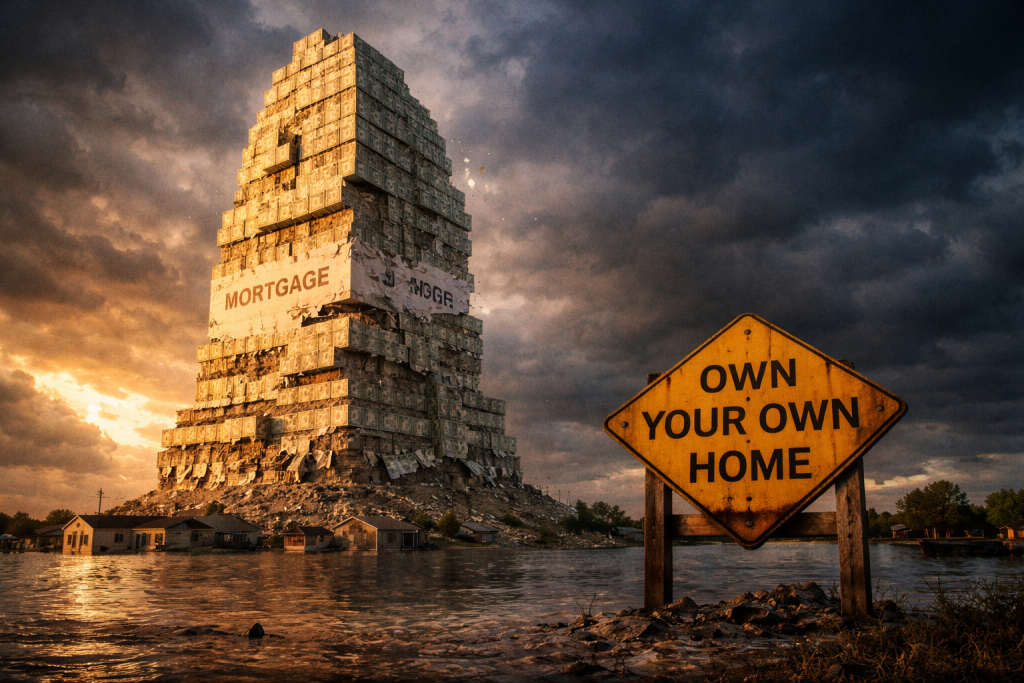
Every tower begins with a promise. People surrender tangible wealth—time, money, labor, health—in exchange for the promise of something greater.
This essay traces one of the largest towers of the modern era: real estate. We will examine what it is, how its value is determined, and how high the structure may already stand.
In Part One, we met the Builder.
“The Builder?” you ask.
The Builder emerges when left-brain analytic control takes command without submission to the right hemisphere’s relational intelligence. The right hemisphere sees the big picture: wholeness, relationships, presence, communion, being-with. The left hemisphere sees parts—observation, categorization, control—and cannot grasp the whole on its own.
These are not separate minds, but distinct tendencies within one mind.
So when we feel exposed, uncertain, or fragmented, the instinct is to build: a system, a framework, a tower, using the left brain’s tools of analysis, strategy, and leverage. It studies human beings not for communion, but for control. This is the Builder: analysis outrunning wisdom until control becomes the operating system, powered by fear.
This hierarchy cannot sustain wholeness on its own. The left hemisphere isolates and manipulates—necessary powers, but dangerous when raised above their proper place. Its corrective is submission to the right hemisphere’s broader vision: the capacity to perceive relationship, wholeness, and meaning.
The Builder’s first great project was Tower of Babel: an attempt to construct a permanent global monoculture, a world of pure coordination without communion. What it produced was not unity, but engineered uniformity. It ended in collapse, and from that collapse came diversification. But the Builder did not stop there. He built another tower, then another. Today he works through credit markets, federal policy, and the dream of homeownership. Real estate may be his greatest tower yet.
Every tower follows the same emotional arc:
Promise
↓
Delay
↓
Anxiety
↓
Forced Fulfillment
↓
Collapse
We see this pattern in the Old Testament and again in the markets that shape our world—from Tulip Mania to South Sea Bubble to Dot-com bubble—each a story of speculative mania built on borrowed confidence. The details change; the structure remains. It is as if human beings are trapped in a drama they cannot fully remember.
To understand the real estate tower in all its complexity, we must return to the moment the modern promise first took shape.
The Foundation: Architecture of Exclusion
Every tower begins with a promise. But before the promise of homeownership, there was a deeper structure—a foundation story about who belongs and who gets left out.
That story begins in Europe, in an age when Christianity shaped public life. In fifteenth-century Spain, a new rule appeared: limpieza de sangre—purity of blood. It meant that even if a Jewish family converted to Christianity, they could never be considered true Christians because of their ancestry.
This was more than social prejudice. It was a profound violation of Christianity’s own foundation. The gospel taught that Christ came for all people, and that through faith, repentance, and baptism a person became new. In Christian belief, the old self dies so that a new life can begin—not through bloodline, but through grace.
Purity of blood quietly overturned that claim. It said ancestry mattered more than conversion, inheritance more than faith, and family origin was something even Christ could not overcome.
What had once been a spiritual community began to harden into something closer to inherited rank. Here we see the Builder’s hand again: the impulse to secure order by sorting, defining, and controlling. A category first used to separate converts from “old Christians” became a pattern Europe carried forward into empire, law, and economics. Long before race became modern policy, the logic was already in place: some inherit legitimacy, while others may labor, conform, and even believe correctly without ever fully belonging.
“What does this have to do with real estate?” you ask.
Everything.
Because before housing became a market, it became a mechanism for deciding who would be allowed security.
That habit of sorting people by category—by ancestry, religion, race; by who belongs and who does not—crossed the ocean and became part of the American landscape.
In the early twentieth century, real estate developers introduced racial covenants: legal clauses written into property deeds stating that a house could never be sold to a Black family, and often not to other minorities as well. These restrictions were marketed to white homeowners as a way to protect property values.
Here again was the Builder’s method: turn fear into policy, policy into property, and property into profit. Long before the federal government became deeply involved in housing, the Builder was already at work, using private contracts to build a wall around the American dream.
The Inversion
After World War II, the old Protestant establishment loosened its hold, and groups once kept to the margins—especially Jewish Americans, Catholics, and other immigrant communities—moved into finance, law, media, and scholarship. The country needed these skills, and many Jewish communities had cultivated them through centuries of adaptation, literacy, and exclusion. By the 1950s and 1960s, Jewish professionals and leaders had moved from the edges of American life to the center of influence.
Along with that rise came ideas drawn from Jewish moral tradition, including tikkun olam—“repairing the world.” What had once been a religious duty was, in some modern circles, recast as confidence that institutions and policy might help mend what history had broken. It found a home in new federal programs, legal reforms, and massive housing developments.
A concrete example: the Federal Housing Administration had once drawn redlining maps to deny loans to Black neighborhoods. But in the 1960s and 1970s, it was repurposed for urban renewal and subsidized housing—the same bureaucratic machinery now used for inclusion. The real estate industry that had architected racial exclusion was now working with the government to manage who got loans and which neighborhoods got investment, all from the top down. It was inclusion, but on terms set by the state and the industry, and it was hugely profitable.
This was the hidden foundation beneath the famous promise of homeownership. A promise that, for a generation of Americans, felt like a dream come true. For the first time, owning a home became a goal for the many—a goal made possible by government-backed credit that, when paired with restricted supply, sent prices climbing. A whole generation started believing a house wasn’t just a place to live but the engine of family wealth.
This brings us to the beginning of the emotional arc we traced earlier: Promise → Delay → Anxiety → Forced Fulfillment → Collapse.
The Promise
A home of your own—stability, dignity, a stake in the country, and the promise that it will only grow in value.
“But what exactly gives a home value?” you ask.
Belief—mostly.
In nature, a house is shelter: useful, physical, and always decaying. Roofs age, materials weaken, systems fail. Real estate is not valuable to nature. Nature assigns no premium for ownership, status, or future resale. Once it is built, it immediately starts to decay and requires upkeep and maintenance.
Nature values based on supply and demand, not on some bogus theory that something always goes up.
Here’s the belief: real estate always goes up.
Here’s the illusion: real estate appears to go up because the value of currency is going down. On this illusion, the Builder constructed a promise.
The promise was simple: a home of your own. Not just shelter, but stability, dignity, a stake in the country.
In the 1920s, the “Own Your Own Home” campaign planted that idea. But when the Great Depression hit, the promise shattered. Foreclosures gutted cities and towns. The market, left to itself, had failed.
So the government stepped in to guarantee the promise, against nature. The New Deal created the Federal Housing Administration in 1934, which helped standardize the long-term fixed-rate mortgage and spread it nationwide by insuring loans against default. Banks could lend without fear; millions of Americans could buy with smaller down payments and predictable monthly payments.
For the first time, housing could expand nationally because risk had been separated from the local lender and absorbed upward into federal guarantees.
This was the promise: federally protected credit laid atop an inherited foundation of exclusion, now partially inverted but never fully removed.
A promise planted by the Builder, in his virtual garden, started to grow.
The Delay
For many, the promise is postponed—by redlining, by exclusion, by a system built to open the door slowly.
The Builder’s architecture of sorting ensured that the door would open for some long before it opened for others.
After World War II, the promise grew. The GI Bill guaranteed zero‑down‑payment mortgages for millions of returning veterans. Suburbs exploded. The American middle class—largely white and legally walled off from Black families—began to build equity. For them, the promise was real. For everyone else, it was delayed—indefinitely.
But delay isn’t just about who gets left out. It’s also about the gap between what a system promises and what it can actually deliver.
Through the 1950s and 1960s, housing was treated as a social good, but the financial machinery was mostly local. Banks held onto the loans they made. They had a stake in the borrower’s success. The system was stable, but it was also limited. It couldn’t grow fast enough to satisfy the ambition it had unleashed.
Then came pressure to make good on the promise for all Americans. The Fair Housing Act of 1968 outlawed discrimination, and new programs like Section 235 and 236 offered subsidized mortgages for low‑income families. The government was now using housing credit not just to promote stability but to push social policy forward. The delay—the long era of exclusion—was supposed to end. But ending it required more than law. It required the financial system to produce more credit than it had ever safely carried.
Anxiety
Inflation, deregulation, and the fear that the economy can no longer grow without ever‑expanding credit.
By the 1970s, anxiety began to crack the surface. Inflation soared. The savings‑and‑loan industry, which had funded most mortgages, was trapped: it held long‑term, low‑interest loans but had to pay high interest rates to depositors. The system was breaking.
But something bigger was also happening. In 1971, President Richard Nixon ended the dollar’s formal convertibility into gold. The currency was now anchored less by metal than by state credibility, productive capacity, and global confidence. The economic promise became more abstract, more dependent on confidence than constraint. When money became more abstract, asset prices often did too.
What followed was a long experiment in sustaining prosperity through credit. Debt became the engine. Leverage became the strategy. The financial sector, once a utility for moving real value, became a machine for generating fees, bonuses, and paper wealth. Regulations were peeled away. Banks grew too big to fail. The gap between work and reward, between production and profit, between Main Street and Wall Street, widened into a chasm.
Deregulation followed. In 1980, Congress began phasing out interest-rate ceilings on deposits. In 1982, the Garn–St. Germain Depository Institutions Act allowed adjustable‑rate mortgages, balloon payments, and other products that had been illegal for a generation. Once again, the Builder was rewriting the rules: what had been stable became flexible; what had been constrained became unmoored. The old, stable system was dismantled in the name of flexibility.
But the deeper anxiety was political. Housing increasingly became a shock absorber: a sector where cheap credit could sustain growth even when deeper fiscal and industrial problems remained unresolved. The government had effectively turned real estate into a sponge—a vast, expandable asset class that could soak up cheap credit and postpone the consequences of poor fiscal management. When the savings‑and‑loan crisis hit in the late 1980s, the government bailed out the industry at a cost of over $120 billion. The message was clear: housing was too big to fail.
Then came the next leap. Fannie Mae and Freddie Mac—the government‑sponsored companies that buy mortgages and package them for investors—were placed under new “affordable housing” mandates in 1992. Wall Street, meanwhile, had perfected securitization: the practice of chopping up mortgages into bonds, rating them, and selling them to pension funds and foreign governments.
The anxiety was channeled into a single idea: we must expand homeownership at all costs, because it’s the only way ordinary people can build wealth, and the only way the economy can keep growing.
Forced Fulfillment
Lending standards collapse, cheap money floods in, and homeownership is pushed to those who were never meant to borrow.
The forced fulfillment of the housing promise happened in the early 2000s. After the dot‑com bust, the Federal Reserve, led by Alan Greenspan, slashed interest rates to historic lows. Money became nearly free. Lenders, increasingly detached from the long-term risk of the loans they originated, loosened underwriting dramatically. No‑income, no‑asset loans. Adjustable rates with teaser payments. Interest‑only products. The industry called them “innovations.” In truth, they were tools of forced fulfillment—a way to extend credit deeper into riskier households because the system now rewarded loan volume more than repayment quality.
Houses physically depreciate; roofs age, walls crack, systems wear out. But because the population was growing, and we had access to cheap energy and labor, what would normally be a liability was transformed into a financial asset. Real estate shifted from shelter to investment—not because the physical properties changed, but because people believed the promises made about them, defying natural law.
This was the moment when real estate became visibly detached from its physical limits. The structures still aged, but the price increasingly obeyed credit conditions rather than material reality.
The government and private finance had become deeply intertwined: public guarantees, monetary policy, and private securitization were now pushing in the same direction. Affordable housing quotas, the implicit government guarantee of Fannie and Freddie, the Fed’s relentless cheap money—all of it pushed the system toward a single outcome: more lending, more buying, more debt. Real estate became the primary sponge for the nation’s expanding balance sheet. Every recession was met with lower interest rates and more housing stimulus. The promise was now being forced into existence by any means necessary.
From 2001 to 2006, Americans watched house prices double in many markets. Flipping homes became a national pastime. The story was that real estate always goes up. It was an exaggeration treated as certainty—and that certainty was amplified by both policy and finance.
Here we see the Builder’s long game. Housing was no longer organized mainly around shelter, but around control through debt. By turning real estate into a debt sponge, he ensured that millions would be bound to the system—unable to default without catastrophe, unable to walk away without losing everything. Homeownership became a golden handcuff. The promise of stability became the engine of dependency.
Collapse (Act One)
The bills come due, the cascade begins, and the tower shudders—but does not fall.
Then the lie met reality. When interest rates began to rise in 2005 and 2006, those adjustable mortgages reset. Payments ballooned. Defaults spread first through the weakest loans, then outward through overheated markets. The cascade was swift. By 2008, the entire global financial system was frozen. The very securities that were supposed to spread risk had instead concentrated it, and no one knew who held the toxic paper.
The collapse of 2008 was real, but it was only the first act.
The government’s response wasn’t to let the tower fall. It was to prop it up. Fannie Mae and Freddie Mac were taken over by the federal government in 2008—not fully nationalized, but close. The Fed began buying trillions in mortgage-backed securities through quantitative easing, directly supporting mortgage liquidity and asset prices. Interest rates were pinned at zero for seven years. The message was unmistakable: housing would be prevented from fully liquidating.
What would a genuine resolution have looked like? Prices falling until they aligned with rents and incomes, banks absorbing losses, and housing returning to its function as shelter rather than speculative asset. Instead, the opposite happened.
The debt sponge would not be wrung out; it would be expanded. A full liquidation would have meant letting home prices, bank balance sheets, pension exposure, and public confidence fall together—politically almost impossible.
Then Wall Street did something new. When individual buyers fled the collapsed market in 2010 and 2011, large institutional investors—Blackstone, Invitation Homes, and others—stepped in, aided by cheap financing in a market stabilized by federal intervention. Single-family housing—the old anchor of middle-class security—was now openly treated as an asset class for private equity and institutional investors.
We Are Still in the Tower
This is the part that usually gets left out of the history. Today, Americans carry mortgage debt measured in the tens of trillions of dollars—an amount so large it now rivals major national balance-sheet categories. We think of 2008 as the collapse and the years since as a recovery—but we haven’t recovered. We’ve simply been living in the upper floors of a tower that never came down.
In many major markets, inflation-adjusted home prices have returned to or exceeded bubble-era peaks. Rents have exploded. Homeownership rates for young people have fallen off a cliff, while corporate landlords own a growing share of single‑family homes. The government still guarantees the vast majority of new mortgages. The Fed still holds trillions in mortgage bonds on its balance sheet. The system that was supposed to crash in 2008 was instead fortified.
So the reason real estate is still up isn’t natural supply and demand. It stays high because three forces now reinforce each other: institutional investors buying up homes, limited new construction, and government policy that keeps credit cheap and guarantees loans. Financial markets operate within a system heavily shaped by central bank policy and federal guarantees. The promise of homeownership has been replaced by the financialization of shelter. The sponge has been supersized.
Real estate is not the only sponge. The dollar itself is a promise backed by government debt. Treasuries are promises on top of promises. Bitcoin and other crypto assets are promises anchored mainly in network belief rather than state backing. Taken together, they form an ecosystem of debt, each propping up the others. When one sponge gets squeezed, they all feel it.
We haven’t experienced the final collapse—we’re living in the delay before the second act. The emotional arc—promise, delay, anxiety, forced fulfillment, collapse—hasn’t completed its cycle. We’re somewhere between forced fulfillment and collapse, having mistaken a government‑engineered rescue for a genuine resolution.
In the past, population growth and cheap energy made the illusion sustainable. But today, population is slowing, and energy is neither cheap nor abundant. The natural supports are giving way, yet prices keep rising. That’s how you know you’re in a tower, not on solid ground.
The Builder’s logic depends on inattention.
Systems endure longest when people mistake engineered stability for natural permanence.
He studies you, tests you, and builds systems that turn your hopes into his leverage. But seeing is the first thing he cannot afford. Once you see, you are no longer just another unit in his machine.
The question is not whether the tower will fall, but how long belief can postpone it. A tower is built on a promise—and a promise is only as solid as the belief that sustains it.
If you remember one thing from this essay, make it this: Towers rarely collapse when everyone expects them to. They collapse when confidence quietly becomes more expensive than doubt.
Next in the series: Part Three — The Naked Emperor
What the dollar, the stock market, crypto, and AI have in common—and why the Builder’s greatest fear is not collapse, but being seen naked.
If this work matters to you, please consider sharing it with others. For those able to support my research and writing, paid subscriptions are available on Patreon, BuyMeACoffee, or Substack. Your support doesn’t just sustain me; it sustains a rare and necessary conversation, especially now.
Thank you for being here.


