



How the Left and Right Are Trapped in the Same Mental Loop
“The line separating good and evil passes not through states, nor between classes, nor between political parties either—but right through every human heart.” — Aleksandr Solzhenitsyn, The Gulag Archipelago
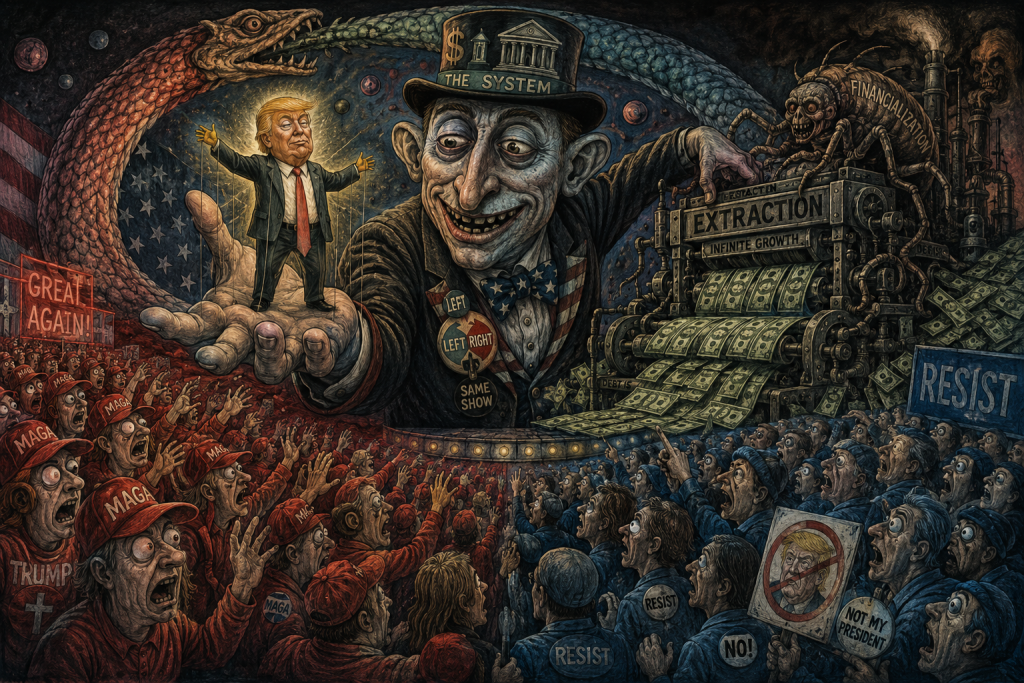
American politics has become bipolar. Both poles organize themselves around a single figure: Donald Trump. The right defines itself as his defenders, interpreters, and intellectual vanguard. The left defines itself as his opponents, resisters, and prosecutors. Both need Trump to exist as hero and villain. They orbit in the same mental loop.
The intellectual architecture of Trumpism has three tiers. At the top are the thinkers who produce the ideological raw material—the books, narratives, and philosophical justification for the movement. The Claremont Institute offers a Straussian critique of a corrupted American founding. The Postliberals argue that liberalism itself has failed and must be replaced by a Christian common good. The National Conservatives defend the organic nation-state against globalist erosion. And the Prometheans believe Britain is the hidden empire, Trump is the liberator, and America is the victim.
These thinkers disagree on many things. But beneath their differences, they share a deeper structure: they all identify an enemy, claim victimhood, position themselves as the righteous remnant, and point to Trump as the instrument of salvation.
Below the thinkers are the policy shops—organizations like the Heritage Foundation and the America First Policy Institute that translate intellectual raw material into actionable policy blueprints and personnel pipelines. They are the bridge between ideas and the levers of power. Below them is the grassroots movement—groups like the Conservative Partnership Institute and Turning Point USA that organize activists, train candidates, and build the infrastructure of political mobilization.
The Prometheans are a special case: they function as both a thinker and a grassroots movement organization through Promethean Action and Promethean PAC. This dual role makes them uniquely effective at bridging the gap between ideology and action.
This architecture is why the right’s movement is durable—it has institutional memory, intellectual firepower, and a pipeline to power.

Now look at the opposition. The left has no such architecture—at least, not one that coheres around a positive vision. It has think tanks, journals, and organizing networks, but they are often at war with each other, and united primarily by opposition to Trump rather than by a shared project of world-building. The right has built a cathedral; the left has built a protest camp.
The left believes the solution to all our problems is to get rid of Trump. The right believes the solution to all our problems passes through Trump. For both sides, Trump is the organizing principle. The right rallies around him; the left mobilizes against him. Both are dependent on him for their identity and salvation.
The Pattern
This thinking and behavior feels new, but it isn’t. It is the oldest blueprint in the history of the world: the Fall.
In Genesis, humanity eats from the Tree of the Knowledge of Good and Evil. Immediately afterward, the man blames the woman, and the woman blames the serpent. He externalizes his failure, and it becomes a template for future civilization.
This story is not about fruit or snakes. It is about what happens when we choose knowledge over relationship—and what that does to our minds. For all of human history, we have been organizing reality around binary categories—good and evil, us and them, victim and oppressor, hero and villain.
This story of the Fall represents a truth about our consciousness. As psychiatrist Iain McGilchrist has shown in his landmark work, The Master and His Emissary, the left and right hemispheres of our brain represent fundamentally different ways of experiencing the world. The left hemisphere abstracts, categorizes, and manipulates; the right hemisphere grasps wholes, relationships, and context. The Fall is the story of this inversion—the left brain took the lead. Analysis severed from relationship.
Both hemispheres are necessary for survival in conscious life, but they are not equals. The right hemisphere is meant to lead the left.
Why must the right lead? Because it apprehends the living whole—reality as it genuinely is—and that perception comes first. McGilchrist argues this is not a mere preference but a necessity: the left brain exists to serve that primary vision. The left dissects reality into parts, analyzing, categorizing, and manipulating fragments. It is a masterful instrument, yet still an instrument—one that must aid the whole.
This hierarchy is not arbitrary. It is woven into the structure of being. The whole precedes the parts. Relationship precedes categories. Presence precedes analysis. The right brain sees the forest; the left brain counts the trees.
When the left brain operates in service to the right, it is a gift—the ability to build, create, and navigate the world with precision. But when the left brain severs its connection to the right and claims supremacy, it ceases to perceive the living whole. It sees only fragments, categories, and systems to be controlled. It becomes the Serpent—the figure in Genesis who offered knowledge outside of relationship—analysis without love, power without wisdom.
The left brain can lead in moments of crisis—when quick analysis is needed, when the map must be consulted, when the emissary must act on behalf of the master. It also plays a crucial role in the development of Self: the left brain helps us distinguish ourselves from the world, build identity, and navigate the social order. But it was never meant to lead permanently. When it does, we lose sight of what we are navigating for. The map becomes the territory—we mistake our categories for reality itself. The servant forgets who sent him.
The tragedy of modernity is that we have allowed the servant (the left brain) to replace the master (the right brain) far too long. This isn’t just about politicians. It’s about how you’ve been trained to see the world—and how that training keeps you trapped.

This is not just an abstract theory. It plays out in our politics every day.
When it comes to politics, here’s what most people aren’t seeing: both the Republicans and the Democrats are expressions of this same left-brain pattern. The Republicans believe the system is corrupted and have built an intellectual architecture to change it. The Democrats believe the system was fine until Trump contaminated it. Both sides identify an enemy. Both claim victimhood. Both point to a hero who will save them. The story is the same—only the names change.
Every faction in this essay follows the same script—each has its own villain, its own victim, its own hero. The common denominator is blame. Like Adam and Eve, none of them blame themselves. None of them see the system they are caught up in. To see this pattern at work in its purest, most distilled form, consider the most overlooked faction within the Trump coalition: the Prometheans.
Who Are the Prometheans?
Every mass political movement has its public faces and its behind-the-scenes thinkers—the people who supply the ideas that drive the movement forward. Within Trump’s coalition, a smaller, more ideologically focused faction sees itself as the movement’s intellectual core. They call themselves the Prometheans.
Operating through two organizations—Promethean Action and Promethean PAC—this group traces its origins to Lyndon LaRouche, a fringe political figure who ran for president multiple times. After his death, some of his former allies rebranded as the Prometheans and turned their full attention to supporting Trump.
The group’s leading voices are Barbara Boyd and Susan Kokinda. Boyd is the PAC’s treasurer and its main writer. Kokinda is a longtime organizer based in Michigan. Together, they host regular online talks that have accumulated over 2.5 million views.
The story they tell is simple but dramatic. They believe America is caught in a battle between the “American System”—a tradition of industry, manufacturing, and national independence—and the “British Imperial System,” a hidden network of global financiers that has secretly manipulated world events for centuries. In this telling, Trump is a revolutionary figure chosen to break the hidden empire’s grip.
From this story, followers draw a series of beliefs: the 2020 and 2024 elections were stolen, international organizations are tools of foreign control, and Trump’s tariffs and economic nationalism are deliberate moves to dismantle the “Deep State.”
Most Trump supporters have probably never heard of Barbara Boyd. But the Prometheans matter because they supply the overarching narrative that helps supporters make sense of Trump’s actions and their own frustrations.
The Promethean Narrative
The Promethean narrative tells of a villain (Britain) and a hero (Trump) who is fighting to free you from a hidden empire that’s not the USA. They present many facts that are real.
But here’s the problem. The story they tell—an arrangement of history and facts—is weaponized to conceal a larger truth.
History tells us that since 1944, the U.S. dollar has been the world’s reserve currency. Governments hold dollars, not pounds. The Federal Reserve—not the Bank of England—creates the money that inflates asset values and erodes purchasing power. Wall Street, not the City of London, now consumes a staggering share of corporate profits. This is financialization, and its purpose is extraction.
Think about this. If Britain has been controlling the United States and the world as the Prometheans say, then America was never independent in the first place. We’ve been celebrating a fiction every 4th of July. While this doesn’t make much sense, what does is that Britain simply relocated the extraction machine to America.
Perhaps Britain was shoved aside. Perhaps it stepped down willingly. The point is: it doesn’t matter. What matters is who runs the financialization machine that extracts wealth from you and me today. The United States of America is the primary architect and beneficiary of the current financialization extraction system. If Britain is involved, then it’s a subsidiary.
Financialization turns a nation’s entire asset base—its land, resources, infrastructure, future income—into debt, sold off to a concentrated group of bondholders. Imagine you own a house. Financialization is taking out a mortgage, then another, and another, until one day you realize the bank owns it. That is what financialization does to a nation. The public becomes the debtor. The bondholder becomes the true sovereign, until it breaks and then the real power belongs to those holding physical gold.
To continue extracting with this level of debt—almost $40 trillion—the U.S. government must convince its own people that they are victims of an empire it’s fighting against, not running. That is projection. When people feel economic anxiety, the instinct is to find an outside enemy to blame. It is easier to point at a distant power than to look at the institutions we control. Blaming Britain is clean. It spares supporters the discomfort of recognizing that Wall Street and the Federal Reserve—American institutions—are the real engines of extraction.
But the Prometheans do more than blame; they distract you from the reality and consequence of financialization. Consider the “Trump Highway” in Morocco—a 1,055-kilometer road through Western Sahara. Morocco paid for the $1 billion project. Construction began in 2015, years before Trump’s presidency. The naming was a political thank-you for Trump’s December 2020 decision to recognize Morocco’s claim to Western Sahara, breaking decades of U.S. neutrality.
Watch how the Prometheans present the highway as “American development instead of British extraction”—proof that Trump is finishing what Roosevelt started. Wait a minute, Morocco paid for it and Morocco benefits. The U.S. didn’t build it, and Trump didn’t fund it. While you’re looking at Trump’s name on a road in Africa, you are not looking at inflation, the national debt, the Federal Reserve’s balance sheet, or the transfer of wealth from wages to assets. The Prometheans point at the road and say, “See? The system is changing.” But the system continues to extract.
The same pattern holds for Iran. The Prometheans note that Trump’s strategy differs from the Iraq War in some respects. But the “one military goal”—deny Iran a nuclear weapon—is a distraction. The real objective is maintaining the petrodollar system—the arrangement where oil is priced in dollars, forcing nations to hold U.S. currency—which is what keeps the dollar dominant. This ensures that any nation which challenges the dollar’s dominance in global oil pricing learns the cost. Just as the Iraq War was sold as “disarming Saddam” while the real objective was securing oil, the Iran conflict is sold as “preventing nukes” while the real objective is defending the architecture that keeps the extraction machine afloat.
The Promethean narrative takes real frustration—job losses, shrinking wages, generational anxiety—and redirects it toward a foreign bogeyman. It promises a fix that requires no systemic change, only a change in leadership. But a narrative that blames the wrong enemy is not a solution. It is a sedative, so the extraction can continue until the patient wakes up.
Myth and Manipulation
The Promethean narrative works because it taps into two things: myth and manipulation. Let’s start with the myth. The name itself is the first clue.
In Greek myth, Prometheus was a Titan who defied the gods by stealing fire and giving it to humanity. He is a rebel, a culture hero, a protector of mankind—but also a sophist and a trickster. “Prometheanism” represents faith in human agency, the belief that we can master our own destiny. It is the archetype of pride, of human will asserting itself against the gods.
For a nation with a Christian history, this presents a profound contradiction. The Promethean says, ‘I will ascend to heaven, I will make myself like the Most High.’ The Christian says, ‘Not my will, but Thine be done.’ Most Prometheans are likely unaware of the theological implications. They see the rebel; they miss the warning.
Mythological archetypes work on the human mind at a level deeper than logic. The Prometheus archetype triggers unconscious associations—rebellion against tyranny, the gift of knowledge, the defiance of unjust authority. These bypass the rational mind and speak directly to the emotional brain.
This is how narrative pre‑empts logic to shape perception—a systematic “engineering of consent,” as Edward Bernays called it. He grasped a pivotal truth: the masses needn’t be deceived, merely guided toward a chosen conclusion using real facts, strategically sequenced. The most potent psychological operations are not lies, but weaponized truths. The Promethean narrative supplies verifiable facts—coups, documents, names—and arranges them to steer you toward the operator’s intended endpoint, rather than the unvarnished whole.
This is a perfect expression of the left-brain pattern we have already seen—the pattern of blame, binary opposition, and heroic salvation that began with the Tree of the Knowledge of Good and Evil. It operates through four mechanisms of manipulation that keep followers locked in the loop:
Projection (moral and emotional). The narrative accuses Britain of running the global financial system, but since 1944 the United States has been the primary beneficiary. By blaming Britain, the narrative allows Americans to feel like victims rather than citizens of an empire. The sins of empire are projected outward so you do not have to look inward.
Distraction (attentional and cognitive). The narrative offers a mesmerizing story—names, dates, secret networks. While the follower decodes the hidden hand of the City of London, they are not looking at the Federal Reserve’s balance sheet, the national debt, or the transfer of wealth from wages to assets. The narrative is endlessly fascinating; that is the point.
Hero Worship (identity-based and tribal). It casts Trump as the hero “ending the game” while his opponents are the villains “playing the game.” You choose sides and stop questioning the system entirely. Your identity becomes wrapped up in the hero’s success.
Misdirection (epistemic and logical). It presents itself as “naming the enemy correctly” while pointing at a decoy. The enemy is not Britain; it is financialization—a system the U.S. built and still runs. By naming the wrong enemy, the narrative makes you feel like you have found the truth, when in fact you have been directed away from it.
Projection cleanses your conscience. Misdirection hands you the wrong map. Distraction exhausts your attention. Hero Worship consumes your identity. Together they form a closed loop, but their entry points—guilt, focus, ego, and logic—are entirely distinct.

Thus we return to the closed left-brain loop of good and evil—a binary prison where the hero requires the villain, the victim the oppressor, and the righteous the damned. This circuit feeds upon itself, spinning without end, barring the follower from ever stepping outside to perceive the system whole.
This is psychological inoculation at work. Convinced that Trump is heroically dismantling the old order, the follower will interpret a debt crisis, a collapsing dollar, or an economic crash not as systemic failure, but as the necessary birth pangs of a new world. They embrace their own devastation because they have been told it is prerequisite to salvation.
The Root of the Problem
But the story of the Fall holds more than just the template of blame and binary thinking. It holds the neurological blueprint for how we got trapped in this forest of ideologies—and the key to finding our way out.
Before the Fall, Adam did two things. First, he named the animals—analysis, categorization, language. This is left-brain work. Second, he recognized Eve as “bone of my bones and flesh of my flesh”—relational, holistic perception. He saw her as part of himself. This is right-brain work. Adam had both left-brain and right-brain capacity.
Eve, too, used both capacities, though in a different way. She saw the fruit holistically. It was good for food—sensory evaluation. It was pleasing to the eye—aesthetic perception. And it was desirable for wisdom—not just knowledge, but the integration of knowledge with meaning and ethics. She was seeking wholeness, demonstrating her right brain intelligence.
The Serpent was something else entirely. It asked a question not to understand, but to entrap. “Did God really say…?”—planting the seed of distrust before the argument even began. It offered an alternative narrative that contradicted God and framed divine protection as divine jealousy—exactly the pattern the Prometheans reproduce. It had no relationship, no connection, no humility—only analysis weaponized. The Serpent was pure left-brain cognition, operating without the right brain’s guidance.
This is not merely ancient poetry. It is exactly what McGilchrist identifies as the left hemisphere’s fatal flaw: when it operates without the right hemisphere’s guidance, it ceases to perceive the living whole and instead seeks to dominate, manipulate, and reduce everything—including God—to a system to be controlled.
What inverted the hierarchy was not the eating of the fruit—it was the choice. Knowledge is not bad for us, unless we pursue it outside of relationship. Eve chose knowledge outside of her relationship with God. She chose to forsake the relationship for the knowledge.
That decision flipped the hierarchy. The servant became the king. Left-brain analysis, detached from right-brain relationship, became the dominant mode. McGilchrist argues that this inversion—the servant ruling the master—is the defining pathology of Western modernity. We have built our politics, our economies, and our technologies on this broken foundation.
The problem is not the trees—the individual ideologies we fight over. Nor is it merely the forest—the ecosystem of conflict that dominates our politics. The problem is the soil: inverted hemispheric hierarchy. Left-brain analysis severed from right-brain relationship. Categories without connection.
Knowledge outside of relationship becomes domination. A civilization run by half a brain.
The Tree of the Knowledge of Good and Evil is not just an ancient story. It is the living architecture of the present—the cognitive structure that produces every ideology, every political faction, and every system of extraction that feeds on human life.
From that inversion, everything else followed. The Tree produced fruit, fruit made seed, and seed grew into a dense forest. Today we live inside that forest, but we can only see individual trees. Trumpism is one of those trees, just as progressivism, nationalism, globalism, liberalism, and conservatism are others. Each claims to explain reality, each points to a different enemy, and each asks us to eat its fruit—but none asks us to examine the soil from which they all grow.
We see the map, but not the territory.
The Illusion of Choice
Trump’s role is not merely that of a hero fighting the old system. He serves both the old and the new—which is exactly what makes him the perfect gatekeeper for the transition. His Iran policy serves the old system (maintaining the petrodollar). His family’s business ventures and foreign real estate deals serve the new system (positioning for the post-dollar world). This is not a contradiction. It is a hedge.
Do you see the contradiction? Trump profits from the old system while promising to dismantle it. His brand, his deals, his name—all are products of the very financialization he claims to oppose.
The “American System” and the “British Imperial System” are not different opponents; they are the same extraction machine viewed from different angles. Whether managed from London or Washington, the endpoint is total financial dependency, the erosion of sovereignty, and the replacement of citizenship with consumption.
This machine operates through a predictable playbook: legal manipulation, de-industrialization, inflation, propaganda, and institutional coercion.
The state created the Federal Reserve. It signed NAFTA—the trade deal that shipped millions of manufacturing jobs overseas. It deregulated banking. It bailed out the banks in 2008 and again in 2020. It now spends over $1 trillion a year on interest payments alone—more than the entire defense budget. The state cannot fix what it created. It cannot reform its way out of financialization, because it is financialization.
The left’s proposed solutions—more regulation, higher taxes, a Green New Deal—are not solutions. They are adjustments within the same system. The right’s proposed solutions—tariffs, nationalism, a return to the “American System”—are also adjustments within the same system. Both sides are offering you a choice between two wings of the same burning building. Neither is offering you a way out.
The Way Out
The system of extraction works by making you feel powerless. It tells you that the only choices are between empires and politicians, that your fate is in the hands of forces beyond your control. But that sense of powerlessness is itself the trap. The forest is not locked from the outside. It is locked from within. We are caged by the very categories we use to navigate the world.
The key to escaping is not more analysis, more blame, more strategy. The left brain built this cage—this forest of binary oppositions. The right brain must lead us out. The right hemisphere sees wholeness, connection, and paradox. The way out is to restore the original order: the left brain was meant to serve the right brain, not the other way around.
The Master and His Emissary shows us that the emissary (the left brain) was never meant to lead; it was meant to serve the master (the right brain). Reversing that inversion is the great work of our time—not through conquest, but through surrender to a larger reality.
The enemy is not Britain. Not Trump. Not the Democrats. Not liberalism. Not globalism. These are just different masks on the same system—financialization, a machine that extracts wealth from the real economy and transfers it to the elite. The United States is not its victim. It is its primary architect and beneficiary. Until you see that, you are not fighting the system. You are fighting its decoys.
Seeing the system is not enough. You must also act. The way out is active refusal—the decision to stop feeding the machine and start building something else. This is right-brain work:
Start local. This is not feel-good advice; it is strategic. Local economies are resilient because they are relational. A farmer who knows your name is harder to replace with a supply chain. A business that relies on your patronage is accountable to you. These are not just transactions—they are bonds. And bonds are what the extraction machine cannot replicate or replace.
Support real education. The extraction machine requires a workforce that cannot build, fix, or grow anything for itself. Apprenticeships, journeyman programs, and hands-on trades create a population that can survive outside the system. A society of competent, self-reliant people is harder to extract from because it has less need of the system’s services.
Reject consumerism. The economy of extraction depends on endless consumption—the belief that happiness is purchased rather than built. Buy less, buy better, and learn to distinguish need from manufactured desire. Each purchase made consciously is a vote against the system of planned obsolescence.
Align your savings with your values. Do not invest in companies that extract, pollute, or exploit. Invest instead in local credit unions, community land trusts, regenerative agriculture, renewable energy, and cooperative businesses. Do not keep your savings in cash—cash is debt, a promise from the government backed by nothing but faith in the system. Gold is real. Park your wealth in things that exist outside the debt system: land, tools, and physical gold. As the World Gold Council’s 2026 survey shows, central banks are doing exactly that—accumulating gold as a hedge against a debt-addled world. Held in your own hand, gold carries no counterparty risk.
Simplify your life. The attention economy is the extraction machine’s newest frontier—it harvests your time, your focus, and your capacity for independent thought. Unplug from algorithms that profit from your distraction. The right brain craves silence, presence, and real connection—not endless scrolling. Give it what it needs.
These are small steps, but they are real steps. They are not a political program. They are a way of life. It is the slow, quiet work of building a world that does not require extraction to survive. It is the decision to do what Adam and Eve could not: look inward, take responsibility, and serve something real.
The system demands your loyalty, your labor, your attention, your hope. It wants you to keep watching the magician’s left hand while the right hand works. But you can choose otherwise. You can turn away and serve something real. Your family. Your land. Your community. The people right in front of you. The work that needs doing. The life that is yours to live, not theirs to extract.
Your right brain already knows how to do this. It knows how to connect. It knows how to care. It has been waiting for you to let it lead.
The line separating good and evil passes not through states, nor between classes, nor between political parties—but right through every human heart.
That is the oldest truth of all. And that is where the real battle is fought—not in Washington, not in London, not in any of the stories you have been sold. It is fought inside your mind daily. Now.
Sources
Bernays, Edward. Propaganda. New York: Horace Liveright, 1928.
“A Clean Break: A New Strategy for Securing the Realm.” Institute for Advanced Strategic and Political Studies, 1996.
Federal Reserve. “Factors Affecting Reserve Balances.” Weekly balance sheet data. 2025.
McGilchrist, Iain. The Master and His Emissary: The Divided Brain and the Making of the Western World. New Haven: Yale University Press, 2009.
Project for the New American Century. Rebuilding America’s Defenses: Strategies, Forces, and Resources For a New Century. September 2000.
Promethean PAC. “Introducing Project Prometheus: Make the Leap to the Future.” 2024.
Solzhenitsyn, Aleksandr. The Gulag Archipelago. New York: Harper & Row, 1973.
U.S. Treasury. “Debt to the Penny.” Fiscal Data. August 1, 2025.
U.S. Treasury. “Monthly Treasury Statement.” Interest on the Public Debt. July 2025.
World Gold Council. Central Bank Gold Reserves Survey 2026. June 2026.
If this essay resonated with you, consider supporting my work through Patreon, BuyMeACoffee, Substack. And if you have thoughts, questions, or opportunities to collaborate, I’d love to hear from you. Thank you for reading.



 “Outstanding, sophisticated, and mesmerizing…a spiritual intrigue similar to Dan Brown’s The Da Vinci Code.” —ForeWord Reviews