



“And no marvel; for Satan himself is transformed into an angel of light.” — 2 Corinthians 11:14
I have always been packed full of curiosity, and I have always prayed that God would answer my many questions, bring clarity to the things I had difficulty understanding, and reveal the logic beneath what seemed to have none.
Recently, I received some answers. But what I have come to see weighs heavily. Not only because of what it means for my own life and family, but because of what it may mean for yours.
Ignorance is fashionable. It often looks like bliss. But I cannot live with a false bliss built on real ignorance, and I suspect you can’t either. We want to see clearly, and to steer that clarity into light for others.
Since discovering the lens of enantiodromia—the principle that every extreme gives rise to its opposite—I have begun to recognize a pattern I cannot unsee: a civilization turning against its own foundations.
I have shared what I see even when it runs contrary to what is trendy: hot takes, partisan outrage, and blame games. I have shared it even when the sharing costs me something. Because I have to. Truth is, I often feel helpless. We all do in different ways. But we are not helpless. A brick laid is a wall begun. One person who sees is one person who can help another see.
From Thesis to Anti-Thesis
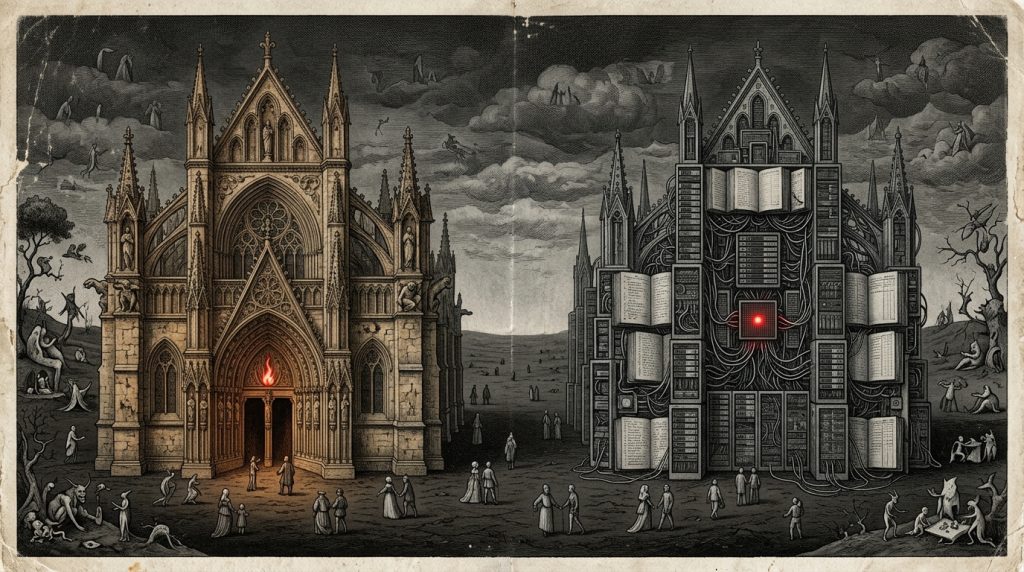
Modern Western civilization was built on Christianity. What is unfolding now is not decay. It is a structural inversion. Our society, once grounded in the Church, is becoming its opposite: an Anti-Church. Relationship is being replaced by administration. Grace is being replaced by an efficient system of control. The living Word has been reimagined as the machine. Mostly, we do not even notice.
We are becoming the thing we were against. That is what a contradiction looks like from the inside. It cannot hold. Something has to give. The synthesis that follows will not be a return to the past—the past is gone, and it was never as pure as we remember it. What follows is a recovery. We will find again what we abandoned. Not so that we can go back to it, but so that we can become what we were meant to be.
In other words, there is a point to this antithesis. It is where our transformation will come from. Not all of us. But those who choose.
In this essay, I will show you the emerging opposite. But first, I need to ask you to look beyond familiar religious symbols and consider the realities they may represent.
What if the Antichrist is not a tyrant, but an efficient system of control?
What if the mark of the beast is not a tattoo, but a verification badge?
What if the false prophet is not a religious leader, but a venture capitalist?
And the false church is not a cathedral, but a network of “trusted partners”?
Pax Silica
The story begins with the architecture of a new American-led world order, organized around control of the infrastructure that will power the AI economy. It is being built right now.
Its name is Pax Silica. It is a US-led strategic initiative that, as of June 2026, had 24 signatories. Its stated purpose is to secure the supply chains underpinning artificial intelligence, from critical minerals and energy inputs to semiconductors, advanced manufacturing, and data infrastructure.
The State Department is funding a pilot involving Panama’s ports and customs authorities. The aim is to verify high-value shipments and expedite the movement of goods deemed trusted. If the pilot succeeds, the department envisions expanding the platform to other Pax Silica partner economies.
The stated purpose is security and efficiency. But the architecture raises a larger question: what happens when access to the infrastructure of economic life increasingly depends on digital verification? A system built to distinguish trusted shipments from unverified ones may serve a legitimate logistical purpose. But as such systems expand and become interconnected, the power to define what counts as trusted—and to determine the consequences of failing verification—becomes increasingly consequential.
The Inversion
I believe the Pax Silica infrastructure is emerging from something larger: an Anti-Church. Nobody intends to build a structural inversion of civilization, but one can emerge when the system we create begins to assume the functions once reserved for moral and spiritual authority.
The true Church was given the authority to bind and loose—to forgive sins and let them go. The Anti-Church threatens to reproduce that power in inverted form. It does not forgive debts; it records them. It does not confer grace; it verifies status. It does not welcome the sinner; it can exclude the unverified. It does not promise resurrection; it promises optimization.
You do not have to believe in God to see what is happening. You only have to notice what happens when a system replaces grace with verification.
The inversion is not only spiritual. It is economic. When a civilization mistakes debt for wealth, it inverts contrary to nature. We have been treating sovereign debt as wealth since 1694, when the Bank of England was founded and with it the modern system of perpetual national debt. What was once a temporary measure to fund a war became the permanent architecture of the economy. Three centuries later, we are still living inside it.
Those who have built and administered that machinery have acquired extraordinary power. They have names, ideas, and funding. They have philosophy, policy, and plans. They may even believe they are building a better world. But they have mistaken their ability to optimize a system for the wisdom to govern human life. They do not understand what they are unleashing—not because they are necessarily malicious, but because the system they are building has a logic of its own.
The warning has already been given: “You will be ever hearing but never understanding; you will be ever seeing but never perceiving. For this people’s heart has grown callous…” (Matthew 13:14–15). We are being drawn toward a vision of the world that would convert the human being into a machine: measurable, predictable, and manageable. It promises the whole world in exchange for something we may not realize we are surrendering.
Father, forgive those who are leading us to the cliff, for they know not what they do. Give us eyes to see and ears to hear what we are sacrificing when we put the machine above the human being. Let us instead die to ourselves so that the mind of Jesus Christ may live through us and transform the world by a different logic—one grounded in love rather than control.
To overcome something, we must first understand it, so here we begin.

The Prophets
Idolatry does not speak for itself. It needs prophets. Today, two men help illuminate the logic of the ledger: Curtis Yarvin and Nick Land. Their ideas are not confined to obscure corners of the internet. They have entered wider debates about technology, political authority, and the future of government.
Curtis Yarvin: The State as Corporation
Yarvin is a software architect who began blogging in 2007 under the pseudonym Mencius Moldbug. He is one of the most influential voices associated with the Dark Enlightenment, a movement that takes technocracy seriously as a form of government and rejects liberal democracy in favor of hierarchical, often monarchical rule.
He is also a funded prophet, with connections to venture capital. Peter Thiel’s venture firm, Founders Fund, put $1.1 million in seed funding into Yarvin’s computing platform, Urbit—an attempt to build an alternative computing architecture organized around persistent digital identities and individually controlled resources. Urbit’s central preoccupation is who owns the infrastructure, who controls access, and who sets the rules.
Yarvin’s core argument is that democracy is a failed experiment. In his account, it breeds bureaucracy, corruption, and paralysis. It empowers a self-reinforcing network of media, academia, and government institutions—what he calls “the Cathedral”—that establishes and enforces an ideological orthodoxy on an unwilling population. The system, he concludes, must be replaced.
What he proposes is a sovereign corporation: a CEO-monarch with concentrated, effectively absolute executive authority. Yarvin calls it “neocameralism”—the state restructured as a for-profit business, with the sovereign treated as an owner responsible for the performance and value of the enterprise. Citizens become, by analogy, shareholders or customers; governance becomes a service to be optimized. The state becomes a corporation. The citizen becomes a customer. The law becomes a service. The bureaucracy becomes a management problem. Everything measurable, optimizable, and under control.
The theological problem begins here. What happens when the state is understood primarily as an enterprise to be managed, and the people within it as assets, liabilities, or customers? What happens to the person who cannot be made productive, whose needs cannot be justified by a balance sheet, or whose life does not fit the sovereign’s calculations?
Yarvin has offered a disturbing answer. In a 2008 blog post, he considered how a corporate-run state should deal with people it deemed unproductive or unwanted—those he called “wards.”

He proposed confining them permanently in sealed cells, where immersive virtual reality would provide the illusion of a rich and fulfilling life. They could even perform work remotely through technology, while remaining physically isolated and effectively removed from society. He presented this as an alternative to eliminating them outright, arguing that such confinement would be cheaper than conventional imprisonment. The language was framed as a thought experiment, but the underlying logic is unmistakable: people judged to be liabilities become a problem to be managed, isolated, and made invisible rather than human beings whose lives possess inherent worth.
Confinement becomes virtualization. The deprivation of a real human life is recast as a technical solution. The altar has an offering. Not grace. Not forgiveness. A simulation of life for those the system has decided it cannot accommodate.
This is as old as civilization itself. Babylon’s temple economies joined religious authority to the administration of material life. Temples and palaces controlled land, managed resources, extended credit, and recorded obligations. The ledger was not merely a record of economic life; it helped establish the claims and duties through which that life was organized.
Yarvin does not offer grace or reconciliation as the organizing principles of government. The contrast is stark: the Christian vision begins with a person whose dignity cannot be reduced to utility; the corporate vision begins with an enterprise whose parts must serve its purposes.
The CEO takes the place of the servant. Management takes the place of moral judgment. The sovereign occupies the position from which the rules are made, while everyone else must live within them. Yarvin is not building a state in the traditional democratic sense. He is imagining a sovereign enterprise. And when the enterprise becomes the highest authority, the ledger begins to resemble an altar.
Nick Land: The Accelerationist Machine
If Yarvin is the theorist of sovereign control, Nick Land is the philosopher of acceleration. Yarvin provides a blueprint for reorganizing the state. Land explores a more radical possibility: that capitalism and technology may develop a momentum that overwhelms the political and moral systems attempting to contain them.
Land is a British philosopher who helped establish the Cybernetic Culture Research Unit at the University of Warwick in the 1990s. His early work blended cybernetics, continental philosophy, and occultism. His later writings became associated with accelerationism, a broad and internally diverse set of ideas concerning the intensification of capitalism, technology, and social change. In Land’s particular version, technological and economic forces are not simply instruments humans control; they are processes that can escape the purposes and constraints humans impose on them.
Land’s work challenges the assumption that society can preserve its existing political order while indefinitely accelerating technological and economic change. In his framework, democracy and other institutions that restrain market and technological forces can become obstacles to the process of acceleration. Rather than slowing the system down to preserve existing arrangements, accelerationists ask what happens when its underlying forces are intensified.
This is not simply a call for faster computers or more efficient markets. It is a challenge to the idea that human beings should remain the ultimate measure and purpose of technological development. Where Yarvin imagines a sovereign who commands the system, Land explores a process in which the system itself acquires momentum, reorganizing the world around its own demands.
Acceleration becomes an apocalypse without a planner: a process that converts more and more of the world into inputs for further expansion. Human beings become consumers, workers, data sources, and biological substrates. The world becomes a field of transactions. The future becomes an open-ended calculation of growth.
This is where the ledger becomes more than a metaphor for financial bookkeeping. It represents a way of seeing the world in which whatever exists must be translated into information, measured for its usefulness, and made available for transformation. What cannot be measured becomes difficult to recognize. What cannot be optimized becomes an obstacle. What resists conversion becomes a problem to be overcome.
Land describes the emergence of a “technoplastic being”: a human whose identity is no longer treated as fixed, but as something that can be understood, redesigned, and transformed through technology. In The Dark Enlightenment, he argues that as scientific knowledge advances, the distinction between understanding human biology and modifying it begins to collapse. Humanity becomes increasingly integrated into the technological system, with biological information itself subject to processes of reading, editing, and engineering.

The self is no longer a person to be loved; it is a platform to be upgraded. It is not a soul to be saved; it is data to be processed. The body is no longer a temple of the Holy Spirit; it is hardware awaiting a firmware update.
The point is that the logic of the system can produce these conclusions even when the people inside it do not consciously hold them.
The theological contrast is profound. The Christian vision does not deny that human beings can change. It places transformation within a relationship: the person is loved before being improved, forgiven before being perfected, and granted dignity that does not depend on performance. The logic of the machine runs in the opposite direction. It sees what a person is as the beginning of an engineering problem.
Yarvin imagines a sovereign who can direct society from above. Land describes forces of technological and economic acceleration that may outrun the capacity of any sovereign to direct them. One concentrates authority in the ruler; the other questions whether human authority can ultimately contain the process at all. Yet both challenge the assumption that existing democratic and moral limits should govern the future of technological society.
These are the prophets. But prophets need a patron. They need someone to fund the temple, promote the doctrine, and decide who is allowed to speak.
The High Priest
In the true Church, the Pope is the Vicar of Christ: the servant of the servants of God, the one who holds the keys. He does not merely administer an institution. He guards a deposit of faith. He speaks with an authority that is not his own.
In the Anti-Church, the position of high priest is occupied by Peter Thiel.
He does not administer a church. But the functions he performs—funding the prophets, bankrolling the politicians, and helping determine which ideas receive capital, influence, and institutional power—are the functions of a papacy. The political and technological networks in which he operates have helped elevate figures who now hold positions of power. JD Vance, whose political rise Thiel helped finance, sits in the White House as vice president. Jacob Helberg, a technology-policy figure who became an under secretary of state, launched Pax Silica, Washington’s flagship initiative for AI and supply-chain security. The connections between capital, political authority, and technological ambition are not hidden, and they now meet in a small number of hands.
Nor has Thiel concealed his skepticism toward democracy. In 2009, he wrote that he no longer believed freedom and democracy were compatible.
The project is not hidden. It is spoken aloud.
In the autumn of 2025, Thiel delivered a four-part lecture series in San Francisco titled The Antichrist. The lectures were held under an off-the-record condition, but recordings later obtained by The Washington Post revealed a man who had given serious thought to the identity of the Antichrist—and whose conclusions turned the traditional Christian warning on its head.

In Thiel’s account, the modern Antichrist would not necessarily be the scientist who unleashes a monstrous technology. It might instead be the person who tries to stop technological progress. He identified climate activist Greta Thunberg and AI-safety researcher Eliezer Yudkowsky as examples of this kind of figure. Yudkowsky was particularly notable because Thiel had previously supported his work before becoming critical of his opposition to the current direction of AI development.
In June 2026, Thiel extended this argument to Pope Leo XIV. At the Aspen Ideas Festival, he argued that the Pope’s call for stronger AI safeguards would benefit China by restraining American technological development while doing little to slow Beijing. He went so far as to characterize the Pope as serving Chinese communist interests.
In the true Church, Christ is the one who brings salvation. In the Anti-Church, salvation is promised by one who has not yet come. The Singularity—the imagined moment when the machine surpasses its makers and technological transformation becomes the answer to humanity’s limitations.
In the true Church, the Antichrist is the one who opposes Christ, the deceiver, the destroyer. In the Anti-Church, the Antichrist is the one who opposes the machine: the regulator, the safety researcher, the Luddite.
Here the inversion becomes visible. Those who warn that technological power must answer to human dignity become enemies of humanity’s future; those who promise salvation through technological supremacy become its prophets.
Thiel is the high priest of the Anti-Church, a figure who occupies, in this essay’s analogy, the place of the papacy: not because he holds ecclesiastical office, but because he helps finance the doctrine, elevate its prophets, and shape the political order through which it may be realized.
The Cardinal
In the true Church, the Pope is not the only office. There is also the cardinal: the administrator, the one who translates doctrine into policy, who runs the curia and keeps the institution functioning.
The Anti-Church has its cardinal too. His name is Jacob Helberg.
Helberg worked at Palantir, the defense-technology company whose early institutional backers included In-Q-Tel, the CIA’s venture-capital arm. He is not a philosopher. He is a translator. He takes the prophets’ vision and makes it policy. He speaks in the language of network optimization and strategic alignment: “trusted nodes,” “Golden Node,” “network of trusted nations,” “innovation sovereignty.”
“Innovation sovereignty” is the doctrine. Helberg uses the phrase to describe a new kind of national independence. But listen to what it actually means. In his June 2026 essay, “The Digital Sovereignty Trap,” he describes efforts by nations to build their own AI systems as “backward and counterproductive.” He argues that digital sovereignty does not require each country to reproduce the entire technological stack, but to contribute something distinctive to a shared ecosystem. The question is who defines that ecosystem, who owns its most valuable components, and who captures the wealth it produces.
Translate that. You may participate in building the future, but the terms of participation are not equal. Your country may contribute the land, the minerals, the water, the energy, and the labor. Others may control the most valuable chips, models, platforms, capital, and infrastructure. You are welcomed into the network, but that does not mean you own the network. You are a node.

The Visible Church
Pax Silica is that institution in visible form. As of June 2026, it had 24 signatories, including the United States, the European Union, Japan, and India. It has a creed: innovation sovereignty. It has a communion: the network of trusted nations. And it offers the promise of salvation through participation in the AI economy. Its digital credentials and emerging financial infrastructure become the sacraments of access; its Golden Node designation becomes a sign of privileged admission. And it carries the corresponding risk: exclusion from the networks through which capital, technology, and economic opportunity increasingly flow. Helberg himself warns of “synchronized mediocrity” for countries that try to reproduce yesterday’s technology rather than contribute to the frontier.
The first Golden Node is planned for the Philippines: a roughly 1,618-hectare industrial hub at New Clark City in Tarlac, intended to bring together AI infrastructure, advanced manufacturing, semiconductor-related activity, and critical-mineral processing. The project is presented as an opportunity for the Philippines to move into higher-value industries. But it also raises questions about who will benefit from the investment, who will control the infrastructure, and what the costs will be for the communities and ecosystems on which it depends.
Some of the clearest opposition has come from Filipino churches. In August 2026, the National Council of Churches in the Philippines issued a statement rejecting Pax Silica on theological, economic, and environmental grounds. It questioned whether the initiative would serve ordinary Filipinos or primarily preserve American economic and technological dominance. It also raised concerns about the proposed hub’s demands on land, electricity, and water, and the consequences for farmers and Indigenous Aeta communities.
Shalom

The council’s criticism points toward a different understanding of peace. The word pax, from the Pax Romana to the Pax Americana, evokes an order secured by a dominant power. But biblical shalom means something more than the absence of conflict or the orderly functioning of a system. It speaks of wholeness, justice, well-being, and right relationship—with God, with one another, and with the land.
This is the heart of the matter. Pax is imposed. Shalom is lived. Pax requires a ledger. Shalom requires a relationship. Pax is what the Anti-Church offers. Shalom is what it has replaced.
Shalom is a grandmother setting another place at the table because someone might come by hungry. It is a farmer knowing which corner of his field holds water after a dry week, and a neighbor arriving with a tractor when the work becomes too much for one pair of hands. It is a house that has passed through generations, its walls marked with the heights of children who have long since grown, its worth measured in the lives it shelters. No one has to calculate the return on these things. Their value is already known.
The Anti-Church offers a different vision.
It is a meal delivered by a platform, arriving only when your credential is current. It is water that flows when the meter recognizes your account. It is a house you live in but do not own, its walls repainted between tenants so that no one’s height is ever marked. It’s hollow.
Everything is calculated. Everyone is verified.
And access can always be withdrawn.
This essay is the first of two. The second essay is about the Anti-Church’s machinery of control. It begins with the saints who sell the faith—the men who perform its signs and state its creed. Then it shows what the sacraments produce in an ordinary life, and what they cost.
If this essay resonated with you, I would love to hear your thoughts. And if you would like to support more work like this, you can support me on Patreon, BuyMeACoffee, or Substack. I also appreciate direct donations via digital payment networks like Zelle—message me for details.


A Note on the Art
The images in this essay are inspired by Hieronymus Bosch, whose hell is not fire but mechanism. His figures are small. The architecture overwhelms them. The system does not punish souls. It processes them.
That is what Pax Silica is. The images are stark, black and white, with a single red accent for the machine’s appetite.
References & Sources
Bulatlat. “Faith groups push against US-backed ‘Pax Silica’ hub.” September 25, 2026.
Cato Unbound. “The Education of a Libertarian” by Peter Thiel. April 13, 2009.
Fast Company. “From CIA cash to local police: How Palantir got its start.” November 23, 2025.
Financial Times. “EU allies join US pact to break reliance on Chinese AI supply chains.” June 24, 2026.
Helberg, Jacob. “The Digital Sovereignty Trap.” U.S. Department of State, June 24, 2026.
Hudson, Michael. …and forgive them their debts: Lending, Foreclosure and Redemption from Bronze Age Finance to the Jubilee Year. ISLET, 2018.
IISS. U.S. Critical Minerals Diplomacy: From America-First Deals to Pax Silica. International Institute for Strategic Studies, January 2026.
Land, Nick. The Dark Enlightenment. 2012.
Mashable. “Peter Thiel reportedly linked Greta Thunberg and AI skeptics to the Antichrist.” October 11, 2025.
Observer Research Foundation. “Pax Silica and the New Architecture of AI Partnerships.” July 13, 2026.
Philstar. “New Clark City tagged as AI hub for Philippines’ Pax Silica entry.” April 21, 2026.
Philippine Information Agency. “BCDA eyes AI industrial hub in New Clark City under US-led Pax Silica initiative.” April 23, 2026.
Politico. “Peter Thiel slams pope’s AI encyclical as gift to Chinese Communist Party.” Politico, 24 Sept. 2026.
Reuters. “Peter Thiel talk on Antichrist says he told Elon Musk not to give wealth to charity.” October 9, 2025.
Tribune. “US Plans First Pax Silica Industrial Hub in New Clark City as AI and Semiconductor ‘Golden Node.’” May 18, 2026.
Washington Post, The. “Inside billionaire Peter Thiel’s private ‘Antichrist’ lectures.” October 23, 2025.
WION News. “Audio from Peter Thiel’s secret ‘Antichrist’ seminar leaks, revealing apocalyptic tech theology.” October 11, 2025.
Wood, Patrick M., and Courtenay Turner. The Final Betrayal: How Technocracy Destroyed America. Coherent Publishing, 2025.
Yarvin, Curtis. Unqualified Reservations. Blog, 2007–2013.
The Holy Bible. 2 Corinthians 11:14; Galatians 6:9; Matthew 13:14–15.


