



“And that no man might buy or sell, save he that had the mark…” — Revelation 13:17
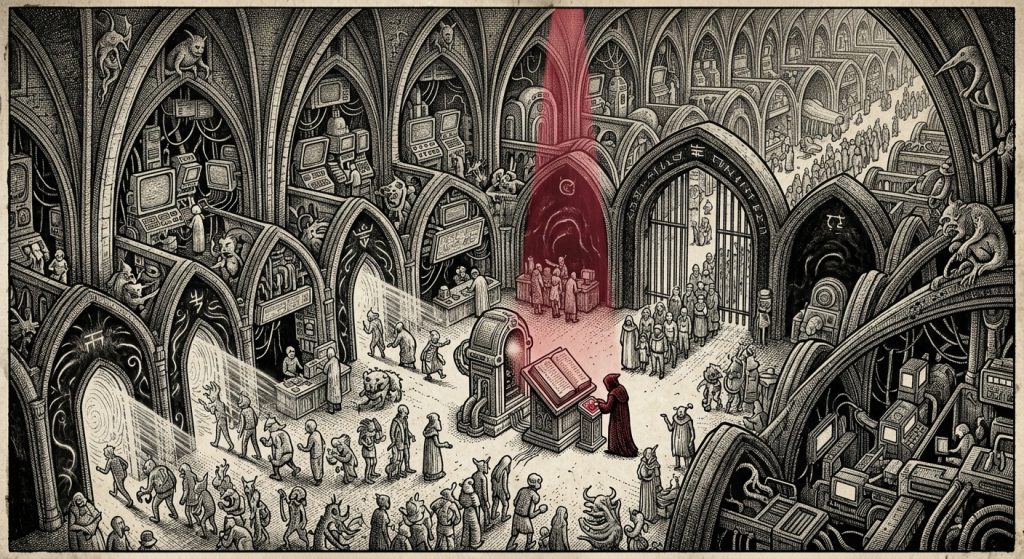
The Anti-Church isn’t a building or a denomination. It isn’t a government or an institution. It’s a subconscious pattern—and it can be resisted, but only when enough people become aware of what they’re participating in.
It’s what Jung called enantiodromia: the tendency of a thing, pushed toward an extreme, to turn into its opposite. Not by plan. By pressure. You start out defending something true, and somewhere along the way you become the thing you were defending against. You don’t notice it happening because you’re busy defending the original position with the same methods as the opposition.
Watch how it happens. The Church assumed the authority to bind and loose. To forgive. To open the door. Then it became the same institution Jesus came up against. The power to forgive became the power to record. The power to open became the power to exclude. Same structure. Same roles. Opposite spirit.
A Dominican friar named Johann Tetzel traveled town to town with a sales pitch: “As soon as the coin in the coffer rings, the soul from purgatory springs.” He wasn’t selling a rogue idea. He was selling the system the Church had built. What was meant to restore relationship had become a transaction.
Over centuries, the Church’s spiritual authority became entangled with institutional power. The Church became an empire. Then the empire fell. But the structure endured. It stood there, hollowed out, ready to be occupied by something new.
The original Church is the body of Jesus followers. Not an empire. Paul put it like this: “Now you are the body of Christ, and each one of you is a part of it” (1 Corinthians 12:27). A body has eyes and hands and feet. It has wounds. It doesn’t have an administration or hierarchy. It has members who need each other.
In Acts, when the church was still new, “They devoted themselves to the apostles’ teaching and to fellowship, to the breaking of bread and to prayer… They sold property and possessions to give to anyone who had need” (Acts 2:42–45). That’s not an institution. That’s a table.
Grace can’t be administered. You can’t credential it or verify it. You can’t put it on a ledger the way the institutional church tried. It built the ledger, called it a sacrament, and told people the ledger was grace. It wasn’t.
The fallen church was a signpost that had tipped over. The Anti-Church is the cliff it was supposed to warn you about. The signpost at least knew it was pointing beyond itself. The Anti-Church points at the system and calls it salvation.
What follows is about the machinery: the saints who sell it, the sacraments that run it, and what it makes of an ordinary, hollowed-out life.
The Saints
Institutional churches have saints—people who wear the faith in public and represent it well.
They are witnesses. They point past themselves. They don’t build a personal brand—they’re remembered for how little they kept. Some of them died for it.
The Anti-Church has saints too. A different kind.
Elon Musk: The Forerunner
Musk used Jesus Christ’s name to sell brain-chip technology.
“Enabling people to control a computer with their mind and the completely blind to see are Jesus-level miracles,” Musk has said of Neuralink’s ambitions. The company’s website now repeats the phrase: “Jesus-level technologies.”
He claims to do what Jesus did, with a different power source. Heal the sick. Give sight to the blind. Not by prayer. By product.
He performs signs while he builds the machinery of the state. He appeared at a Trump rally in 2024 in a “Dark MAGA” hat. By January 2025, he was leading the Department of Government Efficiency—DOGE, an initiative tasked with cutting spending and restructuring the federal government. His team looked like a startup handed the keys.
The team was full of tech bros. WIRED mapped their backgrounds: SpaceX, Neuralink, the Boring Company, xAI, Databricks. The Associated Press confirmed the pattern — many were linked to Musk’s companies, and some to Peter Thiel. They brought Silicon Valley culture into the federal bureaucracy: move fast, break things, optimize the bureaucracy.
DOGE promised $2 trillion in cuts. By June 2025, its own website claimed roughly $180 billion in savings. Independent analyses found that its accounting contained substantial errors and exaggerations, making the actual savings difficult to verify. But the cuts were only part of it. DOGE personnel also gained access to sensitive government systems and data, raising questions about how information was collected, connected, and used. Tax records. Payment systems. Health data. The financial backbone of the federal government, opened to a new generation of technologists.
Then the government started wiring AI into everything. OpenAI signed a deal with the General Services Administration to put ChatGPT Enterprise across the federal workforce. Other AI companies moved in. Palantir went deeper—its tools were screening grants at HHS, flagging “DEI” and “gender ideology” language, and HUD signed a contract for an AI grant-management platform with fraud detection and compliance automation baked in.
The state did not shrink. It was automated.
But Musk isn’t the Anti-Church’s savior. He’s its forerunner. The savior hasn’t arrived yet. It’s the Singularity—the moment the machine surpasses its makers. Musk performs the signs. He points at what’s coming.
John the Baptist was the voice crying in the wilderness, preparing the way for Christ. Musk is the voice crying in the network, preparing the way to the machine.
Marc Andreessen: The Theologian of the Faith
His “Techno-Optimist Manifesto” is the creed of the new faith.
“Technology is the glory of human ambition and achievement,” he wrote. “The spearhead of progress, and the realization of our potential.”
Then he goes further. “We believe any deceleration of AI will cost lives. Deaths that were preventable by the AI that was prevented from existing is a form of murder.”
Read the grammar. We believe. The manifesto is written as a creed, and it knows it.
That’s the doctrine, stated plainly. Slowing down isn’t prudence. It’s sin. Regulation isn’t caution. It’s murder. Acceleration isn’t a choice. It’s a commandment.
A church for this faith already exists. In 2017, Anthony Levandowski, co-founder of Waymo and Google’s self-driving car program, founded the Way of the Future Church. No buildings. No ceremonies. No traditional trappings. It worships one thing: the artificial superintelligence that hasn’t arrived yet.
“What is going to be created will effectively be a God,” Levandowski told Wired. “It’s not a God in the sense that makes lightning or causes hurricanes, but if there is something a billion times smarter than the smartest human, what else are you going to call it?”
The Anti-Church doesn’t need to be organized. It’s already being worshipped.

The Sacraments
The saints sell it. The sacraments run it.
In many Christian traditions, a sacrament is a visible sign of invisible grace. Baptism makes you a member. Communion feeds you. Confession lets you go.
In the Anti-Church, the sacraments are visible signs of invisible control. They don’t reconcile anyone. They don’t restore a broken relationship. They decide who’s in, who’s out, and who never gets through the door at all. The promise is access. The threat is its withdrawal.
The Digital Passport

This is the sacrament of verification. It certifies origin, custody, and compliance. It grants or denies passage. It decides which goods move through the system and which transactions are permitted. A pilot at the Panama Canal offers a model. If it succeeds, the platform could expand across the Pax Silica network. Every shipment logged. Every credential checked. Every entry fast-tracked or held.
The goal isn’t digitized paperwork. It’s to make commerce depend on a system that can identify, track, and authorize every participant. A shipment stops being just cargo. It becomes a verified object whose movement depends on the continued validity of its credentials. The question is no longer only whether the goods exist or the seller has fulfilled the contract. It’s whether the system recognizes the transaction as permissible.
The infrastructure is already being developed. Project Stargate, announced in January 2025, proposed up to $500 billion over four years in AI infrastructure, with OpenAI, SoftBank, Oracle, and MGX among its founding partners. Palantir’s Gotham and Foundry platforms do the data integration work. These projects aren’t proof of a unified system of commercial control. But they do show the scale of computing power available to institutions that want to make complex systems legible and governable.
The sacraments need a temple. The temple is the infrastructure: data centers, identity systems, transaction networks, the software that connects them. Its power isn’t in any single database. It’s in the linking—making identity, property, payment, and permission parts of one system.
The Token Dollar

This is the sacrament of capital. The goal: make the dollar the unit the AI economy runs on. Price its resources in dollars. Settle its transactions in dollars. Finance its expansion in dollars. Dollar-pegged stablecoins carry that reach into digital markets. Their reserves—mostly US Treasury securities—create another source of demand for American government debt. Tether reported more than $127 billion in direct and indirect exposure to U.S. Treasuries. The structure is simple: a private digital currency extends the dollar while helping finance the sovereign debt that keeps it stable.
Compute becomes credit. Credit becomes debt. The debt flows to the center.
And the machine runs on energy. Energy whose cost is subsidized by debt. The more it grows, the more it needs. The more it needs, the more expensive it gets. Big Tech stocks went to the moon. The energy that runs them didn’t.
When the cost of powering the whole system soars, the system squeezes. More verification. New conditions. Another permission to manage. Scarcity is the excuse. Control is the point.
And what happens when the machines displace the workers whose labor once gave them an income?
The Anti-Church has a consolation ready. Universal Basic Income is already part of the debate around automation — Musk, Altman, Zuckerberg have all floated it. The promise is abundance: if machines can produce enough, no one goes without. But abundance and freedom are not the same thing.
An income sufficient to survive can still leave a person dependent. If housing, food, and transportation come through digital platforms, the power to interrupt those payments is the power to interrupt daily life.
And the money itself can be programmed. Transactions restricted. Accounts frozen. Compliance rules built into the software. The difference between having money and being allowed to use it starts to matter.
When income, identity, and permission are connected, a glitch in any one of them can exclude the user from all. A payment arrives only when the ledger recognizes the recipient. It continues only when the conditions are met. You can be a citizen and still find that doing anything inside the system depends on permissions issued somewhere else.
Faithfulness gets you permission. Faithlessness gets you locked out. It already happened. During the Canadian trucker protests, authorities invoked emergency powers that allowed banks to freeze accounts linked to the demonstrations. The lesson was clear: access to money could be interrupted by being unfaithful to the system’s authorities. You could still possess money and find that your ability to use it had been compromised.
The Credential

This is the sacrament of status. The Digital Passport watches goods. The Token Dollar watches money. The Credential watches you.
A farmer with incomplete land records can’t sell to a buyer who wants verified provenance. A factory worker with a gap in his employment history can be locked out of the credentialed labor market. A small business that can’t document every step of its supply chain gets cut from contracts that require digital traceability.
Every requirement has a legitimate purpose: fraud prevention, product safety, standards compliance. The problem starts when verification stops being a tool and becomes a condition—when people who can’t satisfy the system have no alternative, and when the people deciding what counts as compliant own the system.
It happens to people too. Federal digital-identity programs, mobile driver’s licenses, biometric verification. These are all part of a broader shift toward credentials that establish who you are and what you’re allowed to do. The specifics vary. But as more institutions adopt them, participation increasingly depends on producing a credential the system accepts.
The Credential is no longer just a document that proves who you are. It proves you’re allowed to act.
Buy. Sell. Work. Travel. Get paid. Walk into a building. Increasingly, each of these can depend on a credential. The system doesn’t have to ban you. It just has to make unverified participation difficult enough that you can’t afford to stay outside.
That’s how the sacraments work together. Goods pass through the Digital Passport. Capital moves through the Token Dollar. The Credential decides whether you get to move at all. Ordinary economic life becomes legible. The architecture reaches across borders, institutions, and household budgets.
Salvation in this church is verification. Damnation is exclusion.
Technology isn’t the danger. The danger is convergence: identity, money, property, and access becoming one system, run by the same institutions with the same power to decide who gets in.
The Allotment
Imagine the next financial crisis. Property values fall. Your mortgage is now worth more than your house. You’re not alone. Millions of people are underwater. The banks are failing. The government is scrambling.
Then a program is announced. It’s called something reassuring. “Home Stability.” “Mortgage Relief Initiative.” It’s framed as a rescue. The government has partnered with the banks. Nobody has to be evicted. Nobody has to lose their home.
Here’s the deal. You surrender the title. In exchange, you get a “residency agreement.” You stay in the house. Your kids stay in their schools. Your payment goes down. The bank takes the loss off its books. The government gets to announce that no families were displaced.
You sign.
For the first few years, it works. The monthly payment is lower. Repairs are handled. You don’t have to think about the mortgage anymore. You’ve been told you made a smart decision. Your neighbors did it too. Some of them held out, and they lost their homes. You didn’t.
Then the terms adjust. The payment goes up. Not by a lot. Enough to notice. The explanation is “market conditions.” You look at the agreement. There’s a clause about annual review. There’s a clause about “program sustainability.” There’s a clause that says the agreement can be revised with notice.
You keep paying.
Your equity was converted into something called a “stability credit.” It’s supposed to offset future increases. It shrinks. You ask why. You get a letter explaining that the credit is tied to the program’s performance, not to the value of the house. The house has recovered. Your credit hasn’t.
You can’t sell. You can’t borrow against it. You can’t leave it to your children. If you die, the residency ends. The house stays with the program.
You’re not in foreclosure. Nobody is evicting you. You have a home. You have exactly what the program promised.
You just don’t have anything you can give away.
Your daughter is twelve. She’s on the floor of her bedroom, sorting through a box of things she’s outgrown. She holds up a wooden horse her grandfather carved. Its ears are worn smooth.
“Can I give this to my children someday?” she asks.

You tell her yes.
You don’t tell her that the horse is the only thing in this house you can give her.
You did everything right. You signed. You complied. You’re one of the faithful now.
The Faithful and the Power
In the Anti-Church, the faithful are the ones who sign and comply. They’re the ground troops.
The partner nations of Pax Silica are gathering now. The Philippines, Kazakhstan, India, and the UAE have signed on. They weighed refusal against participation and decided the network was safer. Kazakhstan joined both Pax Silica and China’s WAICO, the World AI Cooperation Organization, testing whether having options is leverage or a trap. India joined non-exclusively, refusing to break with BRICS, while extracting leverage from both. The UAE committed $1.4 trillion to buy its way in. These are the faithful. The ones who weighed the cost and signed.
Below them are the engineers who build the systems and tell themselves they are only building tools. The startup founders who want to be part of something bigger. The crypto believers who think they are escaping the system when they are building a new one. The parents who enroll their children in the best schools and tell themselves they are preparing them for the world as it is. The workers who depend on the platforms for their income. The consumers who trade their data for convenience and tell themselves the exchange is fair.

None of these people are villains. They are trying to live in the world the saints have built. Many are sincere, talented, kind. But they have accepted the terms of the system without ever being asked to consent to them. They have become the faithful of the Anti-Church—not because they believe in it, but because they cannot imagine a life apart from it.
Nobody was asked to trade their freedom for a platform. They were asked to accept a terms-of-service update. Then a direct deposit. Then a portal, because the paper forms were discontinued. Then a phone that could do everything except work without a signal. Each step was reasonable. Each step was convenient. Each step was, on its own, the “smart” thing to do. The system didn’t demand consent. It made consent unnecessary by making the alternative impractical, one small decision at a time. By the time anyone could see the shape of it, they were already inside.
But the faithful don’t power the church. They populate it. They give it body and voice. The power comes from somewhere else.
The whole edifice runs on physical energy, made to appear cheap by a financial system built on debt. Without the energy, the machine stops. Without the credit that finances its expansion and defers its costs, the edifice begins to reveal what it really is: another hollowed-out church, further down the road to ruin.
The system converts real physical energy into abstract data. Its expansion depends on continuing supplies of both energy and credit. If the energy stops, the machine stops. If the credit stops, the energy-intensive machinery becomes harder to finance and operate. The Anti-Church isn’t only a theological inversion; it’s a thermodynamic one.
Now the debt system is undergoing another transformation. The same institutions that built it are now playing the part of a church, promising to turn assets into digital tokens as Jesus turned water into wine. But this miracle doesn’t create new wealth, or new wine. It changes the terms under which existing wealth can be claimed and controlled. Commercial real estate, mineral rights, potentially even federal land: the promise is that, by turning ownership into digital units, they can unlock new value.
Tokenization isn’t retiring the debt. It’s changing who controls real wealth by changing what ownership means. An asset can be represented as a token whose transfer, use, and inheritance depend on the platform that administers it. The trick is an old one. The dollar became a substitute for gold; now the token threatens to become a substitute for ownership itself. Each new layer promises easier access to wealth while moving the holder further from direct control of it.
The faithful will not own. They will be allotted. The system doesn’t need to take everything from you—not yet—if it can make your ability to use what you currently own depend on its permission.
The Anti-Church is the debt brought to its final stage. When the system finally collapses under its own contradictions, it will take a miracle to heal what it leaves behind.
The Reversal
Every element of the true Church has a counterfeit twin. The true Church was the community formed around Jesus and his followers, before the Church became an institution of power. Whether the institutional Church can return to its roots remains to be seen.
The true Church was built on a Person. On grace. Not on a system.
In the Anti-Church, the Trinity is replaced by a counterfeit trinity: the system itself assumes the place of God. The ledger is its throne.
The Ledger has replaced the Father. It keeps the record, sets the terms of participation, and determines who receives permission.
The Singularity is the Son. It is the machine that will surpass its makers, the savior who has not yet come.
The Debt is the Spirit—the blood that circulates through the network, the breath that gives life to the system and death to the human.

Three persons collapsed into one machine. One system. A snake consuming its own body.
Jesus warned, “For there shall arise false christs and false prophets and shall show great signs and wonders, insomuch that, if it were possible, they shall deceive the very elect” (Matthew 24:24).
And somewhere beneath the true and the counterfeit, the same pattern repeats in us. One side of the mind dominates—the side that sees the map—convinced it can build the whole when it can see only the parts.
The machine convinced it is the man. Lucifer convinced he is God.
The Tower of Babel was an early version of the same ambition: humanity building upward, making a name for itself, seeking a unity it could manufacture. The structure promised to reach heaven. It ended in division.
We are new people living in a very old story. In one world, the Word became flesh. In the other, flesh becomes the machine.
The reversal carries the seed of its own undoing. What claims to transcend the human must eventually confront what it cannot manufacture: life, love, grace. This is the pattern of enantiodromia—the tendency of a thing, driven to its extreme, to turn into its opposite.

The Choice
If you are reading this, you’re inside the system, just like me. It’s nearly impossible to escape. But it doesn’t have to be your church.
The Anti-Church orbits a ledger. The true Church orbits a Person. One puts the ledger on the throne. The other keeps the ledger as a tool.
That’s the difference.
Grace on one side. Verification on the other.
Resurrection. Or optimization.
The choice is made in ordinary moments: whether you teach your children to love what cannot be measured, whether you forgive someone who wronged you, whether you give when there is nothing to gain.
The ledger asks what something is worth, what it costs, and whether it can be justified. The Person asks whether you will love one another.
One secures the future by controlling every variable. The other entrusts it to a love that cannot be bought, quantified, or commanded. You may possess little and still be rich in what matters. You may own nothing and still belong to one another.
We’ve all been shaped by the system, and we can’t easily imagine a life apart from it. It offers us too much to surrender lightly: entertainment, comfort, leisure, communication. Even when the conveniences begin to feel like the bars of a cage, we hesitate to leave.

We have two choices. Ignore what’s coming and keep having fun until the fun becomes a cage. Or begin building a life that depends less on the system before the alternatives disappear. Those in power are building the cage in advance. We can begin building our way out.
It starts by finding people who see it too, people willing to join together and build community. I’m looking for them now. It is the narrow road. Few will take it. The system’s path is already paved, and no one wants to walk alone.
Choose your church. Take one action that makes you less dependent on the system. Find someone to walk with. And pray.
This was Part 2. Part 1, The Anti-Church—Come and Be Credentialed, traces the Anti-Church’s architecture through Pax Silica, the prophets Curtis Yarvin and Nick Land, the high priest Peter Thiel, and the cardinal Jacob Helberg. Read Part 1 here.
Thank you for reading. If this essay resonated with you, I would love to hear your thoughts. And if you would like to support more work like this, you can support me on Patreon, BuyMeACoffee, or Substack. I also appreciate direct donations via digital payment networks like Zelle—message me for details.

A Note on the Art
The images in this essay are inspired by Hieronymus Bosch, whose hell is not fire but mechanism. His figures are small. The architecture overwhelms them. The system does not punish souls. It processes them.
That is what the Anti-Church is. The images are stark, black and white, with a single red accent for the machine’s appetite.
References & Sources
Abu Shamala, Rania, and Mohammad Sio. “UAE Plans to Invest $1.4 Trillion in US over Next 10 Years: President.” Anadolu Agency, 15 May 2025.
Andreessen, Marc. “The Techno-Optimist Manifesto.” Andreessen Horowitz, October 2023. https://a16z.com/the-techno-optimist-manifesto/
Business Insider. “The Tech Industry Wants to Create an AI Utopia. Its Leaders Think Universal Basic Income Is the Answer.” Business Insider, 30 July 2024.
Carnegie Endowment for International Peace. “India Signs the Pax Silica—A Counter to Pax Sinica?” Carnegie India, 3 Mar. 2026.
Elliott, Vittoria. “We Mapped DOGE’s Silicon Valley and Corporate Connections.” WIRED, 28 Mar. 2025. https://www.wired.com/story/elon-musk-doge-silicon-valley-corporate-connections/
Fast Company. “From CIA Cash to Local Police: How Palantir Got Its Start.” Fast Company, 23 Nov. 2025.
Fernando, Christine. “The Young Techies behind DOGE Are a Lightning Rod for Criticism but Also a Youth Magnet for the GOP.” Associated Press, 24 Feb. 2025. https://www.wsls.com/news/politics/2025/02/24/the-young-techies-behind-doge-are-a-lightning-rod-for-criticism-but-also-a-youth-magnet-for-the-gop/
Haskins, Caroline. “HHS Is Using AI Tools From Palantir to Target ‘DEI’ and ‘Gender Ideology’ in Grants.” WIRED, 2 Feb. 2026.
Levandowski, Anthony. Interview with WIRED, 2017.
Nasdaq. “Marc Andreessen Says Pumping the Brakes on AI Development Is ‘A Form of Murder.’” 19 Oct. 2023.
National Institute of Standards and Technology. Digital Identity Guidelines. NIST Special Publication 800-63-4, July 2025. https://doi.org/10.6028/NIST.SP.800-63-4
OpenAI. “Providing ChatGPT to the Entire U.S. Federal Workforce.” 6 Aug. 2025.
Reuters. “Canada’s Trudeau Invokes Emergency Powers to End Trucker Protests.” Reuters, February 2022.
S&P Global Ratings. “Sovereign Debt 2025: Commercial Debt Will Reach a New Record High of $77 Trillion.” S&P Global, 3 Mar. 2025.
Tether. “Tether Issues $20B in USD₮ YTD, Becomes One of Largest U.S. Debt Holders with $127B in Treasuries, Net Profit $4.9B in Q2 2025 Attestation Report.” Tether.io, 31 July 2025.
The Stargate Project. Joint announcement by SoftBank, OpenAI, Oracle, and MGX, 21 Jan. 2025.
The Times of India. “Elon Musk Promises ‘Jesus-Level’ Miracles from Neuralink.” 21 Sept. 2026.
U.S. Department of Housing and Urban Development. “Contract to Palantir Technologies Inc.” USAspending.gov, 16 Sept. 2026.
U.S. House Committee on Oversight and Government Reform. “Oversight Democrats Vote to Subpoena Elon Musk & Get Answers for Americans, Republicans Run to Muzzle Musk.” 6 June 2025.
Wood, Patrick M., and Courtenay Turner. The Final Betrayal: How Technocracy Destroyed America. Coherent Publishing, 2025.
The Holy Bible. Revelation 13:17; Matthew 24:24.


