



Why the Shadow-Empire Story Mirrors the System It Opposes
“We do not see things as they are. We see them as we are.” — Anaïs Nin
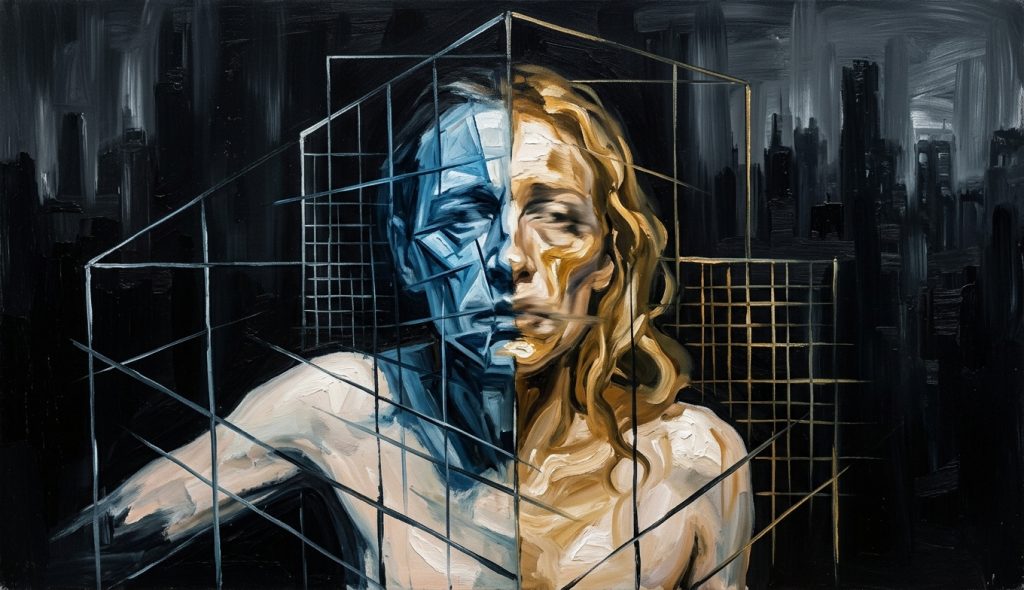
There is a particular kind of person—call them the Awakened Analyst—who sees the machine clearly, or thinks they do. They see a villain behind the machinery of money and power: central banks, intelligence agencies, multinational corporations, the unseen networks that seem to run everything. They believe that if a hero can overcome that villain, all will return to the way it was before, which they remember as good.
They are intelligent, well-read, self-taught, pattern-hungry, morally serious, and genuinely more informed than average. They can talk fluently about finance, geopolitics, historical revisionism, media manipulation, and elite networks. They distrust official narratives and feel a thrill of clarity when they “connect the dots.” They are often responding to real extraction, real corruption, real wars, real elite impunity.
The unspoken premise is: Others are caught in the machine; I am the one who sees it. This is salvation by knowledge rather than by transformation, by standing above the fray rather than by entering into the relational vulnerability of personhood.
I’ve been there. For years I found those stories compelling, and I can still feel their pull. What changed wasn’t that I got smarter. It was that I got tired—tired of villains, tired of heroes, tired of the whole apparatus of blame. What interests me now is relationships: between people, between us and the natural world, between God and human beings.
Gil Bailie wrote a book in 2023 that I only recently found. It’s called The Apocalypse of the Sovereign Self: Recovering the Christian Mystery of Personhood, and it describes a cultural shift from “personhood” to an autonomous, self-made individual who answers to no one. Personhood, in Bailie’s sense, is its opposite: an identity received rather than built or invented, fulfilled not by asserting one’s will but by giving oneself away. Bailie argues that recovering personhood is the only antidote to social and psychological dissolution, and I couldn’t agree with him more.
This essay is about one expression of our culture’s shift to the sovereign self—and how it traps us in a struggle that never ends. It is the shadow-empire story: the belief that a hidden cabal controls the world, that the nation is its hostage, and that a strongman can break the iron grip. There are many such stories, and they are compelling. They are also, in structure, a mirror of what they claim to oppose. To see why, we have to look at the person who tells such a story: how they think, and what it costs them.
The Narrative
The Awakened Analyst tells a story that goes something like this.
There is a shadow empire. It is centered in a particular place—a banking district, a Swiss vault, a foreign capital, depending on which version of the story you have heard. It controls the global financial system. It manipulates governments. It orchestrates wars. It is the source of all the extraction, all the debt, all the suffering. The villain and the hero vary. The frame does not.
The nation—usually America, sometimes another—is a victim of this shadow empire. The nation’s people are good. The nation’s ideals are noble. But the nation has been captured by foreign powers who use it as a host.
The solution is a strongman. A leader who will break the grip. A figure who will stand up to the shadow empire, reclaim sovereignty, and restore the nation to its rightful place.
This narrative is compelling. It explains the chaos. It names the villain. It offers a hero. It gives people something to fight for.
The person who tells it tends to share a recognizable set of mental habits:
- One villain is behind everything. Debt, war, cultural decay, personal unhappiness—all of it traces back to a single hidden agent whose removal would set everything right.
- A pure people against a demonic elite. The nation is innocent, ordinary people are good, the self is awake while everyone else sleeps.
- Salvation through a leader. The answer is never reform, repentance, or the slow work of local community. It is a strongman who will restore sovereignty.
- Impatience with nuance. Ambiguity is seen as cowardice; complexity is seen as an excuse. Anyone who says “it’s more complicated than that” is suspected of being compromised.
- A tribe built on suspicion. Community comes from shared exposure—“we see what they don’t”—which means the group is held together more by what it fears than by what it loves.
- Eyes open to the machine, closed to themselves. They have seen the system clearly. They have not yet seen their own desire to be the one who is not deceived.
Put those traits together and you have what Bailie calls the sovereign self: an individual who has made their own clarity the final authority. They are their own god.
And the story they tell is, in its essential structure, a mirror of the system it claims to oppose: a map of the machine, drawn by the machine.
The Mirror
The most revealing version of the shadow-empire story is the one told in America—the one where the empire is centered in London and the United States is its hostage. The truth is harder to hold than that narrative.
The United States is both the architect of the post-1944 global financial system and its primary beneficiary. It inherited the broader machine from Britain, but it built the modern iteration: Bretton Woods, the dollar as reserve currency, the IMF and the World Bank, the swap lines that let the Fed lend dollars to foreign central banks when the system seizes.
The dollar’s status allows America to export its inflation and import the world’s real wealth. That is the architecture of extraction, and it is no secret.
For a mind trapped in a particular way of seeing, this creates a devastating paradox. How can my good nation be the author of an evil system? How can the hero also be the architect?
The mind has no room for both/and. It needs either/or. So it resolves the paradox by erasing one side. To preserve the sacred narrative that America is good, it strips America of the architect role and projects that creative, malevolent agency onto someplace else.
Britain becomes the puppet master. America becomes the righteous victim. The City becomes the extraction machine. Wall Street becomes an innocent bystander.
Watch how the same person who can explain the Federal Reserve’s mechanics with precision will locate the intention behind the system in London. Watch how the same person who knows the dollar is fiat will insist the real power sits in Zurich. The knowledge is real. The displacement is the tell.
This is the mirror image. The mind sees the villain in the reflection across the ocean, but it never recognizes the face behind the glass. It projects the empire outward because it cannot bear to see itself as the empire.
This is a cognitive shortcut—an automatic, unconscious resolution of psychological friction. But a shortcut, left unchecked, becomes ideology. And ideology, when it serves power, becomes a cage.
The mirror goes deeper than this single paradox. It shapes the entire structure of the shadow-empire story:
- The shadow empire is the sovereign self projected outward: a single will, omnipotent and autonomous, that answers to nothing. The narrator does not want to dissolve that will. He wants to hold it.
- The strongman is the sovereign self politicized: the solution is not personhood, vocation, or self-gift. One sovereign replaces another.
- Mimetic rivalry is built in—the dissident wants what the enemy wants, and so copies the enemy’s methods: secrecy, centralization, enemy-making, instrumental power.
- The nation remains passive material: there is no vision of persons bound in reciprocal love and responsibility; only sovereignty regained.
So the Awakened Analyst is not the opposite of the sovereign self. They are its most sincere devotee. They see the machine clearly—but only in the image of their own desire for control.
And the story does one more thing. It produces a new scapegoat while claiming to expose scapegoating. In the terms of René Girard—whose work on mimetic desire and scapegoating underlies much of Bailie’s thought—the story assigns all chaos to one hidden agent and keeps the nation, and the narrator, innocent. It is the scapegoat mechanism in reverse. It is a false apocalypse. It unveils a villain, but not the self.

Why the Mirror Works
Why does the mind do this? Why does it project rather than see?
The brain has two fundamentally different ways of attending to the world. Iain McGilchrist’s work on the divided brain describes them: one mode sees in fragments. It categorizes, analyzes, simplifies. It craves certainty, clarity, control. The other sees wholes. It holds context, relationship, ambiguity. It tolerates paradox.
In a healthy mind, the two work in balance. The analytic mode serves the holistic mode. The map-maker reports to the map-reader.
But when the analytic mode dominates—when the map-maker refuses to consult the map-reader—a specific kind of blindness sets in. The mind stops checking its conclusions against the broader reality. It trusts its own abstractions more than the living world they were meant to describe. The point is not that one hemisphere is good and the other bad. It is that one has assumed authority in a place it has no way to see.
This is the pattern the ancient traditions recognized in Lucifer. He was meant to serve; he rebelled to become like God. When a part of the brain refuses to serve the whole, it repeats that fall.
And because the analytic mode craves binary narratives—heroes and villains, good and evil—it creates a story that resolves the tension. The story is not a lie. It is a partial truth. It names real institutions, real mechanisms, real extraction. But it names the wrong enemy. And in doing so, it protects the real one.

The Empire Is Not a Place
What the mirror narrative is really trying to describe is an empire much older than the City of London, not external but internal. It is a broken relationship in the human mind. One hemisphere overtakes another.
The curse that followed the fall in the Garden of Eden was this claim to authority. The part of the mind that was meant to serve the garden took the seat of God. It called the fruit good on its own authority, apart from the One who called the world good. It decided to name good and evil without the capacity to see beyond itself. That is the founding charter of every empire that has ever existed: the claim to name reality on one’s sole authority.
The empire built on that claim values, measures, and assigns worth. Where God gave freely and asked only for trust, the empire prices everything—land, labor, time, water, attention, human beings—and calls the price the truth. Its currency is debt. It takes what has not been given and books the obligation as an asset. Your mortgage is its asset. Your labor is its collateral. The empire does not merely tolerate this inversion. It runs on it.
Every empire since Babel has been a variation on this one. The City of London is a node. Wall Street is a node. The Bank for International Settlements is a node. The Federal Reserve is a node. The pattern is larger than any of them, because the pattern is not a place you can conquer and plant a flag. It is a lens—the knowledge of good and evil—that blinds us to whatever it cannot see through its own limits.
What the narrative calls a shadow empire is the local franchise. What the narrative cannot see is the parent company. That blindness belongs to an ancient lie: that everything, including human beings, should be valued, traded, and controlled. It is devoid of wisdom. And it has a name—Mammon, the biblical word for wealth made into a god. Mammon is what half a brain worships when it breaks from its relationship with the whole and declares itself sovereign.
Why It Cannot See
So why can’t the Analyst see the mirror?
Not because they are stupid. The person trapped in the religion of one half of the brain is often deeply sincere. They can see the parts—the bankers, the global elite, the shadow empire—but not the whole pattern: institutions that take on a life of their own wherever power accumulates. They see a conspiracy to be overthrown rather than a pathology to be healed.
The two halves of their mind are not rightly ordered toward each other. One has taken over. The left hemisphere builds a world in its own image—and then fights over who controls the machine instead of questioning the machine itself. This is not a defect in some people. It is the ordinary condition of a mind that has stopped consulting the whole. And it is a choice as well as a pattern.
But there is a deeper reason. The narrative gives them something the truth cannot: a sense of control.
Put yourself in their place. If you know who is pulling the strings, you are not helpless. You have named the enemy, located the lever, and found your place in the fight. The truth offers none of that. The truth says you are complicit, that the machine runs on your participation—on the way you price and measure and rank other people without noticing you are doing it—and that the only way out is a change in yourself you cannot perform by force. That is why the mirror is unbearable—not because it is hard to understand, but because it demands surrender where the narrative offered mastery.
And surrender costs them their identity. If you have spent years fighting the shadow empire—if your community is built on that fight, if your sense of self depends on being one of the few who sees the truth—then admitting the mirror means losing all of it. You become an outsider to your own tribe. You start over.
Most people cannot do that, because the cost is too high. The narrative is not just a belief. It is a home. And leaving home is always painful.
So they stay. They double down. They find new evidence for the old story. They dismiss the contradictions as disinformation. They surround themselves with people who confirm what they already believe, and cut off the friends who ask them to give themselves away.
It is a failure of courage, not of intelligence. To see what you have been avoiding, to admit what you have been denying, to let go of what you have been holding—that is a kind of death, and there is no cheap way back.
The same failure afflicts all of us in one form or another. We all have narratives we cannot see past. We all have mirrors we refuse to look into. We all have truths we cannot bear.
That is why the only way out is humility and forgiveness—humility to see, and forgiveness to let go of what seeing costs. The work is to unblind yourself by first realizing that you alone cannot possess the truth. It is a seeking the left hemisphere knows nothing about.

The Way Out
The solution is not more information. It is not better arguments. It is not sharper logic. Those are the analytic mind’s preferred weapons, and they are the reason the arguments we keep having never end.
Nor is it joining a different team. It is silence, and listening. It is sitting with complexity without needing to resolve it—through art, poetry, and direct embodied experience: a walk in the woods, a piece of music that moves you, a conversation where you truly listen rather than wait to reply, a relationship where you don’t try to fix the other person. It begins with an attitude that says: I do not know everything and I am not perfect—and the willingness to stay in that uncertainty and imperfection long enough for a different kind of knowing to arise.
The integrated mind sees context and relationship. It does not break the world into fragments; it holds the fragments in unity. It does not demand a hero; it sees that we are all complicit. It does not project evil onto an other; it recognizes the shadow in itself.
And what it recognizes is this: the empire is not a place or a plot. It is a way of valuing—the part of the mind that took the seat in the garden, priced the fruit, and has been pricing everything since.
Which is why the State will not save you. Your religion will not save you. They are projections of your own outlook, and those projections have built this world of idols and cages. You do not escape a cage by fighting it. You escape by seeing through it.
The choice remains what it has always been: you cannot serve both God and Mammon.
To see through it is to forgive. Not to excuse, but to understand. Not to condone, but to release.
So start here. Forgive those trapped in one side of their minds. They are not villains. They are fellow travelers on a confusing road—brilliant, sincere, and profoundly misled. To forgive them is not to patronize them. It is to recognize that but for a different configuration of attention and information, we might stand where they stand, and vice versa.
We do not mistake ourselves for heroes of the story. We recognize ourselves as participants in a pattern that has outlived its usefulness. So we do not shame others out of that cage. We simply leave the door open and point to the horizon. With our life, not our argument.
That is friendship. Not a tribe of people who think like you, but being in relationship with people who don’t—who vote differently, pray differently, live differently, see the world differently. It is the daily, unglamorous work of loving someone you cannot control and cannot convert. It is the one school the sovereign self cannot pass through alone.
What Bailie calls personhood is not a better conspiracy map or a stronger man. It is the conversion from spectator to person—the one who stops trying to stand above the machine and begins to live as a gift within it. That conversion is not an argument. It is a death and a rebirth: the moment the sovereign self, whatever mask it wears, lets go of its claim to name reality on its own authority and receives a personhood it did not create and cannot control.
Forgive the bankers. Forgive the politicians. Forgive the priests. Forgive the true believers who fight the wrong enemy. They inherited a way of seeing they did not choose. Forgive them, and help them see.
And forgive yourself—for you too have been trapped. You too have projected. You too have built this world.
The mirror is not a trap. It is an invitation. To see the empire in the glass is to begin to see through it.
If this essay resonated with you, I would love to hear your thoughts. And if you would like to support more work like this, you can support me on Patreon, BuyMeACoffee, or Substack. Thank you for reading.

References & Sources
Bailie, Gil. The Apocalypse of the Sovereign Self: Recovering the Christian Mystery of Personhood. Angelico Press, 2023.
Girard, René. Violence and the Sacred. Translated by Patrick Gregory, Johns Hopkins University Press, 1977.
Girard, René. The Scapegoat. Translated by Yvonne Freccero, Johns Hopkins University Press, 1986.
McGilchrist, Iain. The Master and His Emissary: The Divided Brain and the Making of the Western World. Yale University Press, 2009.
McGilchrist, Iain. The Matter with Things: Our Brains, Our Delusions, and the Unmaking of the World. 2 vols., Perspectiva Press, 2021.
The Holy Bible, King James Version. Genesis 4; 11; Matthew 6:24.


