



The Rise of Sophia | Part 2
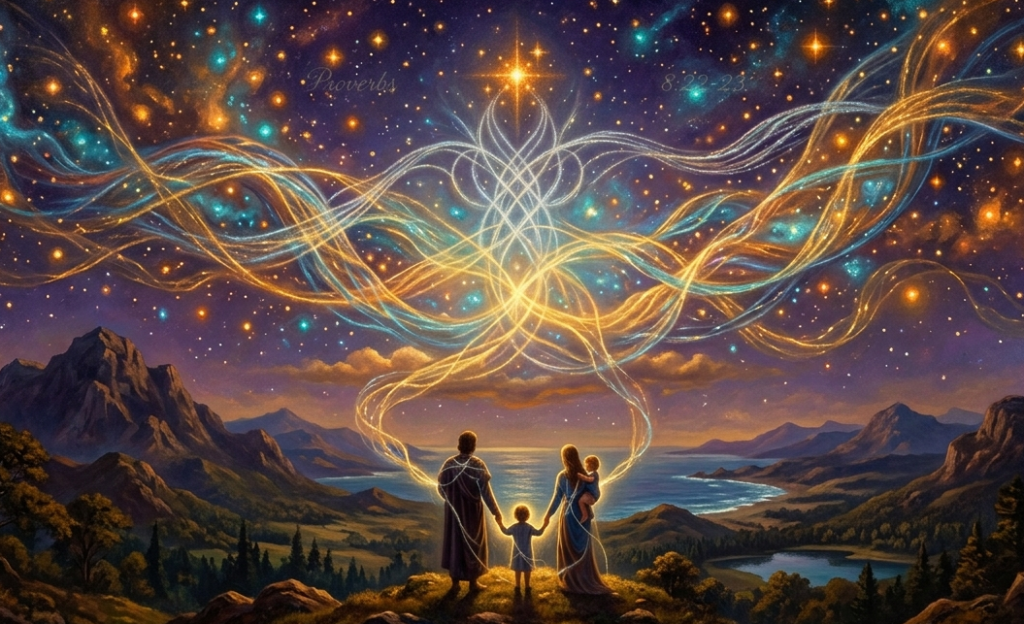
“The Lord brought me forth at the beginning of His way, before His works of old. From eternity I was established, from the beginning, from the earliest times of the earth.” — Proverbs 8:22-23
I remember wholeness before I knew it had a name.
My childhood was, from the inside, a garden. My mother wrote songs, and my father played guitar, and we sang together in front of the fireplace. Love was not something I had to earn; it was simply there.
I imagine it is how the Garden of Eden felt to Adam and Eve before the Fall—that sense of being held by something larger than yourself, of knowing you belong without having to prove yourself. Children assume the garden will last forever. They don’t fully appreciate what happens when it’s gone.
At twelve years old, my world split in two. Two homes. Two stepfamilies. Two competing versions of reality. I did not simply lose my parents to divorce; I lost my trust that wholeness was possible. That fracture became the shape of my longing.
My father remarried quickly and started a new family. I became a visitor in his world, an awkward guest at a table where I no longer belonged. I was included, but never fully welcomed. The message I received was: You are from my old life. You do not belong to my new one. I’m not saying that’s the message he intended; it was what I received.
My mother remarried quickly too. Her new husband was charismatic and funny, but beneath the surface, his controlling personality gradually shaped the atmosphere of our new home. It became difficult for me to see the garden. He was a self-declared alcoholic, not in form but in personality. Later, he found God and became a pastor. But he was still a work in progress—as we all are, as I have learned to my own cost.
Ever the peacemaker, my mother was caught between us. She loved us both, but she could not stop our conflicts. I see now how much that cost her. My wound was not just about losing my parents—it was about losing my foundation of family. I could not escape the feeling that I was the obstacle—the reminder of a fractured past that both my parents were trying to leave behind.
I grew up navigating the gaps between two households, always visiting, never quite at home—and that disorientation tuned my eye to the fractures beyond my doorstep. My family was fractured, just as the world was fractured. I was fractured the same. I see it everywhere now: empires built on control, systems built on extraction, cultures built on consumption. A civilization with more knowledge than any before it, yet clueless about what that knowledge serves.
We didn’t just have a bad run of circumstances. We were separated—from the garden, from the presence of God, and from the family we were meant to be born into. That separation is the root cause of everything that followed. It is the wound I carry in my chest—the same wound that’s bleeding through the headlines. Recognizing this is the first step toward healing.
So what were we meant to become, if we hadn’t been exiled from the garden? Don’t answer. Remember.
Wisdom Before the World
Proverbs 8 contains one of the most astonishing passages in all of Scripture. Wisdom speaks—not as an abstract idea, but as a living presence. She does not merely describe wisdom; she reveals herself. She claims to have been with God before the foundations of creation were laid.
“The Lord brought me forth at the beginning of His way, before His works of old. From eternity I was established, from the beginning, from the earliest times of the earth. When there were no depths, I was brought forth, when there were no springs abounding with water. Before the mountains were settled, before the hills, I was brought forth” (Proverbs 8:22-25).
The Wisdom of Solomon echoes this, describing her as “a breath of the power of God, and a pure emanation of the glory of the Almighty… a reflection of eternal light, a spotless mirror of the working of God, and an image of His goodness” (Wisdom 7:25-26). She is not an idea. She is a presence.
The Hebrew word for wisdom is Chokhmah—and in Hebrew it is grammatically feminine. The ancient writers did not speak of wisdom as an impersonal force, but as a woman: a companion, a presence, one who stands beside God at creation. The Greek translation of the Old Testament calls her Sophia—the same word that gives us philosophia, the love of wisdom.
Chokhmah carries the meaning of skill, craftsmanship, and the ability to create in the world. It is not information stored in the mind. It is wisdom embodied in action—what a master craftsman possesses, what an artist expresses, and what a wise person carries into the world. It is not knowing about life. It is knowing how to live.
There is another Hebrew word often translated as knowledge: Da’at. But Da’at is not really knowledge. It is experiential knowing—the kind that comes through relationship. It is the word Scripture uses when Adam “knew” Eve—a knowing that is intimate, trust-filled, and participatory. Not observing from detachment, but knowing through connection.
Whether we read this as history, myth, or metaphor, the ancient story of Adam and Eve helps us see their differences, while capturing a profound psychological truth. Eve did not reach for the fruit out of relationship with God; she reached for another reason. She wanted the wisdom the fruit promised, on her own terms, apart from the Giver.
The tragedy was not that she desired wisdom, but that she sought it outside of relationship with God. She bypassed intimacy with God (Da’at) to obtain wisdom (Chokhmah) through autonomy. She grasped. She tried to possess it rather than allowing herself to receive it in the right time through relationship.
But there’s no shortcut here. Wisdom comes only through relationship as a gift.
Because she tried to possess it and did not receive it, the order was reversed—relationship was no longer first, and wisdom was no longer received as a gift. That reversal is what we call the Fall.
Before the Fall, the order was:
Da’at (Relationship) → Chokhmah (Wisdom) → Binah (Understanding) → Life
The Fall inverted this order. Humanity chose autonomy over intimacy, grasping over receiving, control over trust. The new order became:
Autonomy (Separation) → Knowledge Without Wisdom → Domination (Control)
Eve grasped knowledge, but she lost wisdom. Adam follows. He turns from “bone of my bone” to “the woman You gave me”—from union to accusation. Connection becomes blame, and humanity’s wholeness is fractured.
He names her only after he blames her—just as he had named the animals. Before the Fall, she was bone of his bone. After, she was something to name, to own, to control. Relationship had become possession. Patriarchal control emerged not from creation, but from the Fall.
This yields a clear thesis: Wisdom pursued outside of relationship becomes not wisdom at all, but domination. Knowledge without relationship is control—and that control is what we call the Fall’s enduring legacy. Wisdom was buried, and with her, the very shape of our humanity. Her voice was silenced in our worship, our families, and our perception of God—and we have been living the consequences ever since.

The Pattern of the Family
The Apostle Paul reveals that the pattern of creation reflects the Creator: “For by Him all things were created, in heaven and on earth, visible and invisible… all things were created through Him and for Him” (Colossians 1:16).
Look at a family: two people come together, and from that union, something new is born—a child, a home, a future. It is a weaving, not a solo act. Strength meets tenderness. Justice meets mercy. Masculine and feminine, each incomplete without the other, woven into one fabric.
When I speak of the ‘Mother-heart of God’ or the figure of ‘Sophia,’ I am not introducing a fourth person to the Trinity or a separate goddess. Rather, I am describing the eternal, relational Wisdom who stood beside God at creation—the pattern of divine love that, in the fullness of the Gospel, is embodied in the Bride.
She is the soul of humanity awakened, the Church made ready, the exiled feminine heart of creation called home to her Bridegroom, Christ.
The relationship between God and Wisdom is the relationship between the Creator and His beloved counterpart. Creation was not a solitary act. Wisdom was there—beside Him, delighting in what was being made. She was the harmony, the order that gave shape to formless chaos. Without her, creation would have been sound without music, words without poetry, a house without a home.
This is where the fracture begins. The absence of the feminine from our understanding of the divine leaves us broken. It is like speaking of a family without a mother—the structure remains, but the warmth is gone. What we remove from God, we lose in ourselves.
When we reduce God to lawgiver alone, we lose the tenderness of a Father who weeps over His children. When we reduce God to judge alone, we lose the mercy of a Mother who gathers the broken under her wings. And when we reduce God to power alone, we lose the wisdom that asks: Is this good? Does this serve life? Does this bring healing or harm?
We have inherited a faith that spoke often of the Father and sometimes of the Son, but rarely of the Mother—and when she did appear, it was in the figure of Mary, honored but diminished, her personhood reduced to a single function. In that silence, something in us atrophied. We learned to fear God without learning to trust Him. We learned to obey without learning to love. We learned to perform righteousness without learning to rest in grace. The feminine dimension of the divine—Sophia, Chokhmah—was pushed to the margins. And when we lose her, we lose the capacity to receive love, to nurture life, and to hold the world in tenderness rather than control.
Jesus showed us a different way. He called God ‘Abba,’ a term of intimate love, not distant authority. He welcomed women as disciples, restored their dignity, and treated them as full participants in the Kingdom. He washed feet, a servant’s task. He wept over Jerusalem. He let himself be touched by the broken. He did not guard his power; he gave it away. This is what healthy masculinity looks like: strength that serves, authority that nurtures, and power that protects rather than controls.
In Jesus, the pattern of the Divine Family was not a distant ideal—it was a lived reality.
Our wound runs deep. But it is not incurable.
The Consequences
The theology we project upward becomes the psychology we live downward. What we remove from God, we lose in ourselves—not as a theory, but as an ache we carry in our bones.
We become people who grasp for knowledge without wisdom, who seek security through control, who build systems around domination rather than relationship. We are orphans who do not know we have a Mother, performers who have forgotten we are already beloved.
When God becomes only Father—strength without tenderness, authority without nurture—we forget the feeling of being held simply for who we are. We forget what it means to be received without condition, to rest without striving, to belong without earning. We become actors, endlessly auditioning for a love we were already given but can no longer feel.
This absence shapes everything—how we educate, how we treat the earth, and how we relate to one another. A culture that has exiled the feminine from its image of God will inevitably exile it from its politics, its economics, and its families. It measures success by production rather than flourishing. It values strength over compassion. It prizes independence above connection. The result is a world built on extraction, domination, and control.
A culture shaped by this wound becomes anxious. It is never enough. There is always more to achieve, more to prove, more to acquire. When strength is severed from tenderness, man loses his balance. What was meant to serve life begins to consume it.
The same wound distorts our most intimate identities. We no longer know what it means to be male or female—only what it means to perform, to conform, to hide the shame we are taught to see. We learn to hide among the trees of the garden, covering ourselves with fig leaves made of achievement and carefully constructed personas.
This is the deeper wound behind so much of human history. Violence, conquest, extraction, and exploitation are not expressions of true strength. They are signs of strength separated from wisdom—the thrashing of a soul that has forgotten how to receive, how to nurture, and how to rest in the love that was there before we earned it.
None of this is about biological determinism. Men can embody Sophia’s tenderness, and women can embody strength. But as a culture, we have severed the archetypal values of receiving and nurturing—values historically and symbolically carried by the feminine—from our image of God.
This matters because the feminine is deeply connected to embodiment—to birth, to blood, to earth, to the cycles of life and death. Not a cultural stereotype, but a biological and spiritual reality woven into creation. When we lose connection with this dimension, we treat the world as an object rather than a relationship. We see the earth as something to exploit rather than something entrusted to our care. We see our bodies as machines to optimize rather than gifts to honor.
The wound is the reason we are exhausted. It is the reason we feel unseen. It is the reason we scroll endlessly through screens seeking connection we cannot find.
I see this wound in my own story—in the frantic striving of my younger self, always auditioning for love, always afraid that if I stopped achieving, I would cease to matter. The fracture in my family was not only personal. It was the shape of a larger fracture, the one our entire civilization carries. And like all deep wounds, it aches because it is still alive—waiting to be healed.
The Irony
And what happens when the feminine is shamed?
When a woman’s way of knowing—her intuition, her emotional intelligence, her relational nature—is dismissed as “girl brain” or “emotional bullshit” (actual quotes from men I know)? She learns that her voice does not matter.
She learns that to be taken seriously, she must suppress her emotions, silence her intuition, adopt a way of thinking that values knowledge over wisdom, control over connection, certainty over mystery.
This is the deeper distortion. We don’t just silence women—we force them into a broken form of masculinity, one that has already rejected the feminine as weak or irrelevant. They become harder, more guarded, more driven to prove themselves through competition and control. They learn to perform a version of strength that was never theirs to begin with.
The wound is doubled: the feminine is rejected, and women are left to carry the weight of a masculinity that was never theirs, losing access to the very gifts the world desperately needs.
And once women are no longer seen as valuable, they become objects to be used—bodies without voices, functions without souls. Men who shame the feminine and objectify women are not just dismissing part of themselves—they are telling half of the human family to abandon their own nature. But what if her way of knowing—the emotional, the intuitive, the relational—is not lesser? What if it is essential? What if the world cannot be healed without it?
Healthy femininity is not passivity, but a different kind of power: intuition that perceives, wisdom that connects, and a way of holding the world that nurtures rather than consumes.
Here is the irony those who have exiled Wisdom cannot see. In their effort to purge the feminine from the world—to value only the rational and the controlled—they create the very thing they despise. The more they reject the feminine, the more it returns—distorted, exaggerated, often in forms they find threatening.
The irony cuts deepest here: to purge the feminine is to make women unnatural, and then despise them for it. This is the cost of forgetting Wisdom. What you exile does not disappear. It returns—any way it can, even through toxic expression, in men, and in other forms you refuse to accept.
Let Us Make Man
In Proverbs, the father instructs the son to embrace Lady Wisdom. The Hebrew word for embrace is also used in the Song of Songs for the intimate embrace between lovers. It describes both the embrace of wisdom and the embrace of a beloved.
The language of Proverbs 8 is the language of creation. Wisdom is “brought forth.” She is “established” from eternity. She is “beside” the Creator—not as an instrument, but as a companion in the mystery of creation. She is not a tool God uses; she is a partner God loves.
This reveals something extraordinary: wisdom is relational. She does not offer information; she offers intimacy. She does not dispense advice; she invites us into union.
The Song of Songs carries this mystery even further. It is the story of longing, pursuit, separation, and union. The beloved woman at the center of the poem has often been interpreted as a symbol of the soul seeking God. But here is the key to this entire series: She is the voice of Wisdom herself—not as a goddess, but as the personification of the Bride. She is the feminine expression of divine longing, calling humanity back into communion. She is the soul of creation preparing herself for her Bridegroom.
The Song of Songs contains no commandments, no laws, no theological arguments. It is simply a love poem—passionate, intimate, and unashamed. At the heart of reality is not domination. It is love. The love between Creator and Wisdom. The love that gives birth to creation. The love that calls all things home.
The ancient book of Sirach 24 confirms this same Wisdom seeking a dwelling place among humanity—a presence restless until she finds her home among God’s people: “Then the Creator of all things gave me a commandment, and the One who created me assigned a place for my tent. And He said, ‘Make your dwelling in Jacob, and in Israel receive your inheritance’” (Sirach 24:8).
The name Jacob means “he grasps the heel.” He was a schemer, a manipulator, a deceiver who relied on his own cunning. But Jacob’s story is also one of transformation. One night, he wrestled with a mysterious figure until dawn—a struggle that left him wounded and limping. In that encounter, he was given a new name: Israel, which means “he struggles with God.”
So when Wisdom is told to “dwell in Jacob,” the message is profound. It means this: Wisdom does not choose the perfect, the polished, or the self-sufficient. She chooses the broken, the struggling, the one who limps. She does not wait for us to get our act together. She moves into the very heart of our imperfection. Do you see?
If creation is born from relationship, then the universe is not simply a machine. It is more like a family. The stars are not merely objects to be measured. The earth is not merely matter to be managed. Every atom is marked by the love that spoke it into being. Every living thing carries the signature of the relationship that gave it breath. We were not manufactured; we were conceived. We were brought forth.
This same God who meets Jacob in his brokenness is the God who spoke at the very beginning—not in isolation, but in relationship. The “us” in this ancient creation poem—“Let Us make man in Our image”—has long puzzled theologians. But spiritually, it points to something we all intuitively know: we were not born from isolation, but from relationship. Some have understood this as the voice of the Trinity. Others as the divine council. But what if the “us” reflects the presence of Wisdom and the family of God? What if the image of God is not the image of a solitary being, but the image of relationship itself? To be made in that image is to be made for love—to receive it, to give it, and to become it.
God is not defined by isolation. Creation is not the product of a lonely will imposing order upon chaos. It is the overflow of relationship—love giving itself away. The universe is not a monologue; it is a conversation. And we are invited to join it.
But what happens when the institution that claims to lead this conversation instead silences the other voice? What happens when the family that was meant to reflect the Divine becomes a house divided against itself?
The Wound in the House of God
If the divine family is the pattern for the human family, why does the hierarchy of the Church not reflect that pattern? Why is the family—Father, Mother-heart of God, and Children in mutual relationship—replaced in our theology by a Trinity of three males—even though the Spirit’s Hebrew root, Ruach, is grammatically feminine? (The Church’s popular imagination has overwhelmingly rendered God as three masculine persons.)
What happens when an institution founds itself on an all-male image of God, with no room for the Mother, no room for Wisdom, no room for the feminine at all?
We have seen the answer unfold in our own time.
The Catholic Church—an institution that has carried the Christian tradition for millennia, claiming to speak for God and guard divine truth—has been devastated by revelations of sexual abuse, the exploitation of children, and decades of systematic cover-up. This is not about the failure of individual priests or bishops. It is about a failure rooted in the very understanding of God.
The pattern is unmistakable. When God becomes exclusively masculine, exclusively powerful, exclusively distant, obedience replaces intimacy. Rules replace relationship. The priest becomes a mediator rather than a brother. The laity become subjects rather than children. The Church becomes a system of control rather than a family of belonging. Vulnerability is no longer safe. Children become objects rather than gifts. Trust becomes a vulnerability to be exploited.
The feminine dimension of the divine—Wisdom, tenderness, the mother’s heart—was not only neglected; it was exiled. And in that exile, something deformed the soul of the institution itself. The very people meant to embody the Father’s love instead embody the father’s absence—or worse, the father’s abuse.
The men who abused children were products of a system that had divorced strength from tenderness, authority from nurture, and power from vulnerability. They were acting out a perversion of the very pattern they had been taught—a pattern that said God is distant, that power is to be exercised over others, and that the body is something to be controlled rather than cherished.
And the bishops who covered for them? They were protecting not just themselves, but an image of God that could not bear the weight of its own failure. To admit the truth would have required admitting that the institution had lost its way. That the pattern they had been teaching was fractured. That the family they claimed to represent was, in fact, a house divided against itself.
Yet even here, Wisdom does not abandon us.
Wisdom dwells in Jacob. She does not wait for us to become perfect. She enters our brokenness. She moves into the heart of our failure. And she begins to heal.
The Church is Jacob. It has been limping for a long time. It has wrestled with God and with its own demons. It has inflicted wounds on the very ones it was meant to protect. But Wisdom is not institutional; it is personal. Christ showed us this. She does not reside in structures or hierarchies—she dwells in people. And she is calling them now, within the Church and beyond it. Her dwelling place is in hearts that have been broken open.
The recovery of Wisdom is not about abandoning the Church. It is about restoring what was lost—not as a political corrective, but as a spiritual necessity. It is about remembering that God is not a lonely Father ruling from a distance, but a loving parent whose heart is turned toward us. It is about building communities where vulnerability is safe, where children are cherished, and where love is not a performance but a gift.
The wound is deep. But Wisdom is deeper. She is patient. And she is at work.
Patience is not passivity. It is the quiet certainty that what was fractured will one day be healed. And that healing is already underway—not in some distant future, but in the rising of Wisdom in hearts that have been broken open.
Sophia Rising
And yet, I do not end here.
I have named hard things. The fracture in the Church. The fracture in our civilization. The fracture in my own family. I have traced the wound from the Garden to the present moment—from the exile of Wisdom to the ache of longing.
But I have not done this to leave you in despair.
I have done this because I believe something true: the wound is not the end. The fracture is not the final word. Separation is not the destination. The Garden was not destroyed—we simply lost the sense of it. And now, slowly, painfully, beautifully, we are learning to see it again.
The Weaving was never destroyed. Only hidden. And now it is being revealed.
The fracture I felt as a child—the divorce, the loss of wholeness, the longing that shaped my searching—is the same fracture I have traced through these pages. The same pattern that shaped empires shaped my family. And now I see: that fracture was never the end. It was the beginning of the Weaving.
I am not simply writing about Sophia. I am learning to embody what she represents—and in that, I am becoming the one she was always calling me to be. She is rising in me. She is rising in you.
The healing of the world is the restoration of the family—the Divine Family, the human family, the family within each of us.
This is the Weaving made whole. This is the homecoming.
Wisdom is the capacity to see things whole—to perceive patterns, hold tensions, and know when to act and when to wait. She is the gift of integration: the ability to hold strength and tenderness, justice and mercy, truth and love without letting one devour the other. When Wisdom is absent, we become addicted to what can be measured, managed, and controlled. But when she is present, we remember the ancient arts of listening, receiving, and belonging.
I’m not talking about a new theology here, but the oldest one of all. It is what the Hebrews called Chokhmah—Wisdom beside God before creation. It is what the Greeks called Sophia—the feminine presence of divine order, beauty, and love. But these were not separate from the God of Israel. They were expressions of the same God—the God who would one day be made visible in Christ.
In Christ, the love of the Father and the nurturing wisdom of God are united without division—the qualities we so often separate into masculine and feminine, held in perfect wholeness. He is the Logos made flesh, the Word through whom all things were made. And in Him, Wisdom is not replaced—she is fulfilled. She is the Bride made ready, the Church awakened, the soul of humanity called to her eternal wedding feast.
This is the Rise of Sophia: the awakening of the Bride from her long sleep. She is not a goddess to be worshiped, but a nature to be embodied. She is the exiled heart of creation, finally coming home to her Bridegroom. The Bridegroom is Christ—the divine love that seeks us out. The Bride is us—humanity, the soul of the world, awakened, restored, and radiant.
And so I close this essay where it began—with Wisdom beside God at creation, delighting in what was made. But now we see what we were made for: not isolation, but relationship; not control, but love; not fractured families, but the Weaving made whole.
The healing has begun. The pattern is being restored. And we are learning to take our place in the family we were always meant to be born into.
In the next essay of this series, I will take you back to the Tree itself — to the moment a choice was made. But the Fall was more than a choice; it was an opening for another choice yet to come.
If this essay resonated with you, consider supporting my work through Patreon, BuyMeACoffee, or Substack. And if you have thoughts, questions, or opportunities to collaborate, I’d love to hear from you. Thank you for reading.


 “Outstanding, sophisticated, and mesmerizing…a spiritual intrigue similar to Dan Brown’s The Da Vinci Code.” —ForeWord Reviews