



How Financial Extraction Was Invented—and Why We Mistook It for Reality
“If the American people ever allow private banks to control the issue of their currency, first by inflation, then by deflation, the banks and corporations that will grow up around them will deprive the people of all property until their children wake up homeless on the continent their fathers conquered.” — Attributed to Thomas Jefferson
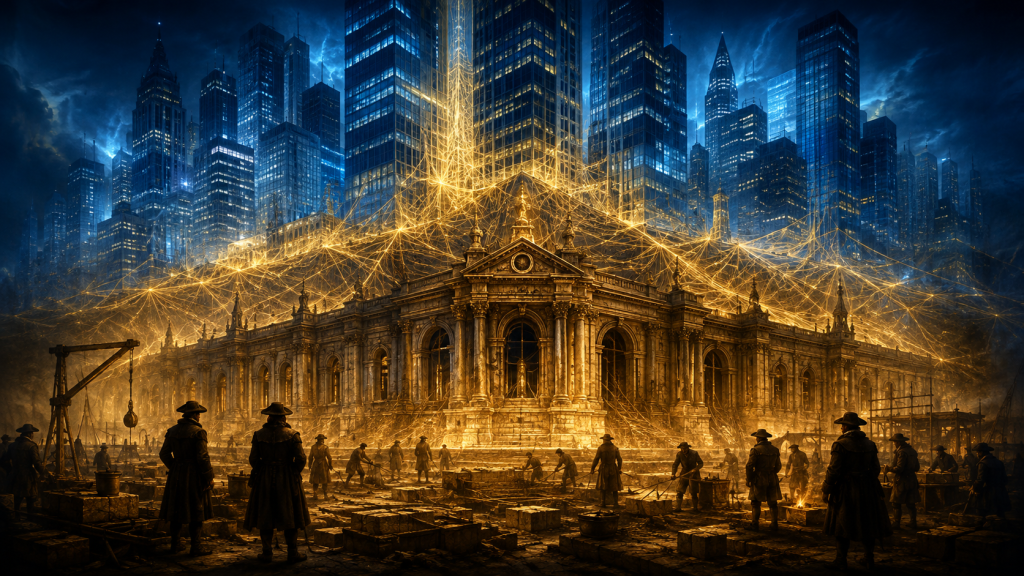
This is the story of how that warning is becoming reality.
The modern world was not born in a parliament or on a battlefield. It was born in a backroom deal in 1694—a quiet heist so audacious that it didn’t just change the power structure; it turned it inside out.
The architect was a desperate king. William III needed £1.2 million—a staggering sum—to finance a war against France. A Protestant champion, recently crowned after deposing a Catholic king, turned to a consortium of wealthy London merchants. While they had plenty of means, the merchants didn’t trust the Crown. Monarchs had a habit of defaulting, and when that happened, their entire investment would be gone.
So they struck a hard bargain. They would lend the money, but only on two conditions: a guaranteed 8% annual interest in perpetuity, and a monopoly on banking—including the exclusive right to issue their own paper banknotes. That monopoly was the masterstroke. It shut out competition, cementing their grip on the money supply. They became the sole architects of the nation’s currency.
Here is exactly how the trick works—and once you see it, you can never unsee it.
Step 1: Create money from nothing. The merchants didn’t hand over £1.2 million in gold. They didn’t have that much. Instead, they used their royal charter to print £1.2 million in notes. These notes were backed not by bullion, but by the government’s promise to accept them for taxes. They lent the King something that did not exist.
Step 2: Spend it into reality. The King spent the notes on ships, guns, and soldiers’ wages. The notes circulated because people trusted the government’s promise to redeem them—even though the bankers kept only a fraction of that gold in reserve. Fractional reserve banking was born.
Step 3: Tax the people to pay the interest. To pay the bankers their 8%, the Crown raised taxes—not from bankers’ profits, but from the wages, bread money, and livelihoods of ordinary working people.
Step 4: Extract real value for nothing. The bankers lent paper (costing next to nothing to produce) and were repaid in sweat and toil. Worse, the loan was “perpetual”—the principal would never be repaid. Only the interest, forever.
Step 5: Devalue quietly. More notes were printed to fund wars and deficits. But the newly printed money didn’t hit bakeries or butcher shops. It flowed into assets that acted like sponges: land, stocks, and bonds. These vessels soaked up the excess, inflating paper wealth for the already-wealthy while hiding the currency’s erosion from the public eye.
For a time, goods kept up with wages and rent held steady. When the housing bubble burst in 2008, it unleashed a flood of liquidity that finally pushed up the cost of everyday goods. The old sponges were saturated. But the printing did not stop.
The Machine Multiplies
A single loan to a desperate monarch does not a global system make. The true genius of this architecture is how it scales.
Money is a symbol. It represents value—labor, time, effort. But you cannot manufacture labor, time, or effort; they are the substance of life. When you create a representation out of nothing, you are not creating value. You are creating a fiction—and when you demand that society treat that fiction as real, you are building a system of control.
Watch how it multiplies:
- A government issues bonds.
- A bank buys $1 million in bonds and uses them as collateral to borrow $900,000 from another bank.
- That money is lent to a business or homebuyer, deposited in another bank, and lent out again.
- Each step creates new money from the original debt, expanding the money supply without new gold or silver.
This is the magic money multiplying machine. The debt expands beyond the state and the bankers, becoming the lifeblood of the entire economy. But it functions only as long as everyone trusts in it, believing the debt is “safe.” The moment that belief changes, the mechanical parts start breaking down.
The British Arc: From Empire to Subsidiary
Britain was the first nation to master this architecture. The 1694 deal gave it a permanent national debt and a trusted, gold-convertible currency. But the gold standard didn’t work the way it should, because the government always prints more currency than it has vaulted physical gold.
Britain suspended gold convertibility during the Napoleonic Wars (1797–1821), effectively defaulting on its paper promises, before restoring it at a higher peg. By the mid-19th century, the pound sterling was at its zenith, the anchor of global commerce. But the signs of decline were already present.
World War I was the turning point. Britain needed dollars to buy supplies from U.S. manufacturers—and to get dollars, it paid in gold. Those gold shipments depleted its reserves, and by 1918, Britain had gone from the world’s largest creditor to one of its largest debtors.
America’s capacity to lend those dollars was no accident. Just six months before the war began, in December 1913, the United States had quietly established its own version of the Bank of England—the Federal Reserve—born from a secret meeting on Jekyll Island in 1910, where the nation’s most powerful financiers drafted a plan for a central bank controlled by private banks. The public was told the financiers had gone duck hunting. When the war erupted, the Fed gave America the financial firepower to become the world’s new creditor.
Britain briefly returned to gold in 1925, then abandoned it for good in 1931, and in 1944, Bretton Woods formalized the transfer: the dollar replaced the pound as the global reserve currency. Britain built the architecture; America now owned the deed.
Enter 1956. The Suez Canal was Britain’s lifeline—roughly two-thirds of its oil passed through it. When Gamal Abdel Nasser, Egypt’s president, nationalized the canal, Britain and France tried to seize it by force. But they couldn’t sustain the invasion without American financial support. Eisenhower refused , unwilling to risk a wider conflict with the Soviet Union. Within 48 hours, Britain’s currency was crashing, and it had no choice but to withdraw its troops.
It was suddenly clear—Britain no longer set the rules; America did. The empire that had ruled a quarter of the globe was now dependent on its former colony.
The Suez-Hormuz Parallel
History does not repeat, but it rhymes. Britain’s humiliation at Suez exposed its dependency. Now in 2026, seventy years later, the U.S. faces its own Suez moment.
The Strait of Hormuz is the world’s most critical oil chokepoint—approximately 20% of global oil and 30% of seaborne oil passes through it. It is the jugular of the global energy system. The U.S. has built a multinational naval coalition to protect it—but the U.S., like Britain before it, is overextended. Its debt is nearing $40 trillion. Its military commitments are endless.
Britain relied on Suez for its oil and lost it because it could not afford to act alone. The United States now relies on Hormuz for the same reason. If the U.S. cannot protect that chokepoint without massive borrowing, it faces the same choice: retreat and humiliate itself, or borrow further and enslave itself deeper to the bankers.

And while America deliberates, the next headquarters is already being built.
BRICS began in 2006 as a diplomatic grouping of Brazil, Russia, India, and China, joined by South Africa in 2010. Since then, it has expanded dramatically. In 2024, Egypt, Ethiopia, Iran, Saudi Arabia, and the United Arab Emirates joined; Indonesia followed in 2025. Today, the bloc represents eleven members, nearly half the world’s population, and—measured by purchasing power parity—a larger share of global economic output than the G7. More important than the numbers, however, is what the group is building: the infrastructure of a parallel financial order.
First: the New Development Bank (NDB). Established in 2015 and headquartered in Shanghai, the NDB was created to provide an alternative source of development financing to institutions dominated by the West—particularly the World Bank and IMF. With $100 billion in authorized capital and more than $40 billion in approved financing across over 130 projects, it is becoming the lending institution of the emerging bloc. The significance is not simply the money; it is independence. Countries seeking infrastructure and development financing increasingly have another institution to turn to, one outside the traditional Washington-centered system.
Second: a new settlement system. BRICS is also experimenting with a digital trade currency known as the “Unit,” designed not for ordinary purchases but for settling international trade. The concept is straightforward: instead of requiring two countries to convert their currencies through the dollar, transactions could be settled through a shared instrument backed by a reserve basket—40% physical gold and 60% BRICS national currencies, equally weighted. The system is still experimental; a working prototype was launched in late 2025, and by December of that year, market fluctuations had adjusted each Unit’s value to 0.9823 grams of gold. BRICS is attempting to create a mechanism through which countries can trade without making the dollar the indispensable middleman. That is a profound change.
Third: the physical foundation—gold. Digital currencies and financial institutions ultimately depend on trust. Gold provides something different: a physical asset that exists outside any government’s promise. China has spent years expanding its gold infrastructure; the Shanghai Gold Exchange has become the dominant center for physical gold trading, with cumulative trading volume reaching 3.14 million tonnes (single side) in 2025. In June of that year, the Exchange opened its first offshore gold vault in Hong Kong, a significant step toward internationalizing yuan-denominated gold contracts. Meanwhile, BRICS nations have accumulated gold reserves now estimated at over 6,000 tonnes, representing roughly 17.4% of global central bank reserves, up from just 11.2% in 2019. Russia and China alone account for more than 2,000 tonnes each. This matters because the emerging system is not being built entirely on digital promises; it is being anchored, at least in part, to something tangible.
And here the historical pattern becomes impossible to miss.
In 1694, a desperate English government and a consortium of financiers created the Bank of England—an institution that helped transform private capital into national power. More than two centuries later, American financial leaders gathered at Jekyll Island to develop the framework that would become the Federal Reserve. The details were different; the historical circumstances were different. But the underlying pattern was the same: a new financial center emerges, institutions are created to support it, capital gathers around those institutions, and eventually the financial architecture becomes geopolitical power.
Today, BRICS is building its own architecture—not in secret, but in plain sight. And there is one crucial difference: the emerging system is attempting to place gold back at the center of international settlement.
The architecture remains. Only the address changes.
The question is no longer whether another center of financial power can emerge. It is whether Americans will recognize the shift before the center of gravity moves—and whether the rest of us will simply inherit another financial architecture under tighter control, or finally learn to build something different.
The Spiritual Vacuum
But the transfer of power was not merely financial. It was a reflection of a deeper, spiritual unmaking.
Christendom was the political and religious order that dominated Europe for over a millennium—the fusion of Christian faith with political power. World War I was fought by the “Christian empires”—Britain, France, Germany, Austria-Hungary, Russia—but it had nothing to do with Christ. It was about power, territory, and resources. The war shattered the moral authority of the Church and the divine right of kings. God seemed absent from the trenches.
When a sacred order dies, it leaves a vacuum. And history fills vacuums. The void was not filled by a new religion, but by a new logic: the logic of the bureaucratic state, the legal contract, and the measurable metric. Max Weber called this “legal-rational authority.” Divine right gave way to procedural efficiency. Sacred bloodlines gave way to spreadsheets.
This is where the neuropsychiatrist Iain McGilchrist enters. He argues that Western civilization has suffered a catastrophic imbalance—a dominance of the left hemisphere’s mode of attention. The left brain fragments, abstracts, and re-presents the world as a static, manipulable system. It mistakes its own symbols for reality. The right brain perceives the whole—the living, the embodied, the sacred. But when the left brain dominates, it builds a machine that cannot see what it is destroying.
This new System—abstract, procedural, indifferent to identity—rewarded those already fluent in its language. It did not care about blood or divine favor; it cared about adaptability and systemic fluency.
The System selected for skills that were mobile, intellectual, and transferable across borders—the very skills required for law, banking, finance, media, and commerce. Historically, European Jews—confined to ghettos, barred from land ownership, restricted to money lending—had been forced to cultivate these very abilities. The Torah was a system of rules; the Talmud, a system of interpretation. Diaspora commerce required letters of credit and enforceable contracts across borders. For centuries, they had been training for a world that did not yet exist.
But they were not alone. Huguenot exiles, Dutch merchants, and English Quakers—all outsiders to the landed establishment—developed similar fluency in contract, credit, and cross-border paper. The System was ecumenical in its opportunism. It took the skills that marginalization had forged and elevated them to the highest offices of power.
The modern world is not a catastrophe. It has delivered wonders—medicine, technology, abundance—that previous generations could scarcely imagine. But every gift has a cost. The cost of this System is that it rewarded abstract, procedural success at the expense of the embodied and the sacred—and in doing so, hollowed out the very traditions it claimed to inherit.
The Inversion Made Flesh
The Balfour Declaration of 1917 stands as the ultimate symbol of this inversion. In the midst of World War I, the British Empire was staggering under war debt. Debt-crippled and desperate for leverage, British officials promised Palestine to the very people they had long kept on the margins.
Edmond de Rothschild’s millions had already sunk into the land—private capital preparing the ground for public policy. But Rothschild was not alone; the broader network of international finance—Protestant, Jewish, Quaker, and secular—was shifting the center of gravity. Christendom had laid claim to the Holy Land for centuries; now, in a single stroke, Britain pledged it to the Jews—not out of idealism, but out of calculation, in exchange for credit and influence. The old order was formally expiring.
The deeper loss, however, was spiritual. The Jewish tradition has tikkun olam—”repairing the world.” It is a sacred call to heal creation. But in the hands of the new System, this ancient calling was hollowed out. It became a grammar of power, a tool for social sorting. What was once a spiritual duty became a bureaucratic checkbox.
Representation and Reality
The system does not merely generate debt. It generates meaning—and the meaning it generates is shaped by the values that emerge through debt itself. Debt creates a logic: everything must be quantified, collateralized, and made legible to the machine. Over time, that logic becomes the only logic that matters.
This is not accidental. The sociologist Max Weber described the “iron cage” of rationality—a world where efficiency and calculation become ends in themselves, displacing the values they were meant to serve. The psychologist Iain McGilchrist describes the same phenomenon from the inside: a left-brain mode of attention that fragments the world into abstractions and mistakes its own symbols for reality. The System does not simply use metrics; it worships them. And when you worship a metric, you begin to reshape the world to fit the metric, rather than the other way around.
Money represents value. A bond represents a claim. A GDP number represents human activity. Over time, we cease to see the underlying reality and live entirely inside the representations. We mistake the symbol for the substance, the map for the territory, the credit rating for the nation.
This is the left-brain loop—endlessly processing its own symbols while losing touch with the living reality they were meant to serve. When a stock price rises, we call it growth. When GDP increases, we call it prosperity. We believe the chart is the economy, the balance sheet is the company, the credit rating is the country. The representation has swallowed the reality.
This is the logic of the System itself: social relationships are reduced to abstract, tradable things. A mortgage is no longer a promise between a lender and a borrower; it is a tradable asset. A pension is no longer a commitment to a worker’s future; it is a portfolio of derivatives. A nation’s wealth is no longer its people, its culture, its land; it is its GDP. The System strips the human from the transaction and sells it back to us as “efficiency.”
We count what can be counted and treat the uncountable—love, loyalty, faith, sacrifice—as irrelevant externalities. That is the worship of Mammon in its most advanced form: the moment when the representation becomes more valuable than the reality it was created to serve.
Debt became wealth. Credit became money. Efficiency became morality. The machine we built to facilitate human life began determining what human life was worth.
The Only Collapse That Matters
Beneath the surface of this entire cycle is a deeper reality:
“For our struggle is not against flesh and blood, but against the rulers, against the authorities, against the powers of this dark world and against the spiritual forces of evil in the heavenly realms.” — Ephesians 6:12
The evil is not a people. It operates through individuals and their choices, their lies, their deeds. It is the worship of Mammon.
Mammon is the left-brain made god—the reduction of all things to measurable output, extractable value, and calculable return. This reduction did not happen overnight. It was the culmination of a slow shift—from the Reformation’s emphasis on text and law, to the Enlightenment’s faith in reason and measurement, to the rise of legal-rational authority. Each step privileged the abstract over the embodied, the calculable over the sacred.
By the time we built the global financial system, we had already trained ourselves to see the world as a ledger to be balanced rather than a creation to be loved. The architects of global finance have built a temple. They have made the state a perpetual debtor, ensnaring the entire world in a web of debt.
Jesus said: “You cannot serve both God and Mammon.” This is a warning about the system of debt, usury, and accumulated wealth that enslaves people and nations. Mammon does not care about flags or borders. It cares about stability, security, and return.
The irony was almost biblical. William III had taken the throne to preserve Protestant Christendom. But the financial architecture he signed into existence would eventually hollow out that Christendom from within. The king who fought to keep the old faith in power had inadvertently signed its death warrant. The system he built did not care whether its debtors were Catholic or Protestant—it cared only about yield, security, and return. In doing so, it replaced the cross with the balance sheet.
The world changed in 1694. But the deeper change—the spiritual inversion—happened gradually, as we began to believe that the fiction we created was more real than the lives it was meant to serve. That is the unmaking of the human: the reduction of flesh-and-blood beings to data points, the substitution of measurement for meaning, the worship of the abstraction over the life it was meant to describe.
And that is the only collapse that truly matters.
But collapse is not the end. It is the breaking of the idol.
The machine was never alive; it could count our labor but never consecrate it. When it breaks, we are freed.
For centuries, we have been told we exist to serve the economy—inputs, credit scores, data points. That is a lie. The collapse reveals what was always true: we are flesh-and-blood beings, made in the image of the divine, bound by love and kinship, not contracts.
The ancient wisdom knew this. The Sabbath declared we are not beasts of burden. The Jubilee commanded debts be canceled and land returned—a divine reset against endless accumulation. Collapse is that Jubilee: a false temple abandoned so we can build a true one.
The true temple is not made of bonds, but of the living—the farmer, the mother, the craftsman, the stranger. Their worth cannot be quantified. It is breathed into them.
So let the temples of Mammon crumble. When the dust settles, we will still be here—not as debtors, but as children. Not as data, but as flesh and blood. Restored to the only thing that ever mattered: the living, the sacred, the real—each other.
References
Balfour, A. J. (1917, November 2). Balfour Declaration [Letter to Lord Rothschild]. Foreign Office, United Kingdom.
Bank of England. (n.d.). History. https://www.bankofengland.co.uk/about/history
Board of Governors of the Federal Reserve System. (n.d.). Nixon ends convertibility of U.S. dollars to gold and announces wage/price controls. Federal Reserve History. https://www.federalreservehistory.org/essays/gold-convertibility-ends
BRICS. (2026). BRICS members and partner countries. https://www.brics2026.gov.in
EBC Financial Group. (2026). Central Banks Shun Dollars for Gold as BRICS+ Bloc Leads Historic Reserve Shift. https://www.ebc.com
Ferguson, N. (1998). The House of Rothschild: Money’s Prophets, 1798–1848. Viking.
Gilbert, M. (1998). Israel: A History. Doubleday.
Institute for Economic Strategies of the Russian Academy of Sciences (IRIAS). (2025). BRICS “Unit” gold-backed settlement currency pilot program. https://www.irias.ru
International Monetary Fund (IMF). (2025). World Economic Outlook – GDP PPP data. https://www.imf.org
McGilchrist, I. (2019). The Master and His Emissary: The Divided Brain and the Making of the Western World (New expanded ed.). Yale University Press.
McGilchrist, I. (2021). The Matter with Things: Our Brains, Our Delusions, and the Unmaking of the World. Talisker.
MeasuringWorth. (2025). Purchasing Power of British Pounds from 1270 to Present. https://www.measuringworth.com
Meltzer, A. H. (2003). A History of the Federal Reserve (Vol. 1: 1913–1951). University of Chicago Press.
New Development Bank. (2025). Membership and projects. https://www.ndb.int
Shanghai Gold Exchange. (2025). Offshore gold vault opening in Hong Kong. https://www.sge.com.cn
Stein, L. (1961). The Balfour Declaration. Valentine, Mitchell.
The Holy Bible, New International Version. (2011). Ephesians 6:12; Matthew 6:24.
United Nations Monetary and Financial Conference. (1944). Proceedings and Documents of the United Nations Monetary and Financial Conference, Bretton Woods, New Hampshire, July 1–22, 1944. U.S. Government Printing Office.
U.S. Department of State. (1956). Foreign Relations of the United States, 1955–1957, Suez Crisis, July 26–December 31, 1956. U.S. Government Printing Office.
U.S. Department of the Treasury, Fiscal Data. (2026). Historical Debt Outstanding – Annual 1900–2025. https://fiscaldata.treasury.gov/datasets/historical-debt-outstanding/historical-debt-outstanding
U.S. Energy Information Administration. (n.d.). Strait of Hormuz. https://www.eia.gov/todayinenergy/detail.php?id=4430
Weber, M. (1978). Economy and Society: An Outline of Interpretive Sociology (G. Roth & C. Wittich, Eds.). University of California Press. (Original work published 1922).
World Gold Council. (2025). Gold reserves statistics – BRICS nations. https://www.gold.org
If this essay resonated with you, consider supporting my work through Patreon, BuyMeACoffee, or Substack. And if you have thoughts, questions, or opportunities to collaborate, I’d love to hear from you. Thank you for reading.


 “Outstanding, sophisticated, and mesmerizing…a spiritual intrigue similar to Dan Brown’s The Da Vinci Code.” —ForeWord Reviews