



“Buy the truth and do not sell it — wisdom, instruction and insight as well.” — Proverbs 23:23
Last week, I got an email: “You can now obtain Uruguayan permanent residency in a single trip.” The usual process involves months of waiting and at least one return trip. Why so easy? I wondered. Neither the host nor the immigration attorney knew the answer. They don’t think the opportunity will last, though, and encouraged people to take advantage of it.
I want to do just that, but I’m also cautious. I know there are no free lunches. So I went looking for what was behind it.
What I found was a group in New York handing out military-style dog tags, stamped with the phrase: “Meet me in the Eternal City.” Not Rome. A town of about 27,000 on the Uruguayan bank of the Río de la Plata. And underneath the dog tags, a country selling residency, a billionaire-funded playbook for exiting the nation-state, and a company preselling a city on land it has not bought.
I’m fifty-five. My youngest son has one year left of college, and then he’ll be off on his own. After twenty-five years of duty as a parent—and a job well done—the time has arrived for me. Not to sail into the sunset and live life to its fullest before I die, but to write the next chapter.
I have been looking for a place to belong for a long time. At first I wanted to build a community. That never got off the ground. What’s left is quieter: a modest house, fertile land, a garden, a greenhouse, chickens, and maybe some sheep and nice dogs, and a few guest houses. A place to grow, to write, to rise. A place where my family and friends can not only come visit but rediscover how to live again when they need healing and renewal.
Uruguay has been on my list of possibilities for a while. Safe. Stable. A path to citizenship in three years. A kilo of high-quality steak for $10. When I looked into it, not much was going on—sleepy, in a good way. Exactly what I needed. But now it looks like it’s turning into a mecca for crypto boys and tech bros. I wonder what it will be like in five years. I don’t have time for mistakes.
The Eternal City is being planned by Praxis, a venture-backed startup that has signed a deal to build inside +Colonia, a 515-hectare private development marketed as a smart city. The plan calls for $1 billion of investment over three years. The first residents are expected in mid-2027. The land, as of this writing, has not been purchased.
It is run by Dryden Brown, who is 30, grew up in New York, and spent part of his twenties as a professional surfer. He says the community has 150,000 members online. About 2,500 have said they will actually move—though the live counter on the Praxis website, when I looked, said 6,558.
Right now they are offering an opportunity to buy into the vision and an app. You get “superintelligence introductions”—an algorithm that connects you to other members it thinks you should know. You also get campaigns, collective projects, events in cities around the world where the dog tags get handed out selectively.
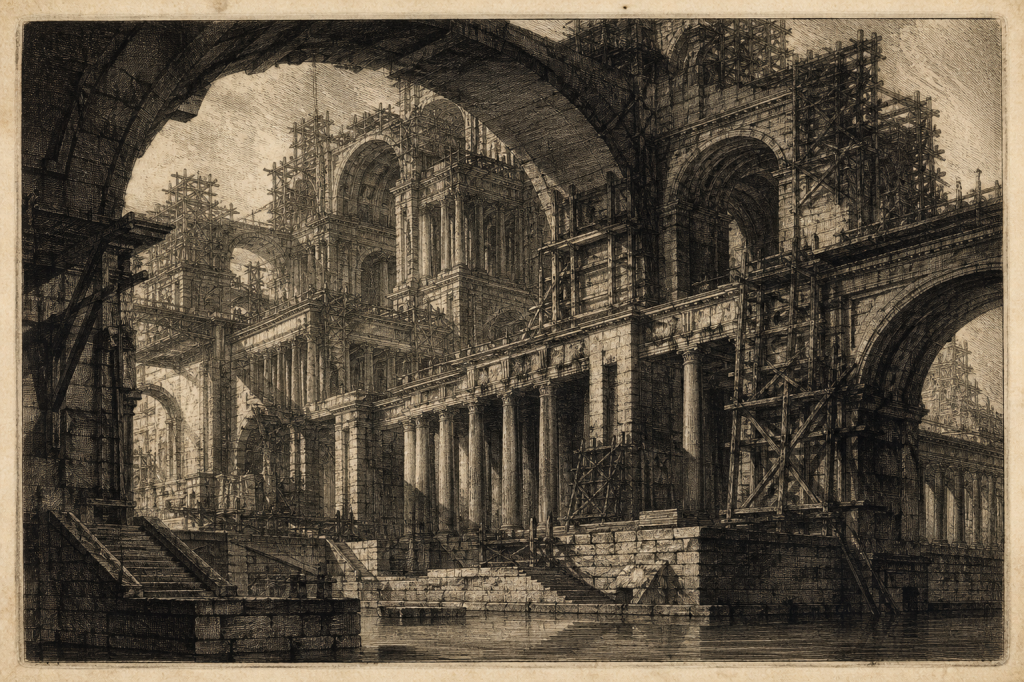
And eventually it is supposed to lead to a utopia. The website describes “luxury residences and resorts,” homes and hotels and clubs “built to the standard of the world’s finest and made to last.” The architecture is in a style it calls “stripped classicism.”
The “Commitment to Move” is a good-faith intention to relocate to a future Praxis city, subject to the details becoming available. The document explicitly says that it is not a lease, a tenancy, a purchase agreement, property ownership, or an obligation to relocate.
Signing costs nothing. But Praxis may later call for a $10,000 deposit to retain your place. The program covers homes with an average expected cost of $1,000,000. Whether the deposit is refundable is “subject to final determination.”
The city, houses, and neighborhoods in the app are, in the company’s own words, “conceptual representations of participation.” They reserve no land. They promise nothing built.
Praxis is selling a place to belong. Or so the website says. Then I scrolled further.
The Pitch
Go to the website and you are met with much more than an eternal city. The first line is: “The superintelligence state.”
Below it: “Creating new cultural, economic, and governance systems for the future of human civilization.”
That’s not a real-estate project. It’s a political project wearing a real-estate project’s clothes. This is the kind of thing I write about. The website is aimed at three audiences at once. The investors are promised a return. The members are promised a place. The believers are promised an exit from the nation-state.
Further down, the project describes itself as “an autonomous political entity,” an “autonomous nation” that uses superintelligence to “understand its members, coordinate shared goals, and improve with each campaign—guided by a constitution and human oversight, and powered by a superintelligence token budget.”
There is a “superintelligence economy,” a “superintelligence token,” and a plan to “acquire land and develop homes, neighborhoods, and cities around a shared culture.”
That is a long way from the city Brown describes in interviews: truth, beauty, and heroism personified by Apollo, in architecture that mixes Gothic, classical, and space-age elements.
The culture is explicitly aristocratic; Brown talks about assembling “the most talented, sharp sort of thinkers in the world.” For what?
Praxis is running Balaji Srinivasan’s playbook from The Network State. Srinivasan, a former Coinbase executive, lays it out step by step: build a community online, crowdfund land, move people onto it, then ask governments to recognize you. His formula is “cloud first, land last—but not land never.” Praxis is the most literal attempt anyone has made to do it.
Are the first residents supposed to prove the model works? Then Praxis needs a government willing to play along.
Uruguay’s president, Yamandú Orsi, met Brown in New York in September and folded the project into his pitch to make the country a regional technology hub. He has also been clear about what he is not selling. His office has said the project “must comply with the norms that Uruguay establishes,” and described it as an urban development project, not a sovereign regime.
The website calls Praxis “an autonomous political entity.” The president’s office calls it an urban development project. Not the same thing. An urban development project is subject to zoning laws, building codes, and the sovereign authority of the state. An “autonomous political entity” is a claim to a new kind of sovereignty. The people signing up may think they’re buying a house; they may be buying a passport to a different political system entirely.
The politics underneath the pitch explain a lot. Peter Thiel, whose fund was an early investor, has said publicly that he no longer believes freedom and democracy are compatible. He has argued that politics is a dead end and that the future belongs to those who can leave it.
And someone is helping them leave.
If Praxis is going to realize its goal, it first needs a state willing to sell it the ground it stands on. The question is: do the people selling the ground understand what they’re helping to build? That question deserves more attention in Montevideo. If Uruguay is selling residency, and Praxis is buying a city that wants to be a state, then the state is not the thing standing in the way of the sale. It is the seller.
The people signing up are being invited to buy an exit from one system and entry into another. Do they know? Do they care? Or are they just looking for a place to belong, same as I am? Loneliness is a powerful motivator, but loneliness plus tech money equals what exactly?
AARP’s 2025 study found that 40 percent of adults 45 and older report being lonely, up from 35 percent in 2010 and 2018. Adults in their forties and fifties are especially vulnerable, caught between work stress, caregiving, and children leaving home. That would be me. I have some savings, but not enough to buy my way out.
The deposit is a filter. Praxis is not selling to the lonely. It’s selling to the lonely who can afford it.
The American Psychological Association found that nearly seven in ten adults said they needed more emotional support in the past year than they received, up from 65 percent the year before. Some of them will go looking for it in a machine, because a machine is available at three in the morning and never gets tired of them.
Someone with cash to invest, tired of fighting with our culture and tired of being alone, and convinced the world is coming apart, is not a fool for being tempted to leave and find community elsewhere. But a machine cannot manufacture the thing it is selling.
There is a better way than buying belonging in an aristocratic country club that wants to be a country.
The Greatest Technology
The better way is to become more human, and to let the people around you do the same.
There is a technology older than artificial intelligence, and it comes from a tradition that has been at it for twenty-five centuries.
In the Upaddha Sutta, the monk Ananda tells the Buddha that good friendship is half the spiritual life. The Buddha corrects him. It is not half. It is the whole of it. The tradition calls this kalyanamitta—spiritual friendship—the practice of showing up for other people, repeatedly, over years, whether or not it feels good at the time.
It means staying in the room when the conversation gets uncomfortable, because the relationship is worth more than your comfort. And so is the person. A machine can deny you or delete you. It cannot stay in the room.
The Buddha was not the only one to make friendship the whole of it. Jesus did too. They lived five hundred years and half a world apart. I like to think they would have been friends.
In the Gospel of John, on the night before he was killed, Jesus tells his disciples that he no longer calls them servants. He calls them friends. Then he gives them a command.
In any other system, a command protects you. Do this, and you are safe. Follow the rule, and you will not be punished. Break the rules and you get ghosted. The command is the wall you build around yourself.
Jesus commands the opposite. He does not tell his friends to build bigger barns or hoard their grain. He tells them to love one another as he has loved them. And he defines the love in the next verse: “Greater love has no one than this, that someone lay down his life for his friends.” A command to lay down your life is not a wall. It is a door.
It means you do not have to perform for me anymore. You can just be with me. He did not ask for vulnerability from a safe distance. He opened his hands before he asked anyone else to open theirs.
This week I found a community that felt like the opposite of Praxis. Thich Nhat Hanh founded Plum Village in 1982, and it has been in the same place ever since. It has been on the same ground for over forty years, and no one there is selling anything. No deposit. No contract. No algorithm. No dog tags.
It’s a Buddhist monastery near Bordeaux, in southwest France. They have a podcast called The Way Out Is In. In the episode I heard, the monk Brother Phap Huu, the journalist Jo Confino, and a former nun, Nho Tran, talk about our deepest suffering as loneliness. It comes from a wrong view of what success is—one that is individualistic. That view rejects people for not following their rules.
People come to Plum Village looking for a fix. A teaching, a technique, a solution. The advice they get is to stop looking for something and just be there, vulnerably, with the people in the room.
Nho Tran said something that touched me. “I think in many ways holding space for your friend to both be and become is an art and a practice in itself.” She went on: “The greatest technology we have is each other. These relationships that we have with each other. We keep seeking something else. But the thing that makes us feel like we are living a meaningful life is being seen and acknowledged and recognized by the loving gaze of another person.”
That is the opposite of the superintelligence state. The state sells a product, a fix, a wall. The monk describes a presence, a practice, a door. The state’s technology is artificial. The monk’s is ancient and human. Praxis is selling a future that is, in fact, a regression. Plum Village is practicing a technology that is older, harder, and more real.
Friendship as they describe it is the slow accumulation of showing up for the whole person, including the parts that are awkward, the parts where you have to tell someone the truth and risk the relationship. Niceness avoids the uncomfortable conversation. Kindness has the conversation because the relationship is worth more than the discomfort.
What Plum Village teaches is not a technique or a program. It is a practice. The practice of staying with people who are difficult. The practice of staying when you want to leave. The practice of telling the truth because the person and the relationship matter. Praxis sells a community curated by an algorithm. Plum Village teaches a community built by people who choose to stay with each other.
The Slow Place
Praxis is building a product that looks like the answer: a community, a city, a family, a destination. But belonging is not a neighborhood in an app. It is a practice. It is an art. It is the people who show up without being matched to you by a model, who stay when you are difficult to be around, who see you beyond your quirks, who tell you the truth.
I have lost people I held close. Some over hard essays. Some over faith. Some to politics. Some to distance. Some to death. And some to reasons I will never know, because they didn’t tell me. Some left loudly with insults and harsh words. Others left quietly, without saying a word. For a long time I read all of it as a verdict on me. Part of it is. I have been hard to be around.
There is one more thing the Plum Village episode taught me. Friends change. They move, they marry, they take different paths. In the episode, they tell a story about a monk who decided to leave the community. The others did not try to stop him. They asked him to stay for one last canoe trip so they could be together before he went.
I can picture the people. Not yet the place. It may be Uruguay. It may be Michigan. But it won’t be Praxis. The place I am looking for is slow. It is built out of ordinary afternoons, difficult conversations, and people who did not choose you like they choose a product off a shelf, or hire a service. They choose you because they see you, and they love you, and that is enough.
I stay with the people I love, even when it’s hard. Part of it is I believe God brings them to me for a reason I cannot see. Part of it is I am afraid of being abandoned. I’m not sure which is virtue and which is fear.
In my Eternal City, people love each other. Just as we have been loved, we should love each other. Our love for one another proves to the world the city in which we belong. It is sustained by a single command of a friend to his friends, and it is the only one that has ever asked anything real of me.
Thank you for reading. If this essay resonated with you, I would love to hear your thoughts. And if you would like to support more work like this, you can support me on Patreon, BuyMeACoffee, or Substack.

References and Sources
AARP. “Disconnected: The Escalating Challenge of Loneliness Among Adults 45-Plus.” December 3, 2025. https://www.aarp.org.
American Psychological Association. “APA poll reveals a nation suffering from stress of societal division, loneliness.” November 6, 2025. https://www.apa.org.
Clarín. “Un exasesor de Milei recibió una inversión de US$ 1.000 millones para levantar una ciudad en Uruguay con foco en la IA.” September 22, 2026. https://www.clarin.com.
CoinDesk. “Pinning the Idea of ‘Network States’ on the Map.” December 5, 2022. https://www.coindesk.com.
New York Times. “These Tech Utopians Want to Build a City for the Post-A.I. World.” September 22, 2026. https://www.nytimes.com.
Plum Village. “Spiritual Friendships (Episode #90).” The Way Out Is In, 2025. https://plumvillage.org/podcast/spiritual-friendships-episode-90.
Praxis. “The Superintelligence State.” https://www.praxisnation.com (accessed October 2026).
Praxis. “Commitment to Move Participation Terms.” https://www.praxisnation.com (accessed October 2026).
Srinivasan, Balaji. The Network State: How to Start a Country. 2022.
Thiel, Peter. “The Education of a Libertarian.” Cato Unbound, April 13, 2009. https://www.cato-unbound.org/2009/04/13/peter-thiel/education-libertarian.
Upaddha Sutta (SN 45.2). Trans. Bhikkhu Sujato. https://suttacentral.net/sn45.2.
Wall Street Journal. “Tech Utopian Project Praxis Gets $525 Million in Commitments for Planned ‘Heroic’ City.” October 15, 2024. https://www.wsj.com.


