



“Woe to those who plan iniquity, to those who plot evil on their beds! At morning’s light they carry it out because it is in their power to do it. They covet fields and seize them, and houses, and take them. They defraud people of their homes, they rob them of their inheritance.” — Micah 2:1–2
“You will own nothing and be happy.”
You remember the slogan. It was mocked. It was dismissed. It was treated as a conspiracy theory.
It was a plan. And the mechanism for completing that plan is called tokenization.
Tokenization is not a technological upgrade. It is a legal structure that separates ownership from control. It converts your home, your land, your assets into a token—a digital claim on a company that holds the thing you thought you owned. When you buy a token, you do not own the apartment. You own a share in a company that owns the apartment. Your name comes off the deed. Your rights become revocable. Your ownership becomes a permission slip that can be frozen, programmed, or revoked.
The New York Stock Exchange is being tokenized right now.
January 2026: NYSE announced digital platform
March 2026: MOU with Securitize
April 2026: SEC approved rule change SR-NYSE-2026-17
May 2026: rule fully operational
July 15, 2026: DTCC pilot production trades
Q3 2026: first token-settled trades expected
Late 2026: full launch targeted
I just finished Patrick Wood and Courtenay Turner’s The Final Betrayal: How Technocracy Destroyed America. I was in shock for days.
Wood has spent decades documenting the technocracy movement. Turner is his collaborator and researcher. The book traces a lineage of technocratic ambition from Columbia University in 1932 to its modern expression in the Trilateral Commission, the UN’s Agenda 21, and the technocrats now running Washington. It documents how a vision for a society run by experts rather than elected officials was funded, theorized, and pursued for half a century.
I highly recommend it. You can read it in less than four hours.
The technocrats who wrote that plan were not hiding it. In 1932, the Technocracy Study Course laid out seven requirements for a fully managed society. They included “continuous registration of energy conversion,” “continuous inventory of production and consumption,” and “specific registration of each individual’s consumption.” One of their stated goals was the elimination of private property, savings, and inheritance.
They called it scientific management. We call it tokenization.
The Blueprint

Technocracy is the belief that society should be run by technical experts—engineers, scientists, economists—rather than by elected officials. The word was coined in 1919 by an engineer named William Henry Smyth. It was popularized in the 1930s by a movement called Technocracy Inc., which proposed replacing politicians with engineers and replacing money with energy credits.
The technocrats did not want to reform the system. They wanted to manage it. All of it. Every asset. Every transaction. Every person.
In 1970, Zbigniew Brzezinski published a book called Between Two Ages. In it, he laid out a vision for a “technetronic” order—a society in which decision-making would be based on data and scientific management rather than democratic deliberation.
Three years later, in 1973, David Rockefeller, chairman of Chase Manhattan Bank, teamed up with Brzezinski to found the Trilateral Commission. Its stated purpose was to create a “New International Economic Order.” The Commission was the vehicle. Brzezinski was the theorist. Rockefeller was the money.
What is the New International Economic Order? It is a system in which resources are managed by experts rather than owned by individuals. It is a system in which the global economy is planned—not by markets, but by committees. It is technocracy on a global scale.
The plan did not stay on paper. It moved through the UN. In 1987, Gro Harlem Brundtland, a Trilateral Commission member, wrote Our Common Future—the document that gave the world the phrase “sustainable development.” In 1992, the UN unveiled the master plan at the Earth Summit in Rio de Janeiro. It was called Agenda 21. It was signed by 178 nations. It was modeled after historic technocracy—a resource-based economic system that would replace market economics with expert management.
And it has now reached the point of implementation.
Executive Order 14178, signed January 23, 2025, identifies commercial real estate, mineral rights, and federal land leases as tokenizable asset classes. The order does not use the word “tokenization” in its title, but the mechanism is there.
The executive order is one piece. A mosaic of legislation is being assembled to build the legal framework. The CLARITY Act. The STABLE Act. The GENIUS Act. Each piece appears separate. Together they form a single architecture.
Tokenization is the process of converting an asset—a building, a stock, a piece of land—into a digital token on a blockchain. The token represents a claim on the asset. But it is not the asset itself. And when you buy a token, you do not own the asset. You own a token that says someone else holds the asset for you. Your name comes off the deed. Your rights become revocable.
Commerce Secretary Howard Lutnick has put a number on it: the tokenizable assets of the United States are worth around $500 trillion. Against $77 trillion in total US dollar-denominated debt, that is enough to wipe all debt—and transfer all ownership. The debt crisis and the tokenization agenda are not separate problems. They are the same problem.
And it is not only America. Trump has negotiated over $2 trillion in agreements with Saudi Arabia, the UAE, and Qatar—each emphasizing AI, fintech, digital economy, and sovereign wealth funds. These are asset-backed investments, not debt. Because Islamic finance outlaws usury and relies exclusively on assets, it is structurally compatible with the tokenization agenda. The Islamic world is positioned to lead it.
Tokenization is the mechanism by which every asset on earth—every home, every field, every forest, every factory—is brought into a single, programmable, centrally managed ledger. It is the fulfillment of the slogan. You will own nothing. And the system will be happy.
The Pattern You Cannot Ignore
Now look at the words.
CLARITY — the Digital Asset Market Clarity Act. We are removing confusion.
STABLE — the Stablecoin Transparency and Accountability for a Better Ledger Economy Act. We are providing security.
GENIUS — the Guiding and Establishing National Innovation for U.S. Stablecoins Act. We are the smart ones.
This is the language of technocracy. It assumes that the problem is complexity and the solution is expert management. It tells you that if you’re confused, it’s because you don’t understand. It tells you that if you’re worried, it’s because you’re not smart enough to see the benefits. It tells you that the people writing the laws are the geniuses, and you should trust them.
This is not accidental. For the last fifty years, Congress has embraced a tactical approach to naming legislation, with short titles frequently taking the form of acronyms designed to curry favor and shape perception. It’s a known technique—the USA PATRIOT Act is the classic example. Placing the word “patriot” in a bill’s title deflects attention from its encroachment on civil liberties.
The names are the marketing. The content is the product. So what is that product?
CLARITY — The bill is drafted by and for the crypto industry. Critics warn it would narrow the SEC’s authority over digital assets while giving more power to the CFTC, which is seen as more industry-friendly. It’s for the industry.
STABLE — The bill would allow nonbank entities—including Big Tech giants like Meta, X, and Amazon—to issue their own stablecoins with federal approval. It bans unauthorized issuers while setting reserve requirements that only the largest players can meet. The stability is for the issuers.
GENIUS — The bill’s real function is surveillance. It requires strict identity verification on every transaction, tracking who sends what to whom. That is the architecture of a central bank digital currency—a government-run digital dollar that can be programmed, frozen, or tracked—built through private banks instead of a government agency. It is total financial surveillance, sold as innovation.
And that brings us to a name that should need no introduction.
George Orwell saw this coming. In Nineteen Eighty-Four, he described Newspeak—a language designed not to express thought but to prevent it. The Ministry of Truth dealt in lies. The Ministry of Peace dealt in war. The Ministry of Love dealt in torture. The words said one thing. The institutions did another.
If you could be made to feel safe while being controlled, you would never resist.
The warning was this: a state that controls language controls thought. A state that can rename power as service, surveillance as safety, and theft as innovation has already won the war on the people before they know it has begun.
CLARITY. STABLE. GENIUS.
Newspeak. Sedatives. They feel good. And they work. People are getting fooled.
The Mechanism: How Tokenization Separates Ownership from Control

The NYSE is not the only thing being tokenized. The same mechanism is being applied to real estate, to commodities, to art, to any asset that can be valued. And the mechanism is the same in every case: it separates ownership from control.
Tokenization is primarily a legal construct. It uses a digital token to represent rights in another asset. And the rights it represents are not the rights of an owner.
Consider how it works for a building. The most common model is the Special Purpose Vehicle, or SPV—a company created to purchase a physical asset—say, an apartment building. The SPV holds the legal title to the building. The company then issues tokens that represent shares or equity interests in the SPV itself. When you buy a token, you are not buying the apartment. You are buying a share in a company that owns the apartment.
The same structure applies to a stock. When the NYSE tokenizes a share, it does not hand you a digital certificate for the share. It creates a token that represents a claim on a custody chain that holds the share. You do not own the stock. You own a token that says someone else holds the stock for you.
This structure is legally viable. But it fundamentally changes your legal standing. You are no longer an owner with a bundle of rights protected by property law. You are an investor holding a security, governed by commercial and securities law instead.
The consequences are profound.
You lose control. You have no say over the property. You cannot decide to live in it, renovate it, or even visit it. Your rights are limited to the economic flows—rent or a share of any capital gains—that the token represents.
Rent is the new interest. It is a claim on your life that never ends, because you never own the thing you are paying for.
You lose legal protections. The law treats you as a shareholder, not a homeowner. Traditional protections like judicial oversight in foreclosure and consumer safeguards for borrowers are eliminated. The relationship is now between a company and its investors.
Your ownership becomes conditional. The token is not a title deed. It is a piece of code. It can be programmed to expire, be frozen, or be revoked based on rules set by the issuer—potentially tied to compliance scores or other algorithmic triggers. Your “ownership” becomes a revocable permission, not a durable right.
The token is not the thing. It is a claim on a company that holds the thing. And claims can be managed. Claims can be programmed. Claims can be revoked.
The Next Crisis: Tokenization as the Solution

This is where the trajectory meets its moment. And the moment may be a crash.
Imagine the next crisis. The stock market falls. Credit tightens. Millions of homeowners are underwater—their mortgages worth more than their homes. They cannot pay. They cannot refinance. They are about to lose everything.
This is not a hypothetical. It is what happened in 2008. And the response in 2008 offers a preview of what the response will be in the next crisis.
During the 2008 foreclosure crisis, Fannie Mae introduced a program called “Deed for Lease.” The program allowed homeowners on the verge of foreclosure to transfer the title of their home to Fannie Mae and sign a one-year lease. They could stay in the house, without owning it anymore. The lender avoided the foreclosure process. The borrower’s credit wasn’t destroyed. And the family stayed in their home—as renters.
Deed for Lease was proposed as a temporary measure. But it contains the seed of the permanent solution. And the permanent solution is tokenization.
So let’s see it in action.
A teacher in Ohio is about to default. The bank is preparing foreclosure. Then a new program is announced. It is called something like “Home Stability Tokens” or “Equity Participation Program.” It is framed as a compassionate alternative to foreclosure. The government has partnered with a private platform. The homeowner can stay in her house. She does not have to move. Her children do not have to change schools. All she has to do is sign a few documents and accept a new arrangement.
Here’s how it’s done.
A Special Purpose Vehicle (SPV) is created and purchases the home, either from the bank or through a short sale facilitated by the government. The SPV now holds the legal title. The homeowner’s name comes off the deed.
The SPV tokenizes the home and it is divided into, say, ten thousand tokens. Each token represents a fractional share of ownership in the SPV. The tokens are sold to investors—pension funds, hedge funds, individual investors on a trading platform. The homeowner does not receive the proceeds from the token sale. The proceeds go to the SPV, which uses them to pay off the bank and cover administrative costs.
The homeowner is issued an “occupancy token.” The patent filings describe this mechanism precisely. The occupancy token is a non-fungible token issued by the SPV to the occupant. It gives her the right to live in the house. It does not give her ownership. It is a digital permission slip, revocable under the terms of the smart contract.
The homeowner pays rent. She no longer makes mortgage payments. She makes rent payments to the SPV. The rent is distributed to the token holders through a smart contract. The smart contract can be programmed. It can adjust the rent based on market rates. It can add fees. It can suspend her occupancy rights if she misses a payment.
Lastly—and this is the crucial part—the homeowner is told she can buy back equity. Each month, a portion of her rent payment can be used to purchase asset tokens from the investors. Over time, she can accumulate tokens. She can transition from being a pure renter to becoming a partial owner. The system provides a user interface where occupants can sell their tokens back to the platform or buy additional tokens as they accumulate savings.
It sounds generous. It sounds like a path back to ownership. But look closer.
The homeowner is now paying rent to a company she does not control. She is subject to a smart contract she cannot read. Her right to occupy her own home is a token that can be frozen or revoked. She is building equity at a pace determined by the platform, not by her. And the platform has no incentive to see her reach full ownership. The platform makes money from her rent, from the fees, from the token trading. Full ownership is the end of the revenue stream.
This is the tokenization trap. It is the “Deed for Lease” model made permanent, programmable, and scalable. It solves the foreclosure crisis for the bank and the investor. It solves the housing crisis for the politician who can say no one was thrown out of their home. But it does not solve it for the homeowner. She has been converted from an owner into a tenant. Her home has been converted from a possession into a financial product. And her right to live there is now a line of code.
The Endgame

Tokenization is the end of the road for claims on the future. It is the moment when the last store of physical value is brought into the system of claims. It is the moment when ownership becomes access, and access becomes permission.
The final transfer is complete when the distinction between the ‘real economy’ and the ‘financial economy’ vanishes. When everything is a token, everything is a claim. And when everything is a claim, nothing is owned. It is only accessed.
Eventually, property rights are replaced by subscription access. You do not own; you rent access to everything from a central ledger. The right to use your own home could theoretically be revoked by a smart contract if you fail to meet certain conditions. This is the logical conclusion of the system we have been building.
Larry Fink, the CEO of BlackRock, has already said it: “Every stock, every bond, every fund—every asset—can be tokenized. If they are, it will revolutionize investing.” He is right. It will revolutionize investing. It will also revolutionize ownership. And not in the direction of more freedom.
The trajectory of total control will, at its peak, produce its opposite. The “end” is the point of total abstraction, where the last physical asset has been tokenized and the system is running on nothing but its own claims. At that point, the foundation it has ignored—the real world of energy, matter, and human relationships—will reassert itself. The very completeness of its control is the signal of its coming collapse.
None of this is inevitable. It is being built. And what is being built can be refused. But refusal begins with seeing it clearly.
And clarity, once you have it, is not something you can keep to yourself. They named a bill CLARITY. It was not. Now you know what is. Pass it on.
References & Sources
Bank for International Settlements. Cornelli, Giulio. “When bricks meet bytes: does tokenisation fill gaps in traditional real estate markets?” BIS Working Paper No. 1311. November 2025. https://www.bis.org/publ/work1311.pdf
DTCC. “DTCC Advances Development of New Tokenization Service, Convenes 50+ Firms to Drive Digital Assets Adoption.” May 4, 2026. https://www.dtcc.com/press-releases/2026/dtcc-advances-development-of-new-tokenization-service
Executive Order 14178. “Strengthening American Leadership in Digital Financial Technology.” January 23, 2025. https://www.whitehouse.gov/presidential-actions/2025/01/strengthening-american-leadership-in-digital-financial-technology/
Fannie Mae. “Deed for Lease Program.” November 2009. Reported in The New York Times, “Fannie Mae to Allow Borrowers to Lease Homes,” November 5, 2009. https://www.nytimes.com/2009/11/06/business/economy/06fannie.html
Intercontinental Exchange. “New York Stock Exchange and Securitize Agree to Memorandum of Understanding to Support Tokenized Securities.” March 24, 2026. https://ir.theice.com/press/news-details/2026/New-York-Stock-Exchange-and-Securitize-Agree-to-Memorandum-of-Understanding-to-Support-Tokenized-Securities/default.aspx
Quarter, Inc. “Methods and Systems for Transmitting Information.” US Patent Application US20240146678A1. Filed 2023. https://patents.google.com/patent/US20240146678A1/en
Securities and Exchange Commission. “Notice of Filing and Immediate Effectiveness of Proposed Rule Change to Amend the Exchange’s Rules to Enable the Trading of Securities on the Exchange in Tokenized Form.” Release No. 34-105260, File No. SR-NYSE-2026-17. April 17, 2026.
Wood, Patrick M., and Courtenay Turner. The Final Betrayal: How Technocracy Destroyed America. Coherent Publishing, 2025.
Thank you for reading. If this essay resonated with you, I would love to hear your thoughts. And if you would like to support more work like this, you can support me on Patreon, BuyMeACoffee, or Substack. I also appreciate direct donations via digital payment networks like Zelle—message me for details.
A Note on the Art
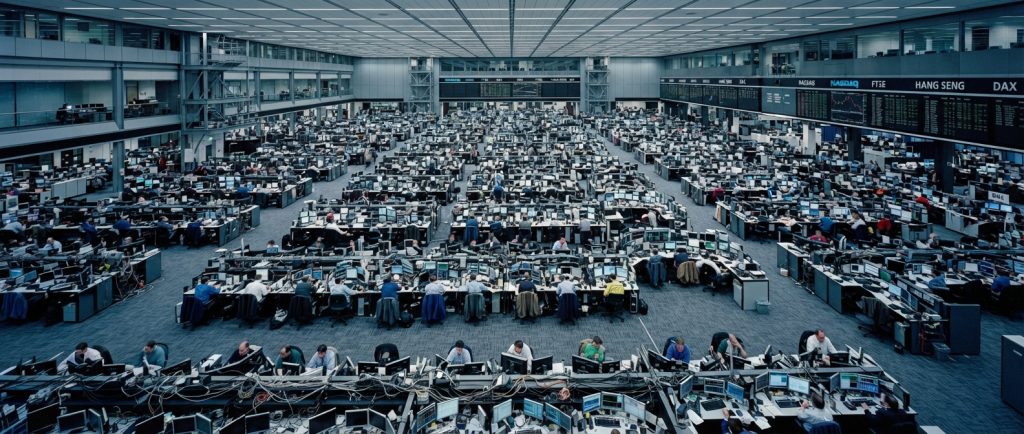
The images in this essay are inspired by Andreas Gursky, the German photographer whose large-format panoramas capture the systems of global finance at a scale that makes the individual disappear. His Stock Exchange series—ten images made over twenty years on three continents—reduces traders to anonymous blobs of color, linking the globe through an invisible matrix of trades and economic dependency.
Tokenization works the same way. It converts your home into a token, your neighborhood into a portfolio, your life into a ledger entry. The individual disappears into the system.
Gursky does not tell you what to think. He shows you what is there. We are still living inside the photograph.


 “Outstanding, sophisticated, and mesmerizing…a spiritual intrigue similar to Dan Brown’s The Da Vinci Code.” —ForeWord Reviews