



The 1694 inversion and the Ponzi geometry of the American retirement system
“It should be clear that modern fractional reserve banking is a shell game, a Ponzi scheme, a fraud in which fake warehouse receipts are issued and circulate as equivalent to the cash supposedly represented by the receipts.” — Murray N. Rothbard, The Mystery of Banking
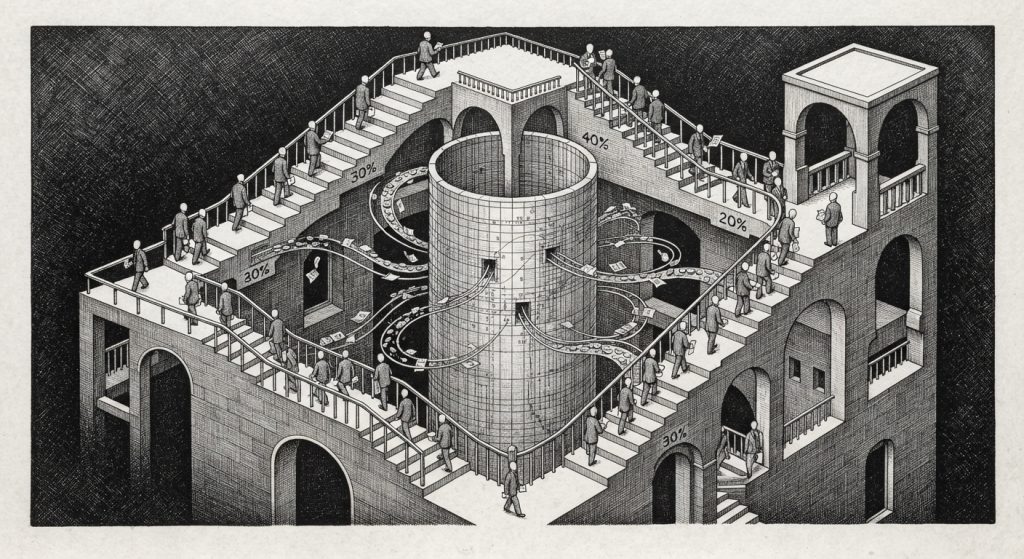
That quote is not a perfect description of index funds. Index funds do not create new shares of Apple or Nvidia out of thin air. But they do share something with fractional-reserve banking: both are part of systems in which financial claims and valuations can grow faster than the underlying production, both depend on belief, and both become vulnerable when that belief begins to falter.
Go find your retirement statement. Look at the total. For most people, it represents the largest single asset they own.
But what is it, really? It’s a claim—a claim on future earnings and production, much of it generated by people who are not yet born.
And a claim rests on belief. What you are really counting on is that millions of strangers will continue to believe in the value of the same assets you own.
To understand why belief is all that holds it up, we have to go back to 1694.
In 1694, a king with bad credit accidentally built the modern financial world.
The Bank of England took a king’s debt and turned it into a permanent, tradable financial asset. The debt did not have to be repaid in the ordinary sense. It could be held, traded, and used as collateral. The king’s obligation became a public asset.
That was the inversion on which the entire financial system was built. Debt was no longer merely a burden to be repaid and extinguished. It became a foundation for wealth. It could be held indefinitely, generate income indefinitely, and support further lending. A liability that once had to be settled could now serve as the basis for expanding financial claims.
The chain of belief that held it together ran from the banknote to the government’s promise, from Parliament’s taxing power to the English economy, and ultimately to the willingness of the English people to work, pay, and trust the government with the power it claimed.
Every link was real. But the chain as a whole depended on something that could not be audited in advance. It could only be trusted.
Index funds do not create new claims the way fractional-reserve banking does. But they do channel relentless inflows into existing shares, creating persistent demand that pushes prices higher. Add credit, derivatives, and shadow banking, and the system can multiply claims without multiplying production.
This is the financial machine that now absorbs the retirement savings of an entire generation, operating at a scale Rothbard never imagined.
The same inversion now runs through the stock market. Government debt is no longer the only obligation transformed into a permanent financial asset. The market has become a vast system of claims on future production, supported by the assumption that capital will continue to flow in.
And the mechanism keeping it aloft is increasingly not individual judgment, but flow.
What Passive Actually Is
Mike Green, chief strategist at Simplify Asset Management, has spent more than a decade studying what happens when trillions of dollars flow automatically into index funds through 401(k)s and similar retirement accounts. His conclusion is unsettling: there is no such thing as a passive investor.
What exists instead is a systematic algorithm. If you give it cash, it buys. If you ask for cash, it sells. That’s the whole mechanism. The investor believes they are making a judgment about the economy, but they are not. Instead, they’re participating in a mechanical flow that has no idea or opinion about whether the price is right.
This is not a market—it’s a machine. A market discovers value. A machine is set by the volume of money moving through it, like an assembly line that doesn’t know what it’s building.
And the machine has a specific effect on prices.
In a normal market, when demand rises, supply responds. If people want more steak, ranchers raise more cattle. Prices find an equilibrium. The market is elastic.
Our stock market is not normal. When a dollar flows into an index fund, the fund has to buy shares. But the number of shares available doesn’t change. There are only so many shares of Nvidia, or Apple, or Microsoft. So the fund has to bid up the price to convince someone to sell. The price rises by more than the dollar that caused it to rise.
This is what economists call the Inelastic Market Hypothesis. Xavier Gabaix and Ralph Koijen found that investing $1 in the stock market increases the market’s total value by about $5.
You put a dollar in. The market’s value goes up by five dollars. The other four dollars came from nowhere. They are pure inflation of the existing claims—the same claims, now worth more because you bought a share.
Green’s current estimate is higher. He places the multiplier at twenty-two for the broad market, and for the largest stocks it approaches one hundred. One dollar in, twenty-two dollars of market cap out. For Nvidia, more than one hundred to one.
The largest companies in the index—the ones with the most weight—receive the most passive capital, regardless of their fundamentals. The smaller companies are starved. Capital formation is distorted. The price signal that guides capital allocation has been detached from judgment.
Green estimates that more than half—nearly 60 percent—of all U.S. equity fund assets are now managed passively. That capital is allocated by a mechanism that doesn’t care what it’s buying, and the market has detached from judgment and value.
It’s true that index funds hold real companies with real earnings. But when flows, not earnings, set the marginal price, the earnings become secondary. The claim is still on future production—but the price of that claim is now determined by the volume of money moving through the machine, not by an assessment of what the production will yield.
Who benefits from this arrangement? The asset managers. BlackRock, Vanguard, and State Street together manage well over $20 trillion. They charge fees. When prices rise, their revenue rises. When inflows continue, their assets grow. They do not need the price to be right. They need it rising, and they need money to keep flowing in. They are not neutral referees of the market. They are the house.
The government benefits too. Every dollar of retirement savings that flows into a 401(k) is a dollar of future obligation the state does not have to fund through Social Security. The belief that the index always goes up is a subsidy to the state’s unfunded promises.
Ludwig von Mises saw this coming. A century before passive investing existed, he wrote: “There is no means of avoiding the final collapse of a boom brought about by credit expansion.”
He was not talking about index funds. He was talking about a structure that inflates claims without producing anything, that depends on continuous inflow to survive. His student Rothbard—whose description of banking opens this essay—called it what it is. A Ponzi.
Our market is that machine, running at scale.

A Claim on the Market
The index fund is not a claim on a specific company. It is a claim on the market itself—a statistical abstraction. The investor does not own a share of a business. They own a share of an index, a weight, a number.
The underlying production is still there. But it has been abstracted. The claim is no longer on a specific future stream of profits. It is on the aggregate expectation of all future streams of profits, priced by a mechanical flow.
This is the 1694 template applied to equity. Debt became an asset because it could be held, traded, and used as collateral. Equities became a passive asset class because they could be held, traded, and used as collateral without anyone making a judgment about the underlying business. The belief is the same, but the instrument is different.
The inelastic market is the chain of belief in its purest form. The price of a stock is no longer set by an assessment of the company’s production, but by the willingness of participants to believe the index will continue to rise. This makes the narrative the collateral. Flow is the backing.
Once, gold was the collateral. It made the paper feel real. When people doubted, they could remind themselves that the notes were redeemable in metal. The belief needed something solid to lean on.
Now there is no gold behind it. There is only the belief that the index will rise. And that belief is protected not by metal or law, but by the belief itself. The more people believe, the more money flows in. The more money flows in, the higher the price goes. The higher the price goes, the more the belief is confirmed. The narrative protects itself.
Gold was visible. You could hold it in your hand. The narrative is invisible. It lives in the confidence of millions of people who have never met, who are all making the same bet without knowing it. They are not investing in companies. They are investing in each other’s belief that the system will keep working.
That is the final inversion. In 1694, the debt became the asset. Now the belief has become the asset. The narrative is not just the collateral. It is the entire foundation. And when the flow reverses, there will be nothing behind it to catch the fall.

The Fire Door
Green has a metaphor that captures the fragility of this arrangement. Everyone fancies they can get themselves out if the facts change. The problem, he says, is that this is a bit like trying to leave a crowded concert through a single fire door when everybody else has the same idea.
When the flows reverse—when layoffs force 401(k) liquidations, when a generation of retirees begins to draw down, when sentiment simply turns—there is no natural buyer on the other side. The same mechanism that inflated prices will deflate them. And it will do so much faster than it inflated them, because selling is more urgent than buying.
The exit isn’t locked. It’s clogged. In a fire, the door doesn’t close; it gets blocked by the bodies of people who tried to leave at the same time.
This is structural. Green calls the potential outcome a 1929-style crash. He is not worried about AI stocks. He is worried about the passive investing bubble.
The structure is not sustainable on its own. The price of existing shares rises because new money is flowing in. The new money is not financing new production. It is financing the appreciation of existing claims. Green calls this, plainly, the definition of a Ponzi.
A Ponzi scheme pays returns to earlier participants from the contributions of later ones, rather than from actual profits. The passive market has the same shape. It depends on a continuous inflow of new capital. If the inflow stops, the structure collapses.
This is not a Ponzi in the legal sense: no fraud, no single operator, no promise of returns. Index funds hold real companies with real earnings. But the geometry is the same. And the geometry now spans the entire financial system.
The government’s obligations tell the same story. According to the Institute of International Finance, global debt has reached a record $353 trillion. U.S. national debt has surpassed $40 trillion, growing by $3 trillion in a single year—the fastest pace outside the pandemic. Debt held by the public now exceeds $32 trillion, roughly equal to the entire U.S. economy.
But the national debt is only the visible portion. According to the Treasury’s latest Financial Report, the U.S. government’s total obligations—including the present value of projected shortfalls in Social Security and Medicare—stand at approximately $130 trillion. In a single year, total obligations rose by $13 trillion. Real GDP grew less than 1 percent. Obligations are growing more than ten times faster than the economy that must support them.
These are not separate problems. They are the same problem at different scales—claims on future production, all dependent on the belief that the future will be large enough to honor them.
When the fire door opens and everyone runs for it, many will be trampled.

Why We Keep Falling for It
The belief survives because it is not, for most participants, a belief at all. It is a default—installed by the state and reinforced by the market’s own mechanics.
The 401(k) was created by the Revenue Act of 1978, expanded through the 1990s, and made automatic by the Pension Protection Act of 2006. Auto-enrollment, default contribution rates, target-date funds that shift into equities by design—these are policy choices. They channeled the savings of a generation into the stock market by default. No one voted for the passive machine. It was legislated into existence, one tax provision at a time.
The assumptions that make the machine feel safe are not taught. They are inherited. “The index always goes up.” “You can’t beat the market.” “Just keep buying.” They feel like facts rather than beliefs, because they have been repeated by employers, by the industry, and by the state until they are indistinguishable from common sense.
And the longer the system works, the more deeply the assumption is encoded. A generation that has only seen the index rise cannot imagine it falling. A generation that has only seen the ledger expand cannot imagine it contracting. The belief becomes the default, and the default becomes invisible.
This is the oldest pattern in human affairs. The belief that the market always goes up contains, buried inside it, the recognition that it cannot.
The same dynamic that operates in individual investors operates at the scale of nations.

The American Empire, Reversed
When the Bank of England was founded, England was the world’s rising power. It was producing, conquering, and accumulating. The chain of belief was anchored in real production: the English economy could actually produce what the government promised to pay.
Three centuries later, the financial center of gravity has moved. Bretton Woods in 1944 formalized the transition from London to New York, from the pound to the dollar. The United States became the world’s banker, the issuer of the reserve currency, the center of the financial universe.
But something else happened along the way. America has run a trade deficit every year since 1976. It has accumulated net foreign debt of roughly $21 trillion—approximately 70 percent of GDP, the largest net foreign debt of any advanced economy. It no longer produces what it consumes. It imports. It no longer saves what it invests. It borrows. It no longer exports what it owes. It prints.
The 1694 template created a system that could borrow against future production. The United States has gone further. It borrows against the production of other countries. It consumes what China, Germany, and Japan produce. It finances its deficits with the savings of foreigners. It has become the world’s largest debtor, and its creditors are the nations it once sought to contain. The question is what happens when the chain of belief that sustains this arrangement starts fading.
The same forced-flow mechanism operates at the sovereign scale. Foreigners recycle their trade surpluses into U.S. assets—Treasury bonds, agency debt (bonds issued by government-sponsored enterprises like Fannie Mae and Freddie Mac), equities—because the dollar system requires a destination for their reserves. The inflows that hold up the bond market are the same inflows that hold up the stock market. The passive investor and the foreign central bank are both buying because the system channels them into buying.
The chain of belief runs from the 401(k) in Ohio to the reserve manager in Beijing, and neither is making a judgment. Both are following a flow.
This is the inversion, completed. The chain of belief that once ran from the banknote to the government’s promise to Parliament’s taxing power to the English economy to the English people has now been stretched across oceans and continents. The first link—the promise—is still there. The middle links—the tax power, the economy—have been hollowed out. The final link—the people—are no longer producers. They are consumers, financed by the production of others.
The 1694 inversion has run for over three centuries. It has survived wars, depressions, and the collapse of empires. It has survived because it is not a bubble in the conventional sense. It is a permanent bubble—a self-reinforcing loop of debt, belief, and state power with no natural exit.
But the extreme produces its opposite. The longer a one-sided tendency dominates, the more violent the reversal. Every dependency the United States has accumulated—on foreign production, on foreign savings, on foreign belief in the dollar—is a link in the chain of belief. Every one of them depends on trust.
When that trust falters—when foreign creditors question whether they will be repaid, when domestic investors realize that their retirement accounts are claims on production that may not materialize, when the flow of passive capital reverses and the fire door proves too narrow—the chain will break.
The prediction is not a date. It is a direction. The belief that claims on the future can function as wealth will produce its opposite. Not because someone is plotting. Not because the system is evil. Because the one-sidedness of the inversion cannot hold.
The correction will not be an event. It will be a process—a slow recognition that the claims cannot all be settled, followed by a faster one. That process is already underway.
The 1694 template is not eternal. It is a historical arrangement, built on a specific set of beliefs, sustained by a specific set of institutions, anchored in a specific set of production relationships. When those relationships change—when the production moves, when the trust erodes, when the flows reverse—the template changes with them.

The Territory
The future is not a ledger entry. It is the farm producing next year’s harvest. The factory producing tomorrow’s goods. The energy that powers the machine. The worker who shows up. The trust that makes a contract meaningful. The natural world that supplies what the system ultimately consumes.
The machine has forgotten this. It has treated the ledger as the territory. It has treated claims on production as production itself. It has treated the savings of foreigners as its own wealth.
That is what you are holding when you hold your retirement statement. Not wealth. A claim—on production that has not yet happened, held aloft by the belief of millions of strangers.
What you think you own is a claim on continued inflows. When the inflows stop, the claim stops being wealth. It becomes a line in a ledger.
And a line in a ledger is not the world. The world is still here, waiting to be seen.

References & Sources
BlackRock, Inc. Annual Report, 2025.
Gabaix, Xavier, and Ralph S. J. Koijen. “In Search of the Origins of Financial Fluctuations: The Inelastic Markets Hypothesis.” NBER Working Paper No. 28967, 2021.
Green, Mike. Interview with Pierre Daillie and Adam Butler. Raise Your Average, AdvisorAnalyst, July 2026.
Institute of International Finance. Global Debt Monitor, May 2026.
Mises, Ludwig von. Human Action: A Treatise on Economics. Yale University Press, 1949. See Part IV, Chapter XX.
Pension Protection Act of 2006, Pub. L. No. 109-280.
Revenue Act of 1978, Pub. L. No. 95-600.
Rothbard, Murray N. The Mystery of Banking. Richardson & Snyder, 1983.
State Street Corporation. Annual Report, 2025.
U.S. Bureau of Economic Analysis. International Investment Position of the United States, First Quarter 2026. Released June 24, 2026.
U.S. Census Bureau and U.S. Bureau of Economic Analysis. U.S. International Trade in Goods and Services, 2026.
U.S. Department of the Treasury. Financial Report of the United States Government, Fiscal Year 2025.
U.S. Department of the Treasury. Debt to the Penny, August 2026.
U.S. Department of the Treasury. Treasury International Capital (TIC) System, 2026.
Vanguard Group. Fact Sheet, 2026.
If this essay resonated with you, I would love to hear your thoughts. And if you would like to support more work like this, you can support me on Patreon, BuyMeACoffee, or Substack. Thank you for reading.

A Note on the Art
The images in this essay are inspired by M.C. Escher, the Dutch graphic artist whose lithographs depict impossible architectures and recursive patterns—structures that appear orderly until the logic collapses. Escher was not a painter of financial systems. He was a painter of visual paradox, of the moment when the viewer realizes that the rules they trusted no longer apply.
The passive market is an Escher print. A machine that looks like a market. A structure that looks like it is allocating capital. A system that looks like it is creating wealth. It is none of those things. It is a visual paradox rendered in capital.
Escher’s work does not tell you the system is broken. It shows you. And once you have seen it, you cannot unsee it.
The images in this essay are all black and white. So is the diagnosis.


 “Outstanding, sophisticated, and mesmerizing…a spiritual intrigue similar to Dan Brown’s The Da Vinci Code.” —ForeWord Reviews