
“War is a racket. It always has been. It is possibly the oldest, easily the most profitable, surely the most vicious. It is the only one in which the profits are reckoned in dollars and the losses in lives.” — Major General Smedley Butler, USMC (1935)
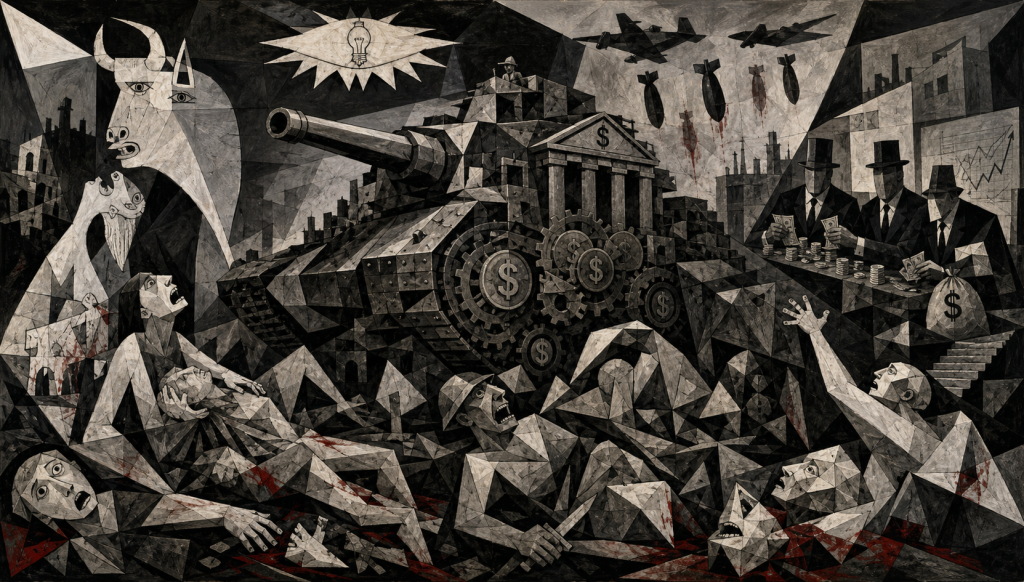
Major General Smedley Butler spoke these words in 1935, after a career that had made him one of the most decorated Marines in American history. He had fought in nearly every major conflict of his era—from Cuba to China to Mexico. And he had come to a conclusion that would haunt him for the rest of his life: war was not a noble struggle for freedom. It was a business. The most profitable business on earth.
Butler understood something that most people still refuse to see. That business has owners. The money does not flow to governments or armies—it flows to private financiers who have, over three centuries, built an invisible machine that turns blood into gold.
Don’t think of the war machine as a government apparatus or a military institution. It’s a privately owned profit system that has, since 1694, inverted the relationship between states and financiers—turning nations into vessels for private wealth accumulation. From the Bank of England to the Rothschilds, from J.P. Morgan to the Federal Reserve, from the Spanish-American War to Ukraine, the pattern is the same: war creates debt, debt creates dependency, and dependency creates profit for the few.
What follows is history—carefully documented, meticulously traced, and urgently relevant to anyone who wonders why the world seems so trapped in endless conflict.
This is the story of the war machine—and the indictment of everyone who keeps it running.

Part I: The Architecture
The Invention
In 1694, a new financial technology was invented that permanently inverted the relationship between the state and private capital: permanent national debt, permanently controlled by private financiers.
A group of private investors lent £1.2 million to King William III. In exchange, they received a royal charter and a monopoly on banking. The Bank of England was born—not as a government institution, but as a private corporation with a government license. The Bank of England Act of 1694 allowed for the formation of a private company that would advance £1.2 million to the government, offering a secure source of public borrowing, and was granted exclusive banking privileges.
At first glance, it seemed like a straightforward transaction. The crown needed money to fight a war with France. The financiers had money to lend. A deal was struck.
But it was the kind of deal the devil makes. You get exactly what you want—and it ruins you.
The government had traded something far more valuable than interest payments. It had traded its independence. From that moment forward, the British state would depend on private financiers to survive. It could not wage war without them. It could not govern without them. It could not even borrow without their permission. Although the Bank was nominally a private institution and profits were paid to its shareholders, it was playing a public role that made the government dependent on its private masters.
This invention caught the attention of other financiers and entrepreneurs, growing quietly into an invisible machine. Once set in motion, it would expand across centuries and continents—feeding on war, enriching its owners, and consuming the nations it was supposed to serve.
The Gears Engage
A century passed. The American colonies broke away from Britain in 1776, but the invisible machine kept turning—expanding, entrenching itself deeper into the fabric of nations.
Across Europe, the Rothschild family—which would become the most powerful banking dynasty in history—was already making its fortune. They studied the Bank of England’s model and saw something no one else had noticed: war was the most profitable business on earth.
The part played by Nathan Mayer Rothschild (1777-1836) and his brothers in helping the British Government finance military operations against Napoleon is legendary. Between 1813 and 1815 alone, Rothschild loaned gold worth roughly $1 billion in today’s money to the British government for war subsidies. He smuggled gold through Napoleon’s naval blockade. He purchased it from the British Army at a discount. Then he resold it to Portugal—making three separate profits on the very same gold.
What was emerging was a new system: profit built on deception, with deception as the fuel that kept the invisible machine running. Nathan’s success in these wartime operations earned him the contract to supply Wellington’s troops with gold coin in 1814 and 1815.
Nathan was not an exception. He was the rule—the first master of a game that would be played for centuries. The Rothschilds had discovered the dark secret of modern finance: governments at war would pay anything for gold. And they would pay anything to borrow. By the time Nathan Mayer died in 1836, he had amassed a fortune equivalent to roughly $250 billion in today’s money.
By the 1830s, the Rothschilds had established an extremely profitable model—and a new presence—in the United States. They financed American railroads. They traded in American securities. They lent money to the federal government. By the time the American Civil War broke out in 1861, the Rothschilds and their allies controlled nearly every dollar of gold in the United States.
In 1835, a highly influential American newspaper called Niles’ Weekly Register described what had become of this new power. The editors were writing about the Rothschilds. Their words were equal parts awe and unease:
“The Rothschilds are the wonders of modern banking… we see the descendants of Judah, after a persecution of two thousand years, peering above kings, rising higher than emperors, and holding a whole continent in the hollow of their hands. The Rothschilds govern a Christian world. Not a cabinet moves without their advice.”
Read that again. Peering above kings. Rising higher than emperors. Not a cabinet moves without their advice.
A new power had risen—one that answered to no nation. It was private, it was global, and it had grown so mighty that kings and emperors bowed to its will.
A higher power than nations now existed—one that nations could not control, could not ignore, and could not escape.
Part II: The American Takeover
How War Was Privatized
Before the Gilded Age, wars were easy to understand. You didn’t need many words to explain them:
- American Revolution (1775-1783): Colonists wanted freedom from Britain.
- War of 1812 (1812-1815): Britain was pushing America around. America pushed back.
- Indian Wars (1609-1924): Land. Who controlled it.
- Mexican War (1846-1848): More land. Texas.
These wars were fought by nations, for nations. The reasons were clear. The enemies were clear.
Then came the Civil War. And everything changed.
By 1861, the Rothschilds had mastered the art of profiting from chaos. They lent money to governments during wartime. They collected interest. They profited from the destruction. When the war ended, they were richer than when it began.
But a new generation of American financiers had been watching—and learning.
J.P. Morgan made his first fortune during the Civil War. He paid a fee to avoid military service. Then he financed the purchase of 5,000 surplus rifles at $3.50 each, which were resold to the government for $22 each—a profit of nearly $100,000 from just one deal. When the government tried to refuse payment, Morgan took the Army to court—and won. Some accounts also note that Morgan made a fortune speculating in gold, the price of which rose against the dollar with each defeat of the Union Army.
Andrew Carnegie made his fortune running military railways and telegraphs during the war. After Thomas Scott was made assistant secretary of war in charge of military transportation, he appointed Carnegie as a superintendent of military railways and the Union government’s telegraph lines. After the war, Carnegie invested in steel companies, knowing they would get government contracts for rebuilding. War made him wealthy. Reconstruction made him richer.
John D. Rockefeller sold the Union petroleum products at exaggerated prices. His business boomed during the Civil War, and he took advantage of the loophole in the Union draft law by purchasing a substitute to avoid military service. His oil, Carnegie’s steel, and Morgan’s financing formed the industrial backbone of America’s war machine.
These men didn’t just lend money to governments—they built industries that depended on government contracts. They financed politicians who supported military expansion. They started wars that opened new markets. They created a military-industrial complex that would eventually consume the nation’s wealth.
The American oligarchs took the lesson of the Civil War and ran with it. War was no longer a national struggle for survival.
War had become a machine that turned blood into gold, and gold into power.
The Machine Finds Its Fuel
Between the end of the Civil War (1865) and the beginning of the Spanish-American War (1898), something shifted.
This was the Gilded Age.
Mark Twain coined the term in 1873, and he meant it sarcastically. This was not a “golden” age of prosperity for all—it was gilded, meaning a cheap metal coated in a thin layer of gold. On the surface, America was booming. Beneath it, corruption, inequality, and exploitation festered.
During this period, industrialization made a handful of men staggeringly rich: Andrew Carnegie (steel), John D. Rockefeller (oil), and J.P. Morgan (banking). These titans didn’t build their fortunes through fair competition alone. They bought politicians, secured protective tariffs, and crushed unions. They built their empires on the backs of immigrant workers who toiled twelve-hour days in dangerous conditions for pennies. Their wealth became so immense that Carnegie himself ended up lending money to the U.S. federal government—a private citizen bankrolling the state.
This is when world power began to shift. It moved, quietly and decisively, from elected governments to private banks and industrial cartels.
Don’t try to pin a simple label on this system. It’s not strictly capitalism—it’s a perversion of it. What we’re describing is crony capitalism, or corporatism: a system where the state and private financiers collude to rig the market in their favor. This is an oligarchy: a small, interconnected group that controls the world’s resources and money, operating through a global financial pyramid. That pyramid depends on three things: endless growth, endless debt, and the endless expansion of credit to future generations. When growth stalls—as it inevitably does—the system turns parasitic. It stops creating wealth and starts consuming its own foundations: cannibalizing the middle class, privatizing public assets, and sending ordinary people to die in wars that enrich the few.
The symptoms are everywhere: stagnant wages, persistent inflation, bitter political bickering, and wars that never seem to end.
The invisible machine had found its fuel—and it was hungry.
Part III: The Globalization of War
The Machine Goes Global
Here is where the reason for war became murky.
In 1898, America went to war with Spain. Officially, it was an act of solidarity—the U.S. was an “ally” to Cuba’s struggle for independence from Spanish colonial rule.
But nations don’t go to war out of charity. There is always a return on investment. The difference now was that the return no longer had to be visible. The oligarchs had discovered something more powerful than gold: the ability to sell war as a noble crusade, with heroes on one side and villains on the other. This was the birth of war as entertainment, and the machine had found its loudest advocate yet: the press.
The spark was the “mysterious” explosion of the battleship U.S.S. Maine in Havana Harbor. To this day, historians debate whether it was an accident or an attack, but American newspapers—led by William Randolph Hearst’s yellow journalism—blamed Spain. “Remember the Maine!” became a rallying cry. Within months, the U.S. was at war.
The conflict lasted barely three months. In December 1898, the Treaty of Paris was signed. Spain relinquished Cuba, ceded Guam and Puerto Rico to the U.S., and sold the Philippines to America for $20 million.
On paper, it was about liberation. In reality, it was about empire. The U.S. needed coaling stations for its growing navy, access to Asian markets (via the Philippines), and strategic footholds in the Caribbean. For the oligarchs back home—the Rockefellers, Morgans, and Carnegies—this meant new territories to exploit, new resources to extract, and new government contracts to win.
War had become the mechanism for expansion—and the machine was now global.
The Machine Dethrones Kings
World War I was sparked by an assassin’s bullet in Sarajevo. But its real fuel was something far older—imperial rivalry, economic greed, and a system that had learned to profit from both.
The narrative sell that had been perfected in the Spanish-American War was now deployed on a global scale. Once again, the public was given a simple story: heroes versus villains, civilization versus barbarism, good versus evil. But beneath the propaganda lay the same engine that had always driven the machine—wealth, control, and the transfer of power from nations to private financiers.
By 1918, the war had done more than kill millions and redraw borders. It had wiped out three of the oldest Christian empires on earth.
The German Kaiser, the Austro-Hungarian Emperor, and the Russian Tsar had all fallen. Their thrones, which claimed “divine right” for centuries, were gone. Their crowns had been blessed by popes and patriarchs. Their authority was supposed to come from God. But in a single year, that authority vanished—replaced by republics, revolutions, and a new master: private finance.
This wasn’t just a political collapse. It was a spiritual one. The old order, which tied European power to Christendom for over a thousand years, had been replaced by something colder—the ledger book and the central bank. The sacred monarchy gave way to the secular vault.
Russia is a curious case of misfortune.
It entered the war on the winning side, with the third-largest gold reserves in the world. It was a Christian empire, ruled by a Tsar who believed his authority came directly from God. Yet by 1917, the Tsar was dead, the Bolsheviks had taken over, and Russia’s gold was gone—not lost in battle, but transferred through loans, arms sales, and debt repayments to Western banks.
And here is where the narrative becomes truly remarkable.
The Bolsheviks—who seized power in the name of the workers and peasants—were presented to the world as liberators, as champions of the people. The Tsar was painted as a tyrant, his regime as backward and corrupt. And in many ways, he was.
But the story conveniently ignored one detail.
The gold.
Legend says that Russia’s gold sank in Lake Baikal—a romantic tale of treasure lost to the depths. Official records, however—like the Federal Reserve Bulletin of 1921, which documented international gold flows during and after the war—tell a different story. That gold was not lost at all. It flowed westward to Western banks and the United States, through loans, arms sales, and debt repayments.
While the Bolsheviks were busy redistributing land and nationalizing industry, the gold that had once belonged to the Russian people was quietly flowing to London, to New York, to the very bankers who had financed the war.
The revolutionaries were celebrated as heroes. But the bankers were the real winners.
While Russian peasants starved and soldiers mutinied, Western financiers—many tied to the Rothschilds, Morgans, and other banking dynasties—lined their pockets. The public was told it was fighting for freedom and civilization. But the real war was being fought on a different battlefield—the balance sheet.
War is always about wealth. But World War I did something deeper. It shifted not just gold, but ultimate authority—from thrones to banks, from emperors to investors. A Christian empire was bankrupted and stripped of its gold while the world watched, believing it was witnessing a noble struggle.
Heaven lost its hold on power. The banker took its place.
Part IV: The Modern Machine
The Machine Crosses the Atlantic
After World War I, the center of global finance began to shift.
Britain was exhausted, deeply in debt to American banks. The pound sterling, which had been the world’s reserve currency for over a century, was weakened. America, by contrast, had emerged as the world’s largest creditor.
The invisible machine had outgrown its original home. It needed a new headquarters—and it found one across the Atlantic.
But the move had been in motion for years. In 1913, Congress passed the Federal Reserve Act, creating America’s first central bank since Andrew Jackson abolished the Second Bank in 1836. The timing was no coincidence. The architects of the new system had been planning for the moment when private financial power would need a new vessel.
Much of the structure of what would become the Federal Reserve Act was laid out during secret meetings held at Jekyll Island, Georgia, in November 1910. Present at the meetings were Senator Nelson Aldrich, investment banker Paul Warburg, Treasury official Abram Piatt Andrew, and other leading financiers. The meeting wasn’t exactly inclusive—there were no representatives present for agriculture, labor, or small business, just prominent bankers. They wrote what became the first draft of the Federal Reserve Act.
The Fed was deliberately designed as a public-private hybrid:
- The Board of Governors in Washington, D.C., is a government agency. Its members are appointed by the President and confirmed by the Senate.
- The twelve regional Federal Reserve Banks, however, are structured like private corporations. Their stock is owned by member commercial banks—private institutions. Those member banks elect six of the nine directors for each regional bank and receive dividends on their stock.
The New York Fed—the most powerful branch, which executes the Fed’s market operations and sets interest rates in practice—is predominantly owned by private banks. Citibank alone once held roughly 43% of its shares. Other major shareholders include JPMorgan Chase and Goldman Sachs.
This was no accident. It was a compromise crafted in secret. The Fed was designed to give private financiers enormous influence over the nation’s money supply—while wrapping it in a veneer of government accountability.
The invisible machine had not been defeated. It had simply found a new host. And from its new headquarters across the Atlantic, it would continue to do what it had always done: turn war into profit, debt into power, and nations into vessels.
The Machine Finds a New Anchor
World War II devastated Europe. Britain was bankrupt. America was not.
In 1944, as the war still raged, representatives from 44 nations met in Bretton Woods, New Hampshire, to design a new global financial order. They decided that the U.S. dollar would replace the British pound as the world’s reserve currency. The dollar was pegged to gold at $35 per ounce, and all other currencies were pegged to the dollar. Global trade would now be conducted in dollars.
The United States did not escape the British system. It became the British system. New York replaced London. The dollar replaced the pound. The private financiers who controlled the Federal Reserve now controlled the world’s primary currency.
The invisible machine had found a new home.
But the machine’s new home came with a problem. The dollar was backed by gold, but America’s gold reserves were finite. And the world was demanding more dollars than America could back with gold.
Then came 1971. President Richard Nixon, facing inflation and a gold drain, ‘closed the gold window’—meaning the U.S. would no longer convert dollars into gold for foreign governments. The dollar was cut loose from its last anchor. It became a fiat currency, backed by nothing but the ‘full faith and credit’ of the U.S. government.
But faith alone is fragile in the public psyche. So the architects of the system found a new concrete anchor: oil.
In 1974, the U.S. struck a deal with Saudi Arabia. In exchange for military protection and weapons, Saudi Arabia would price all its oil exports exclusively in U.S. dollars—a system that would become known as the petrodollar—and invest surplus oil revenues in U.S. Treasury bonds. Other OPEC nations soon followed.
This was the masterstroke. The dollar, no longer backed by gold, was now backed by oil—the most essential commodity on earth. Every country that needed oil had to hold dollars to buy it. This created an artificial, permanent demand for the greenback.
So who really won? Not Britain—it was bankrupt and diminished. Not the American people—they got debt, inflation, and a hollowed-out industrial base. The winners were the same private financial interests that had always been at the center: the banks that own the Federal Reserve, the asset managers that hold the national debt, and the financiers who move seamlessly between Goldman Sachs, the Bank of England, and the Treasury Department.
The system had transferred from Britain to America. But the power had never really been national.
It had always been private—using nations as vessels, discarding them when they were no longer useful.
The Machine’s Endless Wars
Since World War II, nearly every major U.S. military intervention has been about controlling strategic resources—especially oil—or maintaining the dollar’s dominance. But it’s rarely discussed in mainstream media.
Instead, we are given ideological frames:
- Korea (1950–1953): “Communism vs. Democracy.”
- Vietnam (1955–1975): “Communism vs. Democracy.”
- Gulf War (1990–1991): “Liberating Kuwait from aggression.”
- Iraq War (2003–2011): “Weapons of mass destruction” (which never existed).
Each war had its own slogan. Each had its own villain. But the underlying engine never changed.
What’s actually happening?
The oligarchs need resources. They need control. They need the world’s wealth to flow upward. War is the most effective mechanism for transferring wealth from nations to private financiers. It creates debt that must be serviced, contracts that must be filled, and resources that must be secured—all of which flow back to the same private interests.
Since the Gilded Age, war has evolved from a national endeavor into a corporate profit center.
The invisible machine had found its perfect fuel—and it would not stop.

The Machine’s New Wars
The pattern continues.
In the Middle East, the U.S. has been engaged in a shadow war with Iran for decades—through sanctions, proxy militias, and targeted assassinations. The stated reasons vary: nuclear weapons, regional stability, defense of Israel. Iran’s nuclear ambitions may be genuine or exaggerated—it doesn’t matter. The underlying engine is control of oil routes, dominance over global energy markets, and the preservation of the petrodollar system.
Iran has been systematically cut off from the global financial system, its oil revenues blocked, its economy strangled. Notice how these wars churn. The goal isn’t really regime change, but submission. Iran must either accept the dollar system or be destroyed by it. The machine demands compliance. And it punishes defiance.
Meanwhile, in Ukraine, the same pattern plays out.
The mainstream media narrative presents this as a simple battle between good (NATO, democracy) and evil (Russian authoritarianism). But geopolitical reality is never that simple.
Russia’s stated demand—repeated since 2014—is that Ukraine must not join NATO. From Moscow’s perspective, this isn’t imperial whim; it’s an existential strategic imperative. NATO was created in 1949 as a counterweight to the Soviet Union. Yet when the Cold War ended, the alliance did not dissolve. Instead, it expanded eastward, absorbing former Soviet satellites and even former Soviet republics like the Baltic states.
To dismiss Russia’s alarm as mere paranoia is to ignore the geography and history. But to dismiss Ukraine’s right to self-determination is equally myopic. The tragedy of this conflict is that both sides have legitimate grievances, and neither seems genuinely interested in a negotiated peace.
Why?
Because for the invisible machine, a frozen conflict is just as profitable as a decisive victory. Every shipment of NATO weapons to Ukraine, every round of sanctions on Russia, and every spike in global energy prices sends wealth flowing upward—to defense contractors, to private banks financing the war debt, and to the financiers who thrive on volatility. The machine does not care who wins in Kyiv or Moscow. It only cares that the war keeps running, the debt keeps compounding, and the profits keep flowing.
Get out of the good and evil paradigm; this isn’t a Marvel movie. There are no heroes here. No villains either—just interests, resources, and power plays. All sides use propaganda. The only question that matters is: Who profits?
The invisible machine is still running—and the latest wars are just more fuel for the fire. People are asleep, sedated by propaganda and trust in their predators. Nothing changes until they wake up.
Part V: The Human Cost
What This Means for the Awake
It’s easy to get lost in the grand historical sweep—the charters, the gold shipments, the secret meetings, the global agreements. But behind every statistic is a human story.
Consider the soldier in the trenches of World War I, who was told he was fighting for civilization while his government borrowed from private banks at interest rates that would take generations to repay.
Consider the Ukrainian family today, whose home has been destroyed in a war that neither side seems willing to end—a war that enriches American defense contractors while devastating their country.
Consider the Iranian grandmother, struggling to afford medicine because sanctions—imposed to preserve the petrodollar system—have strangled her country’s economy.
The machine does not care about these people. It cannot. It was not designed to.
The machine was designed to grow. And growth requires fuel. That fuel has always been human suffering—converted into profit through the alchemy of war finance.
Do you not see? We are already living in an anti-Christian world—where human sacrifice to Mammon is the engine of the global economy.
Conclusion: Seeing the Sacrificial Machine
The invisible sacrificial machine has been running for over three centuries.
It began with a charter in 1694. It was perfected by the Rothschilds. It was imported to America by the oligarchs of the Gilded Age. It was institutionalized through the Federal Reserve and Bretton Woods. And it still runs today—fueled by endless wars, endless debt, and endless profit for the few.
The machine does not care about borders. It does not care about elections. It does not care about nations. It only cares about one thing: growth. And the fuel for that growth has always been war.
We have traced its gears from London to New York, from the Rothschilds to the Federal Reserve, from the Spanish-American War to Ukraine and Iran. We have seen how it feeds on conflict, how it manufactures consent, and how it discards nations when they are no longer useful.
Smedley Butler understood this in 1935. He had seen the machine from the inside—as one of its most decorated servants. And he had come to a conclusion that cost him his reputation but preserved his soul: war is a racket. It always has been.
Can the machine be stopped? Only if we finally see it for what it truly is—a system that turns blood into gold, and gold into power.
Now that you know, you must answer. Will you continue to fuel this machine with your indifference and silence? Or will you refuse—and help others see what you’ve seen?
Ask yourself: Are you an investor? Do you own war bonds? Military stocks?
If you do, at least now you can see your role—and stop. And you can help others see it and stop. That sight, if it rises like wildfire, could change everything.
But if you choose to look away, don’t be surprised when the machine comes for you—because it will.
Sources and Further Reading
Primary Sources
- Bank of England Act 1694 (1694 c 20) — The original legislation establishing the Bank of England as a private corporation.
- Federal Reserve Bulletin (1921) — Official records documenting international gold flows during and after World War I—see especially the tables on gold movements in Europe, 1914–1920.
- The Holy Bible, Matthew 6:24 — The source of the “Mammon” concept—wealth personified as a false god, contrasted with service to God.
- Niles’ Weekly Register (1835) — Contemporary American newspaper account of Rothschild power.
Books
- Bordo, Michael D. and Roberds, William (eds.). The Origins, History, and Future of the Federal Reserve: A Return to Jekyll Island. Cambridge University Press, 2013. — A mainstream academic collection that provides essential context on the Fed’s creation.
- Butler, Smedley D. War Is a Racket. Round Table Press, 1935. — The original source for the epigraph and Butler’s critique of the war machine.
- Carnegie, Andrew. Autobiography of Andrew Carnegie. Houghton Mifflin, 1920. — Carnegie’s own account of his Civil War service running military railways and telegraphs.
- Chernow, Ron. The House of Morgan: An American Banking Dynasty and the Rise of Modern Finance. Atlantic Monthly Press, 1990. — Covers J.P. Morgan’s Civil War profiteering and the rise of American finance.
- Ferguson, Niall. The House of Rothschild: Money’s Prophets 1798-1848. Viking, 1998. — The definitive history of the Rothschild banking dynasty.
- Rockoff, Hugh. America’s Economic Way of War: War and the US Economy from the Spanish-American War to the Persian Gulf War. Cambridge University Press, 2012. — Offers a balanced, data-driven look at war financing.
- Spiro, David E. The Hidden Hand of American Hegemony: Petrodollar Recycling and International Markets. Cornell University Press, 1999. — Analysis of the petrodollar system and U.S.-Saudi relations.
- Tooze, Adam. The Wages of Destruction: The Making and Breaking of the Nazi Economy. Viking, 2006. — Provides crucial context on the interwar financial system and its collapse.
Articles and Reports
- Federal Reserve History. “The Meeting at Jekyll Island.”
- Rothschild Archive. “The Business — London Banking House.”
- Wasson, R. Gordon. “The Hall Carbine Affair: An Essay in Historiography.” 1971.
If this essay resonated with you, I would love to hear your thoughts. And if you would like to support more work like this, you can support me on Patreon, BuyMeACoffee, or Substack. Thank you for reading.