



“The difficulty lies not in the new ideas, but in escaping the old ones.” — John Maynard Keynes
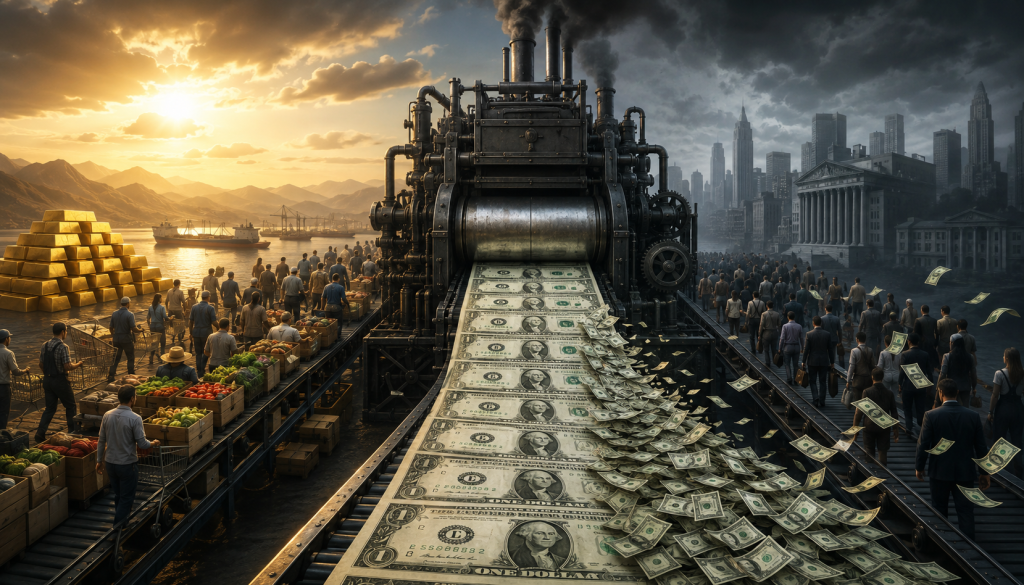
If you have a 401(k), buy gas, or wonder why your grocery and utility bills keep rising, look no further than the invisible machine running our global economy.
For most of the 20th century, that machine ran on gold. A dollar was a promise to deliver a fixed amount of the real metal. Any country could trade its dollars for gold, anytime.
Then, in 1971, Richard Nixon pulled the plug, announcing he was suspending “temporarily the convertibility of the dollar into gold.”
Fifty-five years later, we’re still waiting on that temporary lift.
For decades, dollar bills were IOUs with a promise: “IN GOLD COIN PAYABLE TO THE BEARER ON DEMAND.”

Those words are long gone.
What backs dollars today? Inertia, habit, and the assumption that everyone else will keep accepting them. Most people don’t see it because they’ve fallen into a psychological loophole called automaticity—the brain’s tendency to turn repeated behaviors into reflexes that no longer require conscious thought.
This essay reverse-engineers how the automatic machine works—and why it’s finally breaking.
A Strange Idea
For more than half a century, the global economy has operated on a strange premise: the world exchanges real goods, labor, and resources for dollars the United States can create at will.
Oil is priced in dollars—although that’s changing. Global trade clears through dollars—and that’s changing too. Governments borrow in dollars. Nations compete desperately to earn them.
To see how strange this really is, imagine you’re a farmer. Every day, you trade your fresh vegetables—the real product of your land and labor—for a stack of handwritten IOUs from a neighbor. The neighbor insists these IOUs are just as good as your vegetables. But there’s a catch: that neighbor can print as many IOUs as he wants, anytime, for nothing. And he does. Soon, your basket of vegetables is “worth” a stack of paper that keeps growing but buys less and less every week.
And you begin to wonder… what exactly did I trade my vegetables for?
That’s the global economy. Except the neighbor is the United States, the IOUs are dollars, and the vegetables are everything from Brazilian soybeans to Vietnamese sneakers to Nigerian crude oil.
So why does the world accept this arrangement? Not because everyone sat down and decided it was fair. Because the system gradually became automatic.
It’s a kind of cognitive lock-in. People defend the system not because it serves them, but because admitting it’s broken would require them to rethink everything. The mind resists that kind of upheaval. So it rationalizes. It makes excuses. It blames the victim. Sound familiar?
How the Brain Got Hacked
Psychologist Daniel Kahneman famously described two systems in the mind. System 1 is fast, automatic, and effortless. It’s what makes you flinch at a loud noise or drive a familiar route without remembering the trip. System 2 is slow, deliberate, and effortful. It’s what you use to solve a complex math problem or decide to break a lifelong habit.
The dollar system operates largely through System 1.
Countries don’t wake up each morning and consciously choose to use dollars. They just use them. The infrastructure assumes the dollar. Oil contracts are written in dollars. Global banking runs on dollars. Retirement accounts default into dollar-denominated index funds. Switching to anything else would require the heavy lifting of System 2—research, comparison, risk assessment, negotiation. That mental friction keeps everyone locked in.
The dollar is no longer backed by gold. It’s backed by network effects, habit, and infrastructure. It’s backed by inertia. And inertia is a dangerous thing to rely on when the ground starts to shift.
This automatic reliance on the dollar manifests in three distinct ways:
- Internationally, through the petrodollar system, which forces countries to hold and use dollars to buy oil, creating permanent global demand.
- Globally, through dollar-denominated debt. When a developing nation like Kenya or Brazil needs to borrow money, it doesn’t borrow in its own currency. It borrows in dollars. About 64% of the world’s debt is denominated in dollars. Emerging markets are even more exposed: roughly 80% of their international bonds are in dollars, leaving them vulnerable to exchange rate swings they cannot control.
- Nationally, through passive investing, which funnels trillions of dollars automatically into U.S. index funds through retirement accounts, regardless of valuations or economic conditions.
All three run on automaticity. None require active trust. Together, they explain why the invisible machine has felt like gravity for half a century.
But gravity has a price. The dollar’s exorbitant privilege—the ability to borrow in your own currency while the rest of the world scrambles to lend to you—comes at the expense of everyone else. To stay competitive, many countries suppress their own currencies and wages. The result is a quiet but constant transfer of real value from the developing world into dollar-denominated financial markets and assets.
Since Nixon closed the gold window in 1971, real wages for American workers have barely budged. According to the Bureau of Labor Statistics, median weekly wages adjusted for inflation were just 19% higher in 2025 than they were in 1985—a span of forty years. From 1979 to 2023, cumulative median wage growth was only 29%, less than 0.6% per year on average. That is not growth. That is treadmilling. Meanwhile, the dollar’s purchasing power has been steadily eroded by inflation.
So the machine runs on inertia and habit, on the quiet acceptance of a strange inversion: that the world’s reserve currency is backed by nothing more than the world’s willingness to keep using it.
How the Machine Was Built
In the mid-1970s, the United States struck a deal with Saudi Arabia: oil would be sold in dollars, and in return, America would provide military protection. This locked in global demand for the U.S. dollar. Countries needed oil, so they needed dollars. Those dollars piled up in oil-exporting nations, which then recycled much of them into U.S. debt, financial markets, and physical gold.
The dollar also became the world’s preferred currency for debt. When developing nations borrow, they borrow in dollars—leaving them vulnerable to exchange rate swings they cannot control.
But this system was not entirely accidental. Policymakers actively reinforced it.
In the early 1970s, as Nixon’s gold window slammed shut, U.S. officials debated how to keep the dollar on top. The problem was Europe. France, Germany, and other nations held large gold reserves—collectively more than the United States. If gold remained in the system and its price was revalued upward, Europe would gain dominant control over global reserves.
Secretary of State Henry Kissinger laid it out in a declassified 1973 meeting:
“Why is it against our interest to have gold in the system?” Kissinger asked.
Thomas Enders, a top State Department official, answered bluntly: “It’s against our interest to have gold in the system because for it to remain there would result in it being evaluated periodically. A larger part of the official gold in the world is concentrated in Western Europe. This gives them the dominant position in world reserves and the dominant means of creating reserves. We’ve been trying to get away from that into a system in which we can control.”
The answer was Special Drawing Rights, or SDRs—a made‑up international reserve asset the U.S. could influence. French President Georges Pompidou saw through it. In a separate conversation, he asked: “SDRs are based on what? What is their value other than a symbolic value? A currency must meet two criteria: it must be convenient; it must be secure.” Pompidou warned that if SDRs were judged to be fake, they would not last.
U.S. officials also discussed ways to suppress rising gold prices. Officials discussed selling official gold on the free market to depress its price, which signaled the dollar’s weakness. A National Security Council memo recommended selling up to $1 billion in gold to “reduce the present inflated price” and psychologically support the dollar.
The strategy worked. Gold was demonetized. The dollar remained the world’s primary reserve asset—not because it was backed by anything real, but because the United States had systematically eliminated the alternatives. (You can read the full documents here: Foreign Relations of the United States, 1969–1976, Volume XXXI, Foreign Economic Policy, 1973–1976 at the Office of the Historian.)
The domestic half: Steering Americans away from gold
While the U.S. was clearing gold from the international system, it was also quietly steering American savings away from gold and into the stock market.
For a long time, Americans weren’t even allowed to own gold. Under the Gold Reserve Act of 1934, private gold ownership was illegal. When Nixon closed the gold window in 1971, it became legal again in 1974. But the damage was done: gold was no longer the natural place to park savings. Americans had little choice but to hold dollars or other paper assets.
So the system made dollars more attractive than gold through market manipulation—specifically, packaging stocks into ETFs and mutual funds and building a passive-investing framework.
When John Bogle launched the first index fund in 1976, critics called it “Bogle’s Folly.” But automatic 401(k) enrollment, corporate compliance, and default target-date funds quietly transformed investing into an automatic money machine. (Note: gold funds were not included.) Millions of workers were placed into controlled index funds by default, and most never changed their allocations.
Behavioral economics explains why: people fear losses more than they value equivalent gains. Sticking with the default feels safer than making an active choice.
Together, these two systems—one international, one domestic—replaced gold with automation. The dollar was no longer backed by anything tangible. It was backed by dependence, habit, and the infrastructure of everyday participation.
Once systems like these become automatic, they stop feeling like decisions. They start feeling like gravity.
For decades, the system appeared almost untouchable. The dollar was unavoidable. Global trade, banking networks, sovereign reserves, and payment systems all ran through infrastructure ultimately tied to the United States.
And then, quietly, the foundation began to crack.
Something Is Changing Now
The first cracks weren’t announced on the evening news. They appeared through a series of shocks that forced the world to reconsider its dependence on the dollar: the 2008 financial crisis that exposed the fragility of dollar-denominated debt, the 2014 sanctions on Russia that weaponized the financial system, and the 2022 freeze of Russian reserves that turned a theoretical risk into a concrete reality.
The process accelerated dramatically in 2022. When the United States and its allies froze nearly half of Russia’s $640 billion in foreign reserves following its invasion of Ukraine, it sent a clear message: dollar-denominated assets held in Western institutions were not beyond political reach. For central banks from Beijing to Riyadh, this was an awakening. The very assets they had accumulated for stability now came with geopolitical conditions attached.
The response was quiet but deliberate. Central banks began the most sustained gold-buying spree since the end of the gold standard. Annual purchases surpassed 1,000 tonnes for three consecutive years—levels not seen in more than 70 years. Meanwhile, the dollar’s share of global reserves, which stood at 72% in 2001, fell to roughly 58% by late 2025. More than 70% of central banks signaled plans to reduce their dollar holdings further.
These defensive moves were accompanied by active de-dollarization. The clearest example was Russia-China trade. In 2022, nearly half of their bilateral trade was still conducted in dollars. By the end of 2023, almost 95% of their record $260 billion in trade was settled in rubles or yuan instead.
At the same time, the BRICS bloc—now expanding to include major energy producers like Iran and the UAE—gained momentum. At the 2023 summit in Johannesburg, member states began laying the groundwork for a payment system designed to bypass Western financial infrastructure entirely. By October 2024, Moscow had hosted a prototype of “BRICS Pay,” built to process up to 20,000 cross-border transactions per second in local currencies.
Then came one of the most symbolic shifts of all. In June 2024, the 50-year petrodollar agreement between the United States and Saudi Arabia quietly expired. For decades, the arrangement had served as a cornerstone of the system: Saudi oil sold in dollars in exchange for American security guarantees. The Saudis chose not to renew it. Going forward, they signaled they would increasingly accept yuan, euros, and yen alongside dollars for crude sales. A pillar that once seemed permanent was beginning to loosen.
The shift soon appeared in oil markets themselves. In early 2023, only about 18% of Saudi oil sold to China was priced in yuan. By the end of 2024, that figure had climbed to nearly 30%. Then, in March 2026, yuan settlements in that trade corridor surged to 41%, surpassing the euro. The old system was no longer simply eroding; it was being rewired from within.
Have you seen much of this on your favorite news channel? Probably not. Instead, public attention is pulled toward a steady stream of emotionally charged distractions: political rivalry presented as sport, outrage cycles over symbols and language, celebrity gossip, culture-war skirmishes, AI hype designed to trigger fear and anxiety, and a constant low-level panic about things most people cannot control. Psychologists call this attentional capture—the manipulation of focus to keep attention fixed on the immediate and emotional while structural changes unfold quietly in the background.
It’s the same principle a magician uses: the left hand creates the distraction while the right hand changes the deck.
Meanwhile, the financial plumbing keeps evolving. China’s alternative to SWIFT, known as CIPS, saw transactions surge; by late 2024, it was processing more than 8 million payments annually worth RMB 175 trillion. And mBridge—a platform allowing countries to settle payments directly using their own digital currencies without intermediary dollar banks—grew from a tiny $22 million pilot in 2022 to more than $55 billion in transaction volume by late 2025.
The deeper point is this: all of this new infrastructure makes the dollar increasingly optional. For the first time in decades, countries can begin choosing whether to use dollars rather than defaulting to them out of habit.
And here’s where it becomes personal.
While central banks and foreign governments quietly diversify away from dollar exposure, where is your retirement savings? Parked in U.S. index funds and dollar-denominated assets—the very instruments much of the world is gradually reducing dependence on. You’ve been defaulted into one of the most concentrated positions in a changing system.
The dollar still dominates global trade and reserves, for now. But the architecture beneath it is shifting. The dollar is no longer the only conductor—and its so-called “backing” is $39 trillion in national debt. Is debt a valid asset? Only if you think borrowing more is the same as building more.
If people begin thinking—really thinking—they may notice the strange inversion hidden in plain sight: a Brazilian farmer growing soybeans for dollars, a Vietnamese factory exporting goods for dollars, a Nigerian oil producer selling crude for dollars—all to accumulate debt issued by a country that can create more of it at will.
Notice how real things are getting more expensive in other countries, in dollar terms? That’s not those countries getting richer. That’s the dollar getting weaker.
Inflation is what happens when confidence begins colliding with material limits.
Once you see it, it becomes difficult to unsee. The psychology changes. What once felt automatic starts to feel constructed.
And when enough people begin asking why the system works the way it does, the system itself starts to look less like a law of nature and more like a set of bad habits held together by confidence.
The world may simply be waiting for a wake-up call. Not a revolution. Just a moment when enough people pause and ask: What are we actually doing here?
Running on Fumes
What’s important to see now is that the system increasingly survives on momentum rather than underlying stability.
Sociologist William R. Catton Jr. had a word for what happens when a civilization continues operating long after its foundations begin to crack: overshoot. In his 1980 book Overshoot, he argued that societies often sustain themselves beyond their natural limits by burning through temporary surpluses—cheap energy, borrowed resources, accumulated debt, inherited infrastructure. From the outside, the system still appears stable because it’s still moving. But continued motion is not the same thing as long-term stability.
Nowhere is this clearer than in the world’s energy reserves.
In late February 2026, the United States and Israel launched a war against Iran. Tehran responded in early March by effectively shutting down the Strait of Hormuz, the narrow chokepoint through which roughly 20% of the world’s oil and gas exports normally pass. For three months, this critical waterway has remained largely closed to ships bound for the United States and its allies, with Iran imposing inspections and fees on the limited traffic it allows through. The International Energy Agency called it “the largest supply disruption in the history of the global oil market.”
The economic consequences were immediate. Global food prices jumped 5% in just two months, according to the World Bank. U.S. gasoline prices climbed to nearly $4.18 a gallon, their highest level in four years. Analysts warned that if the closure persisted, crude oil prices could surge as high as $200 a barrel, pushing the global economy into recession.
But here’s the strange part: even with the Strait still restricted, oil prices later fell below $90 a barrel. Why? Because financial markets—conditioned by decades of intervention, stabilization, and automated expectations—continue betting that normalcy will return. Markets continue pricing the disruption as temporary. It may be wrong.
Think about what this means. For months, the world has continued consuming oil from existing stockpiles while one of its most critical supply arteries remains constrained. This is overshoot in real time—not just in energy markets, but in the financial architecture built on top of them.
From 2020 to 2025, new oil discoveries averaged roughly 3 billion barrels per year—far below annual global consumption. We are no longer discovering fuel at the rate we are burning it. Increasingly, the modern world runs on reserves accumulated in the past. The conflict with Iran did not create the underlying problem. It exposed it.
Now consider the pressure this places on developing nations. To earn the dollars needed for debt payments and energy imports, countries are pushed to extract resources as quickly and cheaply as possible. Rainforests become farmland. Minerals are strip-mined. Labor costs are suppressed. Environmental protections are waived. All of it in a race to export soybeans, sneakers, rare earth metals, or crude oil in exchange for a currency another country can issue at will.
At the same time, the system has created an ownership class that benefits enormously from financial inertia. Through passive investing, wealth compounds automatically, often detached from productive contribution or tangible output. The people who already own the largest share of assets receive the largest share of new gains simply because they are positioned closest to the flow of capital.
This isn’t an accident. It is the internal logic of a system built on automaticity. When money moves passively and continuously into financial assets, ownership itself becomes increasingly rewarded. Over time, the gap widens between those who own appreciating assets and those who rely primarily on wages to survive.
The dollar system may still appear stable from the outside. But for decades, momentum has been mistaken for sustainability.
The real question is not whether the system will change. It’s whether we’ll recognize the strain before the system is forced to change with or without our consent.
Further reading
- Catton, W. R. (1980). Overshoot: The ecological basis of revolutionary change
- Kahneman, D. (2011). Thinking, fast and slow
- Thaler, R. H., & Sunstein, C. R. (2008). Nudge


