



How the State-Corporate AI Complex Confuses Power With Intelligence
“What we observe is not nature itself, but nature exposed to our method of questioning.” — Werner Heisenberg
A remarkable set of coincidences unfolded over the past week and a half, and hardly anyone noticed.
On November 12, 2026, Jensen Huang resigned as CEO of Nvidia.
Three days later, the United States and nine partner nations—Australia, India, Israel, Japan, Qatar, Singapore, South Korea, the United Arab Emirates, and the United Kingdom—signed the San Francisco Declaration on the Secure Foundations of Enduring Prosperity. Convened at a Pax Silica summit by Under Secretary of State for Economic Affairs Jacob Helberg, the declaration marked a new phase for the alliance, formally adopting the language of “super intelligence” and establishing dedicated working groups.
Two days after the summit, Nvidia announced expanded commitments with six supply-chain partners—TSMC, Foxconn, Amkor, Samsung Electro-Mechanics, Kinsus, and Siliconware—to scale up manufacturing capacity for AI infrastructure.
Launched in December 2025, Pax Silica is a U.S.-led initiative to control global supply chains for semiconductors, AI infrastructure, and critical minerals. Over the past year, it has grown to 26 signatories. Alongside it, Washington has assembled a wider network of 54 countries through the AI Opportunity Partnership, whose members signed a separate statement promoting light-touch regulation and alignment around a U.S.-led AI ecosystem.
Administration officials have framed the initiative as a successor to the 1970s petrodollar system. At the San Francisco summit, Helberg opened his remarks by harking back to August 1971—the month Washington severed the dollar’s link to gold and reshaped global finance. The emerging strategy is to forge a “compute dollar” that ties America’s allies to U.S. technology while reinforcing the dollar’s status as the world’s reserve currency.
In a June 2026 State Department essay titled “The Digital Sovereignty Trap,” Helberg laid out the philosophy behind this approach. Responding to United Nations efforts to help countries develop independent AI systems, he argued that nations attempting to build their own technological infrastructure would inevitably fall behind. Real strength, in his view, comes from joining a U.S.-led ecosystem in which American firms retain the largest share of the profits and “the commanding heights of the global economy.”
Washington’s role, however, goes well beyond setting policy or securing supply chains. Just one month after Pax Silica launched, the government began taking direct ownership interests in private companies across strategic industries. According to the Council on Foreign Relations, by November 2026 the Trump administration had announced 49 such arrangements totaling $30.8 billion, spanning common and preferred shares, warrants, and other equity rights.
Alongside these investments, Secretary of State Marco Rubio noted in August 2026 that Washington had signed 27 critical-mineral agreements and established FORGE—a U.S.-chaired international partnership coordinating public financing and diplomatic backing for mining and refining. Together, these efforts bind raw materials directly to Pax Silica’s ambitions for semiconductor manufacturing and AI infrastructure.
The government isn’t buying everything, of course. In an August 2025 Fox Business interview, Treasury Secretary Scott Bessent ruled out taking an equity stake in Nvidia, noting the company needed no federal financial support. Yet direct ownership is hardly required for Washington to exercise control. It exerts enormous leverage through the rules, financing, relationships, narratives, and infrastructure it organizes.
What is emerging is an arrangement in which government-favored corporations organize an entire industry around the strategic goals of Pax Silica. Public resources help underwrite the risks, private firms capture the upside, and political authorities dictate the terms on which competitors and trading partners participate. This is not the free market at work; it is the state using the language of partnership to direct economic activity toward its own priorities. The State Department has even stepped into industrial training through its Foundry School, bringing together governments, universities, and chip-industry executives to teach factory operations under the Pax Silica banner.
Meanwhile, all we hear about in the news is Jensen Huang’s resignation and the scandals surrounding it. Strange, isn’t it?
While the political economy of this system deserves scrutiny, a deeper question lies beneath the mechanics of ownership, financing, and state control—one essential to any real conversation about what is actually happening behind the curtain. Set artificial intelligence aside for a moment. What, exactly, is intelligence? And why are we taking on extraordinary debt to build this?
We tend to measure intelligence by its output: how much data a system processes, how fast it solves problems, and how accurately it predicts outcomes. Yet genuine intelligence may begin somewhere else entirely—with the capacity to recognize that reality exceeds what we know, and to keep questioning a world far larger than our explanations of it.
The tension between accepting a dominant narrative and asking a fundamental question is much older than artificial intelligence. It runs through the earliest accounts in the Bible, beginning with a man who discovers there is far more to the world than he had ever known how to see.
The Place Already There
In Genesis, the first book of the Bible, Jacob is the grandson of Abraham and the son of Isaac. He is traveling away from home after deceiving his father and taking the blessing intended for his older brother, Esau. Fleeing his brother’s anger, he stops for the night at a place called Luz, takes a stone for a pillow, and falls asleep.
He dreams of a stairway set on the earth, its top reaching heaven, with angels ascending and descending on it. The Lord stands beside him, identifying himself as the God of his ancestors and renewing the promise made to Abraham and Isaac: land, descendants, and a continuing presence wherever Jacob goes.
When Jacob awakens, he is startled. “Surely the Lord is in this place, and I did not know it.” He calls the place awesome—the house of God, the gate of heaven—and renames it Bethel, Hebrew for “House of God.”
Notice what has happened. Jacob has not been shown how to reach heaven; he has discovered that heaven was already there. He hasn’t built anything, invented a technique, or engineered a way to climb upward. The ground does not become sacred because Jacob names it. What changes is his awareness of where he stands and what is already present.
Jacob’s discovery challenges the assumption that reality ends where our understanding stops. We tend to treat what we can identify, measure, and engineer as the full extent of what exists. Yet the world is not bounded by our ability to comprehend or construct it. Sometimes true intelligence begins not with building something new, but with recognizing what was there all along.
The Map and the Territory
Jacob’s experience points to a distinction also explored in modern neuroscience: the difference between the world we encounter and the mental representations we construct of it.
The psychiatrist Iain McGilchrist provides a clear framework for this divide. In The Master and His Emissary, he examines the distinct ways the brain’s two hemispheres attend to the world. Broadly speaking, the right hemisphere is receptive to reality as a living, changing, interconnected whole, attending to context, relationships, and the unique qualities of things. The left hemisphere narrows its focus—isolating details, categorizing, analyzing, and building practical representations we can manipulate and use.
McGilchrist gives these two modes of attention names drawn from an old parable: the Master and the Emissary. The Master represents the broader, receptive mode of attention; the Emissary represents the specialized, analytical mode. The Emissary is meant to serve the Master by isolating elements of the larger world to make them easier to understand and act upon. Its work is essential, yet it cannot replace the living whole from which its representations are drawn.
We need both. We cannot navigate life without distinguishing one thing from another, naming objects, developing concepts, measuring, and making plans. The ability to abstract—to pull one aspect of reality out of its larger context and examine it—is fundamental to human civilization. Language, mathematics, science, law, and technology all depend on it.
Where we run into trouble is when we mistake the representation for the thing itself. A map is useful precisely because it is not the territory. It simplifies, selecting certain features while ignoring others so we can find our way. It becomes dangerous only when we forget what it is, treating its lines and symbols as though they were the living landscape.
Stories work in much the same way. A story is a map with a plot. It selects and simplifies experience, telling us which details matter, who the heroes are, where the causes lie, and what comes next. A good story orients us, directing our attention toward certain truths and away from distractions. Yet when we forget that a story is merely a representation, we mistake its narrative for reality itself.
When the relationship between the Master and the Emissary is inverted, the Emissary begins to act as though its maps are the entirety of what exists. What can be measured becomes more real than what cannot. What can be categorized becomes easier to recognize than what is encountered directly through presence and attention. We grow increasingly confident in our constructed picture, even as we lose sight of everything beyond its frame.
That distinction becomes critical the moment we look closely at the kind of intelligence we are now spending billions to build.
The Intelligence We Are Building
AI is an extraordinary extension of our ability to work with representations—the exact kind of specialized processing McGilchrist associates with the Emissary. Yet the ability to generate an answer does not settle whether a system understands what is being asked in the way a human being does. So what, exactly, have we built?
The machine that appears to act on its own is anything but self-sufficient. Behind it lies an immense physical supply chain: mines, minerals, semiconductor fabrication, advanced packaging, electricity, cooling, ports, shipping, skilled labor, engineering, capital, and international coordination. Silicon chips require rare materials and extraordinarily complex manufacturing. Their production depends on equipment and facilities scattered across continents, while the assembly of finished computing systems often takes place somewhere else entirely.
As Helberg observed at the Pax Silica summit, open up the machine that trains a frontier AI model and you find a dozen nations packed inside—from Dutch lithography and German optics to Taiwanese fabrication, Korean memory, and Gulf energy. Even the ethereal “cloud” depends on tearing minerals out of the earth, from Chilean copper mines to Argentine lithium reserves, and moving hardware through strategic chokepoints like the Panama Canal.
The machine also runs on vast amounts of electricity. Much of that power still depends on fossil fuels. And the infrastructure that produces and delivers both is increasingly financed with debt. All of it requires pouring ever greater amounts of physical energy into digital abstractions, raising a question we rarely ask: how much energy should be devoted to sustaining financial wealth and its claims on the future, and how much to sustaining life and the living world?
For the past 150 years, we have drawn down the earth’s concentrated endowment of fossil energy while building a financial system designed to borrow against its future extraction. We are borrowing from tomorrow to consume that inheritance today, diverting finite physical resources into maintaining abstract financial claims—often at the expense of the living world. When the debt cycle turns and energy becomes scarce and expensive, what will our remaining power sustain? Wealth, or life?
The more capable the machine grows, the easier it becomes to overlook the human labor, natural resources, and financial leverage holding it up. Yet those underlying arrangements raise questions no computational intelligence can answer: Who controls the infrastructure? Who claims the energy? Who finances the expansion, and who bears the risk? Who dictates the terms on which others may participate?
Consider just how fragile those arrangements can be. In late October 2026, Washington welcomed Paraguay as the 26th Pax Silica signatory, eyeing its vast hydropower resources to feed energy-intensive AI data centers. Less than two weeks later, the collapse of Paraguay’s largest digital bank amid an insider-lending scandal froze accounts for nearly three million customers and triggered a political crisis that ended with President Santiago Peña’s removal. The grand strategic map met the unpredictable territory.
Bethel and Babel
The biblical stories of Bethel and Babel offer two fundamentally different ways of understanding our relationship with the world. One begins with the discovery of a reality we did not create. The other explores what happens when we try to establish our own foundation through collective power.
At Bethel, Jacob realizes that the world contains far more than he had ever known how to see. His first words are a confession of ignorance: “Surely the Lord is in this place, and I did not know it.” His awakening begins with the humility to admit that reality exceeds his grasp.
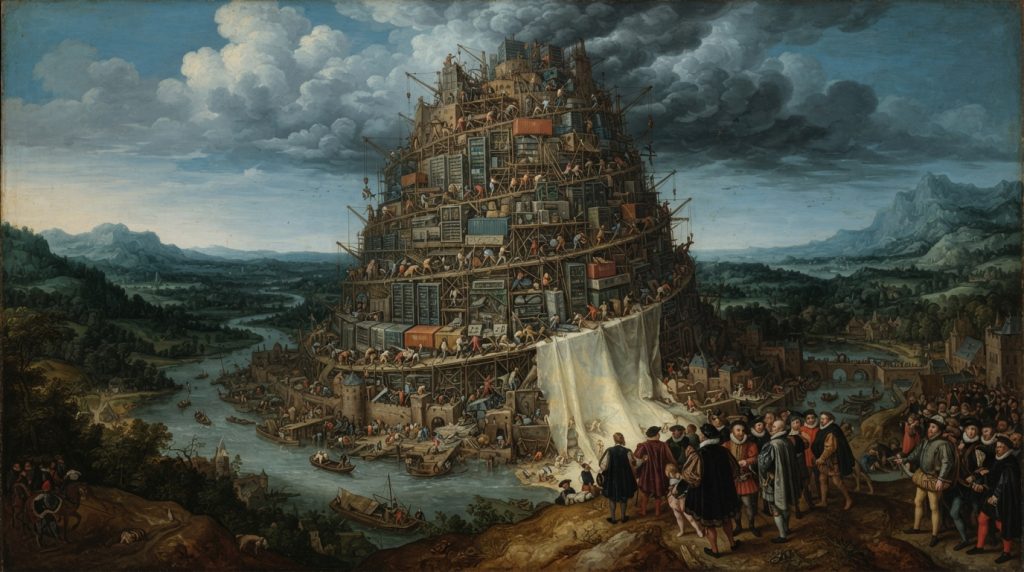
The story of Babel, also in Genesis, presents a stark contrast. Humanity shares a single language and resolves to build a city and a tower reaching toward heaven. The people bake bricks, organize their labor, and declare, “Let us make a name for ourselves; otherwise we shall be scattered abroad upon the face of the whole earth.” They seek to secure their identity and unity through a monument they can construct together. In response, God confuses their language, and the people scatter.
At Bethel, Jacob discovers that the ground is already holy. At Babel, humanity masters brick-making and sets out to manufacture its own permanence. The contrast is not between building and not building; it is between receiving a reality we did not make and attempting to engineer our own foundation for security.
Babel invites us to consider what happens when the systems we construct become the sole source of our security—when preserving the architecture matters more than serving the human beings who live inside it.
And that brings us to what happens when a system demands allegiance.
The Mark and the Ledger
The Book of Revelation, the final book of the Bible, is written in the form of an apocalyptic vision. Its author, John, describes a world of beasts, symbolic numbers, heavenly battles, and competing powers—images addressed to early Christian communities living under the political and cultural authority of the Roman Empire.
In Revelation 13, John describes a beast whose authority extends over all economic life. People are required to receive a mark on their right hand or forehead, and no one can buy or sell without it. The mark is identified with the beast’s name or the number of its name: 666.
This passage is often approached as a puzzle about future technology. What will the mark look like? Will it be a microchip, a digital identity, a biometric scan, or some other mechanism of control? Those questions may be fascinating, yet they risk distracting us from what the text actually emphasizes: the relationship between allegiance and economic survival. The mark signifies loyalty to the beast’s order, and without it, people are locked out of ordinary economic life.
The imagery becomes even more revealing when placed alongside an earlier biblical command.
In Deuteronomy 6, Israel’s central declaration of faith—known as the Shema, from the Hebrew word for “hear” or “listen”—begins with the words: “Hear, O Israel: The Lord is our God, the Lord alone.” The passage calls the people to love God with all their heart, soul, and strength, instructing them to bind God’s words as a sign on their hands and as symbols on their foreheads.
Revelation’s imagery echoes this ancient command, but inverts its loyalty. The beast demands comprehensive devotion—not to God, but to a counterfeit authority. Its mark can be read as an anti-Shema: a competing claim over a person’s actions, mind, and allegiance, enforced through total control over economic participation.
There is another striking detail hidden in the number 666. In the ancient world, letters also functioned as numbers. Each letter carried a numerical value, allowing readers to calculate the sum of a name or word—a practice known as isopsephy in Greek and gematria in Hebrew. Revelation itself invites this kind of reading when it calls 666 the number of a name.
While several historical and symbolic interpretations exist, one revealing possibility emerges from the numerical values of Greek letters. The Greek word euporia (εὐπορία)—meaning prosperity, abundance, or wealth—adds up to exactly 666: epsilon (5) + upsilon (400) + pi (80) + omicron (70) + rho (100) + iota (10) + alpha (1). Notably, in the Book of Acts, euporia appears in a story about craftsmen whose wealth depends on an idol-making enterprise—and whose economic interests are threatened when the gospel disrupts the market for their goods.

In the Gospels, Jesus gives this spirit a name: Mammon. He warns that no one can serve both God and Mammon. Later, in Revelation 18, a similar commercial order appears under the name Babylon, deliberately evoking the earlier story of Babel. Babylon is a global trading empire whose merchants grow rich on its commerce, until the final item listed in its cargo is “human lives.” The phrasing is chilling: human beings themselves have been reduced to commodities inside the ledger.
Revelation envisions a system much like Pax Silica, in which economic participation itself becomes conditional on alignment. The ability to feed, house, and sustain oneself becomes dependent on the very authority demanding loyalty.
The financial system—once fueled by debt to fund living reality—is now increasingly intertwined with financing chips, data centers, and computing infrastructure built to process digital abstractions. Claims on future physical resources are rapidly becoming claims on future human participation.
The Emissary looks for the mechanism: identify the mark, calculate the number, locate the person or institution responsible. The Master asks what kind of relationship the system creates and what it does to the people living inside it. One tracks the machinery of control; the other asks what that machinery is doing to human life.
The danger is that we build tools to serve life, yet eventually find ourselves organizing life to serve the tools—as if reality were merely a projection of our own minds. Carl Jung called this pattern enantiodromia: the tendency of any extreme to turn into its opposite. A project intended to liberate humanity ends up holding it captive.
And so we arrive again at the same two stories. At Bethel, Jacob discovers that the ground beneath him is already holy. At Babel, humanity attempts to manufacture a foundation of its own. Together, they capture a recurring human temptation: to replace the living reality we have received with a world of our own construction, and then submit to the very structures we built to secure ourselves.
That is not intelligence. It is merely power—and power confused with intelligence is the oldest trap of all.
Thank you for reading. If this essay resonated with you, I would love to hear your thoughts. And if you would like to support more work like this, you can support me on Patreon, BuyMeACoffee, or Substack.
References
Bank of England. “Details of the Bank of England Loan to the Government in 1694.” October 23, 2020.
Bessent, Scott. Interview by Maria Bartiromo. Mornings with Maria, Fox Business, August 27, 2025. Quoted in Reuters, “US Not Eyeing Stake in Nvidia, Treasury Secretary Bessent Says,” August 27, 2025.
Council on Foreign Relations. “Trackers: Trump Administration Equity Stakes.” Accessed November 2026.
Eichengreen, Barry, Asmaa El-Ganainy, Rui Pedro Esteves, and Kris James Mitchener. “Public Debt Through the Ages.” IMF Working Paper 19/6. International Monetary Fund, January 2019.
Helberg, Jacob. “The Digital Sovereignty Trap.” U.S. Department of State, June 23, 2026.
Helberg, Jacob. “Remarks by Under Secretary for Economic Affairs Jacob Helberg to the Pax Silica Founders Retreat.” U.S. Department of State, November 15, 2026.
Helberg, Jacob. “Remarks by Under Secretary Jacob Helberg at the Trump Administration’s Foundry School Launch.” U.S. Department of State, September 3, 2026.
Heisenberg, Werner. Physics and Philosophy: The Revolution in Modern Science. New York: Harper & Row, 1958.
Jung, Carl Gustav. Psychological Types. Collected Works, vol. 6. Princeton University Press, 1971.
Koester, Craig R. “The Number of the Beast in Revelation 13 in Light of Papyri, Graffiti, and Inscriptions.” Journal of Early Christian History 6, no. 3 (2016): 1–21.
McGilchrist, Iain. The Master and His Emissary: The Divided Brain and the Making of the Western World. New Haven, CT: Yale University Press, 2009.
NVIDIA. “NVIDIA Expands Commitments With Supply Chain Partners to Support AI Infrastructure Buildout.” Press release, November 17, 2026.
Reuters. Daniela Desantis and Brendan O’Boyle. “How a Digital Bank’s Collapse Toppled Paraguay’s President.” November 8, 2026.
Rubio, Marco. “Remarks at President Trump’s Roundtable on American Mining.” U.S. Department of State, August 7, 2026.
The New Revised Standard Version Bible. Division of Christian Education of the National Council of the Churches of Christ in the United States of America, 1989. Acts 19; Deuteronomy 6:4–9; Genesis 11:1–9; Genesis 28:10–22; Matthew 6:24; Luke 16:13; Revelation 13:16–18; Revelation 18:11–13.
U.S. Department of State. “AI Opportunity Statement” (Joint Statement on AI Opportunity Partnership). September 2026.
U.S. Department of State. “Pax Silica.” Launched December 2025. https://www.state.gov/pax-silica
U.S. Department of State. “Pax Silica AI Assistance Project NOFO.” Media Note, August 12, 2026.
U.S. Department of State. “The San Francisco Declaration on the Secure Foundations of Enduring Prosperity.” November 15, 2026.
U.S. Department of State. “United States Welcomes Paraguay as Newest Pax Silica Signatory.” Media Note, October 23, 2026.


