



“We shape our tools, and thereafter our tools shape us.” — Marshall McLuhan
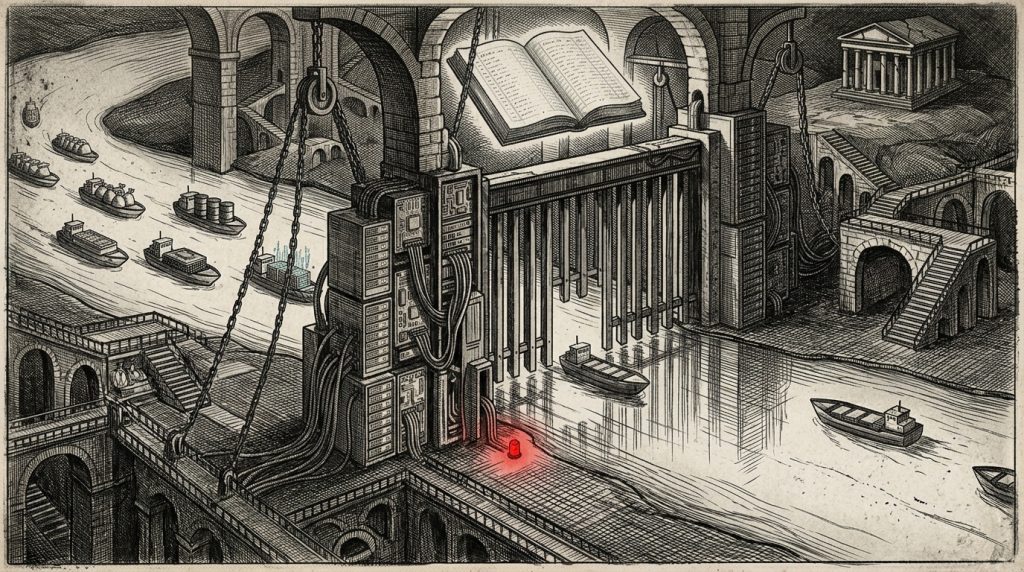
The tool being built today has a name: Pax Silica. The belief behind it is older. It is the faith that experts can manage what markets and democracies cannot. It is called technocracy.
The movement emerged after the First World War, when wartime mobilization showed how extensively governments could coordinate production. Engineers and scientists had helped direct the industrial effort. When the war ended, Howard Scott and others saw a possibility: if experts could organize the economy during war, why not during peace?
In 1918–1919 they formed the Technical Alliance. Its central project was an “Energy Survey of North America.” The survey’s premise was that the price system measured money, not energy—and energy was what actually made industry run. A society, Scott’s team argued, could appear wealthy on paper while exhausting the physical basis of its wealth. The Alliance disbanded in 1921, but its ideas returned during the Great Depression.
In 1932–1933, as unemployment soared, the technocracy movement argued that mechanization was destroying jobs faster than the price system could respond. Scott argued that engineers and scientists should run society. Politicians and businessmen, he said, were managing an industrial civilization through a price system that obscured its physical basis.
The movement proposed replacing prices with an energy theory of value—measuring worth in units of energy rather than dollars—and issuing “energy certificates” tied to available power. They popularized the term “technological unemployment,” the idea that machines were permanently displacing human workers. When unemployment hit 17 million, it seemed like proof they were right.
The movement drew on ideas beyond Scott. In Wealth, Virtual Wealth and Debt (1926), chemist Frederick Soddy distinguished the material wealth produced by transforming energy and resources from the financial claims represented by money and debt. Thorstein Veblen’s The Engineers and the Price System (1921) attacked the ways business interests could restrict production to protect profits, arguing that engineers could organize industry around productive efficiency. Scott supplied the thermodynamic framework that made the price system appear not merely unjust but obsolete.
World War II pulled the engineers into the war effort. The postwar boom, powered by cheap oil and expanding credit, made the price system seem to work again. Scott’s ideas faded to the margins.
For a generation, the questions went quiet, but not for long. In 1971, President Nixon ended the dollar’s convertibility into gold, and the Bretton Woods system—the postwar arrangement that pegged major currencies to the dollar—unraveled. The 1973 oil shock and the stagflation of the 1970s—high inflation combined with high unemployment—revived questions about resource limits and the relationship between money and material production.
Those questions never fully went away. Today they return in a new vocabulary: stakeholder capitalism, public-private partnerships, the World Economic Forum’s “Great Reset,” the UN’s Agenda 2030. Each framework assumes that markets alone cannot manage what is coming—and that the people who understand the complexity should.
I began to suspect that, regardless of which party holds power, the U.S. government is building the institutional architecture of a technocracy—one in which control over essential infrastructure increasingly determines who can participate in the economy, and on what terms.
I did not arrive at this argument lightly. I arrived by following the trail.
I arrived through the gold. In early 2025, I watched as enormous quantities of gold flowed into the United States, and I asked why. I wrote about Fort Knox, about the promises to audit, about the strange silence when the audit never came.
I arrived through Elon Musk. His maternal grandfather, Joshua Haldeman, led the technocracy movement in Canada and advocated rule by scientists and engineers rather than elected politicians. Musk’s role in DOGE—compiling government data, restructuring agencies, and treating the state like a system to be debugged—brought that history to mind.
I arrived through the tariff whiplash. Through the Treasury market that could not sell its debt. Through the crypto conference where the Treasury Secretary said stablecoins would buttress the dollar’s status as the global reserve currency. Through the promises that evaporated.
I had supported some of those promises. I watched them fade, and I stopped asking who was betraying us and started asking what system is being built instead. The architecture.
This essay is about that architecture.
Pax Silica Architecture
It appears that Pax Silica is the architecture of the technocratic lineage. It is a US-led initiative to organize the supply chains underlying the AI economy: critical minerals, semiconductor manufacturing, computing infrastructure, energy, and logistics. Its stated purpose is to secure those supply chains among trusted partners.
But the Trump administration has done more than sign trade agreements. It has taken equity stakes in private companies. It has negotiated golden shares—special shares that give the government veto power over major decisions—in U.S. Steel and other firms. It has used the government’s own money to buy into industries it once claimed to leave alone.
These are not the acts of a movement that wants to shrink government. They are the acts of a state consolidating control over the infrastructure of production.
Pax Silica’s strategic significance extends beyond chips. It is an effort to organize the infrastructure on which production increasingly depends. That infrastructure has three interconnected layers: control over production, control over access, and support for the financial system that funds the network.
Control of production means influence over access to advanced chips, computing capacity, AI models, energy, and the infrastructure that makes them work. The United States does not need to manufacture every chip. It needs its companies and technologies to occupy positions that others depend on.
Control of access means influence over credentials, standards, and payment systems that determine how participants enter and move through a network. Credential verification can improve security and efficiency. But if recognized credentials become a condition of access to important routes or markets, the authority to recognize them becomes a source of leverage.
Support for American borrowing means demand for dollars and dollar-denominated assets, including US Treasuries. Dollar dominance sustains demand for US debt. It lowers the cost of financing American borrowing. And it preserves the financial advantages that come with issuing the world’s principal reserve currency.
These are distinct mechanisms, not yet one unified machine. But together they form a single architecture of dependence. Technological dependence creates leverage. Network rules make participation conditional. Dollar-based instruments sustain the funding. None of it needs a central orchestrator. It only needs the layers to reinforce one another.

The Thermodynamic Limit
The energy return on investment for oil—the amount of energy you get back for every unit you spend extracting it—peaked at more than 50:1 in the 1930s and 1940s. By 2018 it had fallen to roughly 15:1. A 2017 study in Ecological Economics, the most-cited long-term estimate of the trend, projects it will reach 10:1 by 2035 and 5:1 by 2061.
Those projections, however, predate the current acceleration. The AI buildout and cryptocurrency mining are consuming electricity at a scale the models did not anticipate. And electricity, in most markets, is still generated by burning fossil fuels—the same fuels whose energy return is falling. The easy energy is gone. What remains is expensive, dirty, and increasingly difficult to extract.
The war with Iran is not the subject of this essay. But ask what it does. It closes the Strait of Hormuz, through which a fifth of the world’s oil passes. Brent crude doubled, from roughly $70 a barrel before the strikes to more than $125 at its peak. The Energy Information Administration has since reversed its forecast of rising demand for 2026. This creates a visible culprit—a reason for high prices that has nothing to do with the underlying decline in net energy.
Whether the war was engineered or simply exploited, the effect is the same: a constraint becomes a lever, and the lever is now in the hands of those who manage the crisis.
Joseph Tainter, a historian of collapse, described the dynamic in The Collapse of Complex Societies. Societies solve problems by adding complexity. But complexity has a cost. It requires more energy to maintain. When the return on added complexity turns negative, the society consumes more and more energy just to sustain what it has already built. Complexity becomes a liability. Collapse follows.
The technocrats have read Tainter. They know what happens when complexity outruns energy. They have decided not to wait for the collapse.
They are building the next system while the old one is still standing—and accelerating the crisis that will justify it.
What does the technocratic order want? It does not promise abundance. It promises management. It offers to steer the transition, to allocate what remains, to decide who gets access and who does not. It is a system for a world of limits, run by those who understand the limits.
The AI buildout consumes extraordinary amounts of electricity. Global data center demand grew 17 percent in 2025 and is projected to roughly double by 2030, according to the International Energy Agency. AI-focused facilities increased their consumption by 50 percent in a single year. Bitcoin mining, which the Cambridge Centre for Alternative Finance tracks at roughly 150 terawatt-hours a year, now competes directly with AI for the same scarce grid capacity.
An energy crisis need not be deliberately engineered to become a source of political power. When infrastructure cannot meet demand, the institutions that control investment, capacity, and allocation gain influence over who receives what.
When data-center demand strains electricity systems and raises costs for households and businesses, governments face pressure to respond. They may expand grid investment, subsidize infrastructure, negotiate with technology companies, or take a more direct role in strategic industries.
Governments are already taking equity stakes in AI companies. Reuters has reported that OpenAI discussed giving the US government a 5 percent stake. India’s AI mission is considering public equity in Sarvam AI. The UK has established a “Sovereign AI Unit.” Saudi Arabia’s HUMAIN venture launched with $100 billion in government backing.
The pattern is consistent. The energy crisis justifies the state stepping in. The state stepping in normalizes the technocratic model.
This is where Scott’s proposal becomes relevant again. Not as a policy already being implemented, but as a historical answer to the question now forming. Scott proposed energy certificates because he believed the price system could no longer organize an energy-intensive industrial society. Today’s systems are different, but the underlying question remains: if energy becomes a tighter constraint on an increasingly complex economy, who will decide how it is allocated, and by what measure?
The current system still functions. The dollar still works. The compute dollar is an extension of the dollar system, not a replacement for it. It buys time. It sustains demand for Treasuries. It keeps the debt machine running. It does not solve the underlying problem.
The sequence looks like this. The debt system strains. Energy costs rise. The debt cannot absorb the cost. The system needs a new unit of account—a new way to measure value that reflects the real constraint. And that unit will be based on energy, because energy is the only real foundation left.
The energy certificate is waiting. It is the endgame. When the debt system can no longer subsidize cheap energy, when EROI falls too low, when complexity becomes too expensive to maintain, the system will need a new way to allocate resources. It will need to measure energy directly.
It has already been piloted.
In Ecuador, rolling blackouts of up to fourteen hours a day have become routine—reported by the international press and confirmed by the government’s own schedule. The schedule determines when you can work, when you can cook, when you can read.
In Sri Lanka, a QR-code system limits private motorists to fifteen liters of petrol per week. The government determines how far you can drive.
In Iraq, internet access is shut down daily from 6:00 to 8:00 AM.
These are pilots. Real-world tests of systems that determine who gets energy, when, and how much. The pattern spans continents and political systems. It is not confined to one region or one type of government.
The compute dollar is the bridge. The energy certificate is the destination.
It is not a secret cabal meeting in a basement. It is a structural logic that emerges when a system faces constraints it cannot solve through existing mechanisms. The energy problem is real. The AI buildout is real. The financial stakes are real. Given all of that, consolidating control in the hands of those who understand the complexity is the logical outcome.
The people running this are not thinking “let’s implement technocracy” because they are greedy and evil. They are thinking “we need to manage this transition, and we are the ones competent to do it.” They are also making sure they benefit from it, of course. That is the technocratic impulse. It does not require a conspiracy. It just requires a system where the experts are also the beneficiaries, and the costs are externalized onto everyone else.

From Petrodollar to Compute Dollar
The United States has used a related mechanism before, and it is rebuilding it now.
In the 1970s, after the Bretton Woods system collapsed, the United States deepened its relationship with Saudi Arabia and other oil producers. Oil was traded in dollars. That meant any country that wanted to buy oil needed dollars. Oil exporters, in turn, invested their dollar surpluses in American financial markets, including US Treasuries. Global demand for oil supported demand for the currency oil was priced in. American financial markets gave holders of that currency a place to invest. The arrangement sustained the dollar’s international position and helped the United States borrow.
Now imagine the same pattern, rebuilt for compute.
A company in India wants to train an AI model. It needs chips, data-center capacity, electricity, software, and technical services. It may depend on American-designed processors, US cloud providers, or models from US companies. Where those services are priced in dollars, the company needs dollars to buy them. Its payment becomes revenue for the US provider. The provider may hold some of that revenue in dollar-denominated assets.
A further link appears when payments move through dollar-backed stablecoins—digital tokens designed to hold a one-to-one value with the dollar. The companies that issue them hold reserves, including US Treasury bills. As stablecoins circulate and their supply expands, those reserves can generate additional demand for short-term American debt.
This is not an accidental side effect. It is an explicit policy objective.
On July 18, 2025, following the enactment of the GENIUS Act, Treasury Secretary Scott Bessent said: “This groundbreaking technology will buttress the dollar’s status as the global reserve currency, expand access to the dollar economy for billions across the globe, and lead to a surge in demand for US Treasuries, which back stablecoins.”
The Center for Strategic and International Studies has made a similar argument: dollar-pegged stablecoins can extend the dollar’s reach into the digital economy, and regulation is necessary to preserve American financial leadership.
The pattern is straightforward. AI infrastructure creates demand for computing services. Dollar-priced services reinforce demand for dollars. Dollar-based payments expand the role of dollar-denominated instruments. Stablecoin reserves generate demand for Treasuries. Demand for Treasuries helps the United States finance its borrowing.
The United States does not need to own every data center or build every AI model. It needs its companies, technologies, standards, and financial instruments to occupy positions others depend on.
The toll booth is not a single company. It is the network of dependencies through which economic activity passes.

The Permission Problem
Pricing is one source of power. Controlling access is another.
In June 2026, Under Secretary Jacob Helberg announced the Pax Silica AI Assistance Project at the Second Pax Silica Summit in Washington. The State Department has since opened a competition for up to $50 million in foreign assistance to build an AI supply chain credentialing platform—a system to verify where goods come from and speed their passage through participating countries. The pilot begins with Panama’s ports and customs authorities. If it succeeds, it would expand to other Pax Silica countries.
The stated goal is security and efficiency. The underlying mechanism raises a different question: what happens when participation in an economic network depends on credentials recognized by those who operate it?
Goods do not move simply because a buyer and seller agree on a price. Provenance—where a product comes from and how it got there—documentation, and compliance status can determine how quickly goods move, and whether they qualify for preferential treatment. Verification can reduce fraud. It can also become a condition of access.
The distinction matters. A digital credential does not, by itself, determine who may trade. But when credentials are tied to essential infrastructure, preferred routes, or access to important markets, the authority to recognize them becomes a source of leverage.
The same principle operates elsewhere. Export controls restrict access to advanced chips. Cloud providers enforce sanctions. Payment intermediaries refuse transactions. Countries and companies find themselves excluded from technologies they have the money to buy but are not permitted to obtain.
A country can have money and still lack the technology it needs. A company can have a willing buyer and a willing seller and still be unable to complete a transaction. A shipment can have a market and still be delayed or excluded because it fails the network’s requirements.
None of this requires a central orchestrator. The mechanism is not a conspiracy. It is an architecture. Control over production creates leverage. Control over access makes that leverage conditional. Dollar-based payments reinforce monetary demand. Stablecoin reserves channel some of that demand into government debt. Institutions pursue their own objectives while their separate systems converge on the same underlying power.
Architectures shape behavior long before anyone writes a rule. But the architecture is not yet closed. It is being built now, which means it can still be argued with, delayed, or designed differently.

The Close
The old market priced the product. The emerging order organizes the process, conditions access to the network, and sustains the financial system behind it.
The toll booth has moved upstream—from the point of sale to the point of access.
The temple once controlled the grain stores, the means of livelihood, and the obligations that bound people to the institution. The modern system operates through different instruments: chips, credentials, computing capacity, payment networks, and government securities.
But a mechanism is not a meaning. What kind of order is being built around this ledger? Who are its priests? Who are its saints? And what does it ask of the people inside it?
This is the subject of my next essay.

Thank you for reading. If this essay resonated with you, I would love to hear your thoughts. And if you would like to support more work like this, you can support me on Patreon, BuyMeACoffee, or Substack. I also appreciate direct donations via digital payment networks like Zelle—message me for details.
A Note on the Art
The image in this essay is inspired by Giovanni Battista Piranesi (1720–1778), whose Carceri d’Invenzione — the Imaginary Prisons — remain the most unsettling architectural images in Western art.
Piranesi did not draw real prisons. He drew the idea of imprisonment as architecture. Vast arches. Stairways that lead nowhere. Tiny figures scattered through the space like afterthoughts. The architecture is the subject.
A system can constrain people without closing a literal gate. That is what makes Piranesi’s prisons unsettling. Everyone inside them has already accepted the terms.
The image is stark. Black and white for the diagnosis. A single red accent for the toll.
References & Sources
Bessent, Scott. “Statement from U.S. Secretary of the Treasury Scott Bessent on Enactment of the GENIUS Act.” U.S. Department of the Treasury, July 18, 2025. https://home.treasury.gov/news/press-releases/sb0197
Center for Strategic and International Studies. “Stabilizing U.S. Financial Leadership: Why Congress Must Get Stablecoin Regulation Right.” April 30, 2025. https://www.csis.org/analysis/stabilizing-us-financial-leadership-why-congress-must-get-stablecoin-regulation-right
Center for Strategic and International Studies. “Unstable Coins: Stablecoin Regulation, Market Structure Legislation, and U.S. Security Risks.” January 12, 2026. https://www.csis.org/analysis/unstable-coins-stablecoin-regulation-market-structure-legislation-and-us-security-risks
Court, Victor, and Florian Fizaine. “Long-Term Estimates of the Energy-Return-on-Investment (EROI) of Coal, Oil, and Gas Global Productions.” Ecological Economics 138 (2017): 145–159. https://doi.org/10.1016/j.ecolecon.2017.03.015
Hudson, Michael. …and forgive them their debts: Lending, Foreclosure and Redemption from Bronze Age Finance to the Jubilee Year. ISLET, 2018.
IISS. U.S. Critical Minerals Diplomacy: From America-First Deals to Pax Silica. International Institute for Strategic Studies, January 2026. https://www.iiss.org
Philippine Information Agency. “BCDA eyes AI industrial hub in New Clark City under US-led Pax Silica initiative.” April 23, 2026. https://pia.gov.ph
Soddy, Frederick. Wealth, Virtual Wealth and Debt: The Solution of the Economic Paradox. E.P. Dutton & Company, 1926.
Tainter, Joseph. The Collapse of Complex Societies. Cambridge University Press, 1988.
Technocracy Inc. The Technocrats’ Magazine. 1933. https://archive.org/details/technocrats-magazine
U.S. Department of State. “Pax Silica AI Assistance Project NOFO.” August 12, 2026. https://www.state.gov/releases/office-of-the-spokesperson/2026/08/pax-silica-ai-assistance-project-nofo
U.S. Department of State. “Virtual Press Briefing with Jacob Helberg,” December 2025. https://www.state.gov/virtual-press-briefing-with-jacob-helberg-under-secretary-of-state-for-economic-affairs-on-ai-supply-chain-security
Veblen, Thorstein. The Engineers and the Price System. B.W. Huebsch, 1921. https://archive.org/details/engineerspricesy00vebl


