



“For what shall it profit a man, if he shall gain the whole world, and lose his own soul?”—Mark 8:36
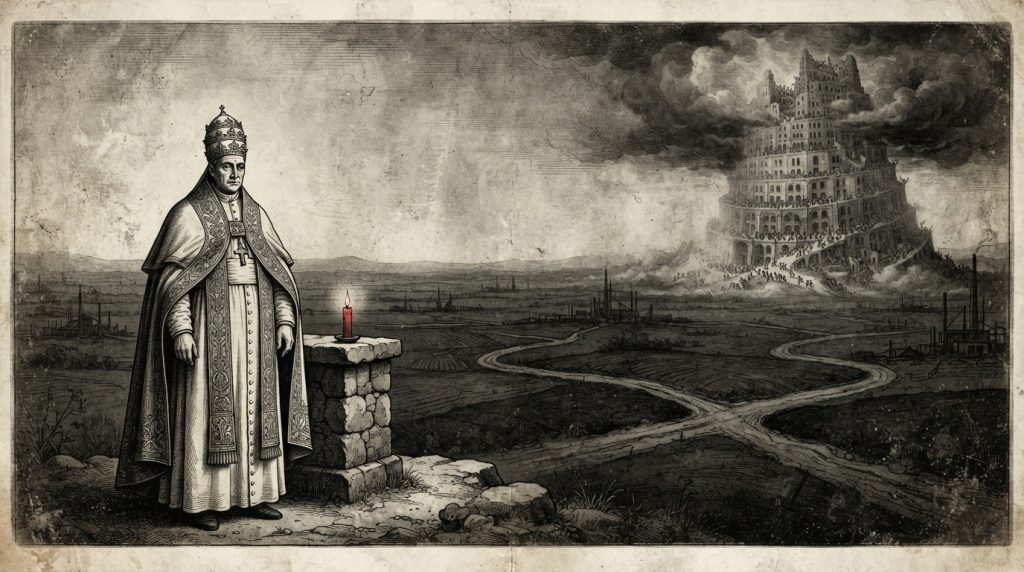
What happens when a system of total control encounters something it cannot control?
This is the question that Pax Silica raises.
Pax Silica is a U.S.-led initiative launched in December 2025 to organize a coalition of “trusted partners” around the control of semiconductors, AI infrastructure, and critical minerals. It is not a treaty. It is a hub-and-spoke network of bilateral agreements. The goal is to credential every shipment, price every AI transaction in dollars, and determine who can buy and sell through a digital passport system first piloted at the Panama Canal.
After breaking with gold in 1971, the United States built its global power on the petrodollar—the arrangement that made oil the foundation of dollar demand. That foundation is now eroding. Pax Silica is the search for the next one. And it is a search conducted with all the tools of the machine: credentialing, tokenization, verification, control.
The architecture can be built. It is being built. The question is what happens when it meets its limit.
It converts real things into claims and persons into nodes. It determines who can buy and sell—a power the Bible reserves for the last days. It is the most sophisticated system of economic coordination ever constructed.
And it has encountered something it cannot tokenize, freeze, or revoke.
That something is the Church.
Not the Church as an institution—the Vatican has no army, no reserve currency, no semiconductor fabs. But the Church as a form of authority that operates outside the ledger. A power that speaks in a language the system does not understand. A pope who cannot be bought.
And what the Church refuses is simple. It refuses to accept that human worth is a credential, that dignity can be verified, priced, or revoked. The Church refuses to be absorbed into the ledger.
The current American administration is discovering this in real time. Every meeting with the Vatican is an encounter with a limit it cannot overcome. And the discovery is not new. It is the recurrence of an ancient struggle—one over who sets the moral limits on money.
To understand why the Church’s refusal matters, we have to understand what the Church once was—and what replaced it.

How We Got Here
For over a millennium, Western civilization was organized around Christendom. It was a political, theological, and economic order all at once. The Church was its greatest concentration of wealth, land, and credit. It minted coin, extended loans, and moved money across borders in an age when few others could.
It was not a bank in the modern sense. It was a religious body that had become the economic center of a civilization—and therefore claimed authority to set the moral rules for money. It prohibited usury—the lending of money at interest—and subordinated economic exchange to spiritual law.
But the prohibition applied only to Christians. Jews were not subject to church law, and they were excluded from most other professions. So lending migrated into their hands. The Church needed credit and could not lend at interest itself. So it left the work to those it excluded.
In the Old Testament, God’s law drew a line around the community: usury was forbidden among Israelites but permitted toward foreigners. The early Church inherited that inside/outside distinction and reversed its direction. The prohibition now bound those inside the faith; the lending was left to those outside it. In the Old Testament, the insider could charge the outsider. Now the outsider charged the insider. The Church condemned the sin and depended on the sinners.

Then Came the Reformation
Luther posted his theses in 1517. He meant to reform the Church’s theology, not its finances. But in Christendom, the two were one. To attack the Church’s doctrine was to attack its authority over money.
By the end of the sixteenth century, the Protestant princes had seized the Church’s lands and wealth. The network that had moved credit across borders for a thousand years was fractured into national pieces. The Church could no longer be the bank of Europe, because there was no longer a single Europe for it to bank.
The Reformation broke the Church’s monopoly on moral authority—and with it, the prohibition on usury. Lending at interest was no longer a sin for Protestants. It was a business.
Into that vacuum stepped men with capital, connections, and no theological scruples about interest, backed by a state that blessed what the Church forbade. They were bound by neither church law nor community—only by contract.
The new arrangement took shape first in England, and 1694 made it permanent. The English king needed money for a war against France. He borrowed £1.2 million from a syndicate of wealthy men. In return, they received a perpetual annuity—a guaranteed yearly payment funded by earmarked taxes. And they were organized as a corporation: the Bank of England.
Here is what made it new. The loan was backed by Parliament, not just by the King’s word, so the annuity was reliable. And because it was reliable, it could be sold. A lender who wanted his money back did not have to wait for the King to repay. He could sell his share to someone else. The King’s debt had become a tradeable asset.
Like magic, the sovereign’s liability became income for its holder. This is the inversion: a claim on the future now passes as wealth in the present. The ledger replaced the altar.

The production and distribution of actual things, bound by physical constraints, was subordinated to financialized pseudo-economics: trading claims, optimizing models, extracting value from relationships the Church held sacred.
The loan officer no longer knows the farmer; he sees a credit score. The doctor no longer knows the patient; she sees a chart. The teacher no longer knows the child; he sees a test result.
The West chose the ledger over the person. It chose to exist outside of God’s law, to become like God rather than to walk with Him. And it built a world in its own image—a world of abstraction, category, and control.
Pax Silica is the extreme logic of that world. The digital passport converts physical goods into verifiable data. The token dollar converts compute into financial claims. The credentialing system converts trust into a permission level. Every step takes something real and converts it into a claim that can be traded, priced, and controlled. This is the inversion at scale—the ledger absorbing the world.
This is Babylon. It is the system the Church once allowed to enter through compromise—the ledger it condemned but depended on. And now, a different Pope speaks again.
The Public Feud
Pope Leo XIV speaks not to forbid usury, but to forbid the reduction of persons to data. The historical rhyme is that the Church is once again naming an economic form as spiritually lethal. This time, it is not usury. It is tokenization.
Pope Leo is the first American pope in the 2,000-year history of the Catholic Church. He was born Robert Francis Prevost in Chicago, raised in Dolton, Illinois, and served for decades as a missionary in Peru before being elected to the Chair of Peter. He is an Augustinian who studied mathematics and is the author of the most consequential papal encyclical on technology ever written.
In May 2026, Pope Leo published Magnifica Humanitas: On Safeguarding the Human Person in the Time of Artificial Intelligence.
But the encyclical did not arrive in a vacuum. It landed in the middle of a fight.
The conflict escalated over the U.S.-Israeli war on Iran. Pope Leo criticized the war. Trump responded by attacking the Pope personally—calling him weak on crime, accusing him of “endangering a lot of Catholics,” and repeatedly suggesting he supported Iranian nuclear weapons. The Pope had done no such thing. The Catholic Church has opposed nuclear arms for decades. But facts were not the point.
The Pope responded with a sentence that belongs in a different category of speech entirely: “If anyone wishes to criticise me for proclaiming the Gospel, let them do so truthfully.”
This is not a political dispute or a diplomatic spat. It is a collision between two forms of power that do not share a common language. One operates through incentives and control. The other speaks in truth.
Then came the image. Trump shared an AI-generated picture of himself as a Jesus-like figure, laying hands on a sick man, healing him with a beam of light. The backlash was immediate. Trump deleted the post and claimed he thought it depicted him as a doctor.

The significance is not the gaffe. It is the mechanism. The President tried to manufacture a counterfeit of sacred authority through the same apparatus—generative AI—that the system uses to credential supply chains and price compute. He tried to tokenize the sacred. And the Pope’s response was not to argue about the image. It was to preach.
“I always believe it’s much better to enter into dialogue than to look for arms and to support the arms industry, which gains billions and billions of dollars each year,” Leo told reporters outside Castel Gandolfo. This is the voice of a different order. It does not negotiate or trade. It speaks truth and lets truth do what truth does. The system expects resistance and negotiation; it has no category for a witness.
The Asymmetry
On May 7, 2026, Marco Rubio arrived at the Vatican. He spent two and a half hours there—longer than planned. The Pope arrived forty minutes late for his next appointment.
The American official line, delivered anonymously: the talks were “friendly” and “constructive.”
The Vatican’s official statement was more careful: “the shared commitment to fostering sound bilateral relations between the Holy See and the United States of America was reaffirmed.”
Notice the word: reaffirmed. In diplomatic language, “reaffirmed” is not “strengthened.” It is not “advanced.” It is code for we are not aligned, but we are willing to keep talking. It is the language of a relationship that requires repair.
The topics discussed were deliberately narrow—the diminishing areas where Washington and the Vatican still have overlapping interests. There were only three. Religious freedom. The growth of the Church in Africa. Humanitarian aid to Cuba, routed through the Church rather than the Cuban government.
The shortness of that list is the story. Two of the three are places where the administration wants something from the Church—its networks, its credibility, its reach. Not its judgment. Not its moral authority. Just its infrastructure.
Thomas Reese, a Jesuit priest and longtime Vatican journalist, said he was hard-pressed to find significant issues over which the Vatican and the Trump administration could work together. Then he put his finger on the problem: “The main challenge for Trump is that the Vatican is very hard to bully. I mean, what’s he going to do, impose tariffs? The Vatican doesn’t sell indulgences anymore. Send in the Marines? You have to go through Italy first.”
The architecture operates through incentives: access to markets, exclusion from networks, tariffs, sanctions. These tools work on states, corporations, and individuals who need to buy and sell. They do not work on the Church.

The system can freeze assets and cut off access, but it cannot tell the Pope he is not authorized to speak. Moral authority is not a claim on a ledger; it is a witness. The Vatican is not a signatory to Pax Silica. It cannot be. Its authority comes from a source the ledger cannot access. That is why the administration keeps meeting with the Pope: not because he has power it wants, but because he has power it cannot replicate.
The Cardinal’s Question
The Philippines signed the Pax Silica Declaration in April 2026. The country is hosting the initiative’s first “AI-native industrial hub”—a semiconductor and artificial intelligence complex occupying 1,620 hectares at New Clark City in Capas, Tarlac.
The project has drawn criticism from many Filipinos. Inquirer data scientist Dr. Alicor Panao warned that the Philippines lacks the electricity capacity for such a project. Agricultural workers’ groups warned that it would accelerate land conversion in Central Luzon and threaten food security.
Then came Cardinal Pablo Virgilio David of the Diocese of Kalookan, asking the question no one else was asking—and the administration cannot answer:
“Will Pax Silica help build Filipino scientific capability, technological innovation, and industrial resilience? Or will it primarily serve the strategic interests of others while Filipinos provide the land, natural resources, water, energy, tax incentives, and labor? … These are legitimate questions—not because we oppose foreign investment, but because genuine partnership should strengthen the nation that hosts it,” he said.
And then he went deeper. He cited Magnifica Humanitas:
“The ultimate question, therefore, is simply whether Pax Silica will make economies stronger or artificial intelligence more powerful. The real question is whether it will help build what Pope Leo calls a civilization of love rather than a culture of power—a future in which technological progress serves human dignity, social fraternity, care for our common home, and peace among nations.”

This is the Church doing what it once did: setting moral limits on economic arrangements—not from institutional power, but from moral witness. The Cardinal is not threatening to block the project. He is asking whether it serves the person. Once asked, that question becomes a standard the architecture must meet.
Dignity Is Not a Credential
Magnifica Humanitas was published on May 25, 2026, in the 135th-anniversary year of Rerum Novarum, the encyclical that launched modern Catholic social teaching. The choice of date was not accidental. Leo was placing his document in a lineage.
The central premise is that technology is never neutral. It takes on the characteristics of those who devise, finance, regulate, and use it. The Pope called for AI to be “disarmed”—a deliberately strong word, he said, “because this moment needs words capable of attracting attention.”
The encyclical warns that AI risks “deepening inequality, weakening human relationships and concentrating power unless guided by ethical oversight.” It calls for “values-based rules and societal control” over the use of artificial intelligence.

But the heart of the document is anthropological. The human person has a “fundamental dignity” that “is neither acquired nor earned, nor does it need to be justified.”
This is the direct antithesis of the credentialing logic.
Pax Silica says: you are trusted because you are verified. The digital passport certifies origin, custody, and compliance. The token dollar prices your transactions. The ledger determines whether you can buy and sell.
The encyclical says: you are worthy because you are human. Your dignity is not a credential. It cannot be verified or revoked. It is given—not by the system, but by God.
The opening image of the encyclical is a choice: “Humanity, created by God in all its grandeur, is today facing a pivotal choice: either to construct a new Tower of Babel or to build the city in which God and humanity dwell together.”
Pax Silica is Babel: total coordination, total control, total abstraction. It completes an inversion that began long before anyone heard the word “blockchain.”
The Church is speaking. The question is whether the system can hear it. The answer is no. The system has no category for what the Church is saying.
The Un-Tokenizable
But that does not mean the Church is powerless. It means the system is limited. And the limits are worth naming.
What can the machine do? And what can it not do?
It can credential goods, lock accounts, revoke privileges, encode compliance, and build a system where no one can buy or sell without the mark.
But it cannot tell you that you are made in the image of God. It cannot confer dignity. It cannot forgive. It cannot love. It cannot die for you. It cannot rise again.
This is not weakness. It is power the system cannot process.
The Church’s objection, in the end, is not to technology as such. It is to the logic of credentialing—the idea that a person’s worth is determined by their verification status. The digital passport does not just track goods. It creates a hierarchy of trust. A farmer whose land records are incomplete cannot sell to a verified buyer. A factory worker whose employment history has a gap cannot be credentialed. A small business whose supply chain cannot be traced is excluded from the network. The Church says this is a false anthropology. Human dignity is not a permission level.
The system does not say “you are excluded because you are dangerous.” It says “you are excluded because you are unverified.” The distinction is the whole problem. It turns exclusion into an administrative procedure.
The system can build a parallel network. It cannot build a parallel soul. It can track every shipment and price every transaction. It cannot make a person worthy, loved, or free.

The Choice
Pax Silica is the Tower of Babel the encyclical warns against: the completion of the inversion that began when the Church lost the power to say no.
The alternative is not a rival economic system. It is a different order of authority. The Church cannot credential supply chains or price compute. But it can say: you are not a node. You are a person. Your dignity is given.
The system cannot process that statement.
Every time you use a credit card, every time you apply for a loan, every time you verify your identity online, you are participating in the system the Church is challenging. The question is what happens when the credential becomes the only thing that matters—when your worth as a person is determined by your verification status.
You may be verified today. But the system is designed to expand. When it does, the question will not be whether you are trustworthy but whether you can prove it—on the system’s terms, with the system’s records, according to the system’s rules. The Church says the person comes first. The system says the credential comes first. The collision is not between two institutions. It is between two visions of what a human being is.
And the collision is just beginning. Watch the Vatican’s refusal. Watch whether Cardinal David’s questions gain traction in the Philippines or are marginalized. Watch whether Magnifica Humanitas enters policy debates in signatory nations. Its language—“civilization of love” versus “culture of power”—is already being used by Church leaders in countries hosting Pax Silica projects. Watch whether that resistance becomes a model. The system can absorb corporations, coerce states, and credential individuals. It cannot absorb the Church, because the Church’s authority is not transactional. It is witness.
The altar stands outside the ledger. The ledger cannot close its circuit around it.

Thank you for reading. If this essay resonated with you, I would love to hear your thoughts. And if you would like to support more work like this, you can support me on Patreon, BuyMeACoffee, or Substack. I also appreciate direct donations via digital payment networks like Zelle—message me for details.
A Note on the Art
The images in this essay are inspired by Pieter Bruegel the Elder’s The Tower of Babel (1563).
Bruegel painted the tower as the architecture of hubris: tiny, anonymous builders beneath an overwhelming structure. That is Pax Silica—the person dwarfed, absorbed into the system.
Bruegel’s tower is unfinished. The scaffolding is still in place. We are the builders, whether we know it or not. The painting is a warning: Babel was not destroyed by an enemy but scattered by God—brought down by the limit it refused to acknowledge.
References & Sources
ABC News. “Marco Rubio visits Vatican after Donald Trump’s social media attacks on Pope Leo XIV.” May 7, 2026.
ABC News. “Trump takes down image from social media that depicted him as Jesus-like figure.” April 13, 2026.
ABS-CBN News. “Cardinal Ambo on Pax Silica: ‘Technology must remain the servant of humanity, never its master.’” July 31, 2026.
Bank of England Archives. “The Bank Capital and the Permanent Debt, 1694–1897.”
BusinessMirror. “Church leaders to govt: Reveal provisions of Pax Silica pact.” August 3, 2026.
CBC News. “In meeting with Pope Leo, Rubio tries to minimize Trump’s attacks.” May 7, 2026.
Global Times. “Issuing ‘digital passport’ in Panama – US overreach goes too far.” August 13, 2026.
Holy See Press Office. “Audience with the Secretary of State of the United States of America.” May 7, 2026.
Inquirer. “Cardinal David on Pax Silica: Will it help the Filipinos?” August 1, 2026.
Kerridge, Eric. Usury, Interest and the Reformation. Aldershot: Ashgate, 2002.
New Development Bank. “Address by NDB President Dilma Rousseff at the 18th BRICS Summit.” September 15, 2026.
Piketty, Thomas. Capital and Ideology. Translated by Arthur Goldhammer. Cambridge, MA: Belknap Press of Harvard University Press, 2020.
Pontifical Missions. “From the Missions to the Papacy: A Short Biography of Pope Leo XIV.”
RTE. “Talks between Pope and Rubio ‘friendly, constructive’, says US official.” May 7, 2026.
The Holy Bible. Mark 8:36; Matthew 16:18; Revelation 13:17.
USCCB. “In first encyclical, Pope Leo urges world to ‘disarm’ AI amid increased reliance.” May 25, 2026.
Vatican News. “Remaining human in the age of algorithms.” May 25, 2026.
Xinhua. “29 countries sign agreement on establishing World AI Cooperation Organization.” July 16, 2026.


