



Recovering the Feminine in the Godhead
“One becomes two, two becomes three, and out of the third comes the one as the fourth.”
— Maria Prophetissa
I grew up praying to the Father, Son, and Holy Spirit. Three persons, one God. All named with masculine pronouns. I didn’t question it as a teen. But somewhere in my spiritual journey, I started wondering: where is the feminine?
The older I get, the more I notice a pattern. Anything pushed to an extreme eventually generates its opposite. The ancients called this enantiodromia—I’ve come to think of it as the Law of Reversal. An all-male God venerated for two thousand years? That’s an extreme worth examining. Not to overthrow it, but to understand what might have been lost along the way.
I’m not a theologian. I’m a writer who pays attention to symbols, dreams, and the strange ways reality bends. The Christian God, as most people imagine Him, is presented in masculine terms. The Father is male. The Son is male. The Holy Spirit is referred to as “He” in most English translations (even though the Greek pneuma is neuter and the Hebrew ruach is feminine). Mary is venerated in some traditions but never declared divine. She is human. A vessel. An exception.
If God is the source of all things, wouldn’t God include the feminine as fully as the masculine? And if the Trinity is supposed to be the perfect image of wholeness, why does it appear to be missing the very thing that makes wholeness whole?
Let me be clear from the start: I am not arguing for a “Goddess” to replace or join the Trinity. That would be heresy. I am pointing to a principle, a mode of consciousness—the receptive, relational, intuitive way of being—that has been pushed aside. The question is not “Where is the female person?” but “Where is that way of knowing and relating?” The feminine is not a fourth person to be added to the Godhead. It is a quality of being that already exists within the Godhead—and within us—waiting to be fully recognized and lived.
The Missing Fourth
Think about the simplest picture of love: a family. A man and a woman—each carrying both masculine and feminine qualities, but in different proportions—come together. Their relationship gives rise to a child. That’s three persons.
But the family doesn’t feel complete until you see the relationship between them—the mother’s warmth, the father’s protection, the child’s trust. That living bond is the fourth thing. Not a new person, but the wholeness that was always meant to hold them. In psychological terms, it is the integration of both principles—masculine and feminine—within each person and within the God-image itself.
By “masculine” and “feminine,” I don’t mean male and female. I mean principles—ways of being, relating, perceiving—that exist in every person, regardless of gender.
The Trinity has three persons. All named with masculine pronouns. No complementary feminine principle is explicitly named. No relationship that balances and holds. No fourth.
How do we bridge this gap? The family shows us what wholeness looks like. The Trinity shows us what we have been missing—not a person, but a principle.
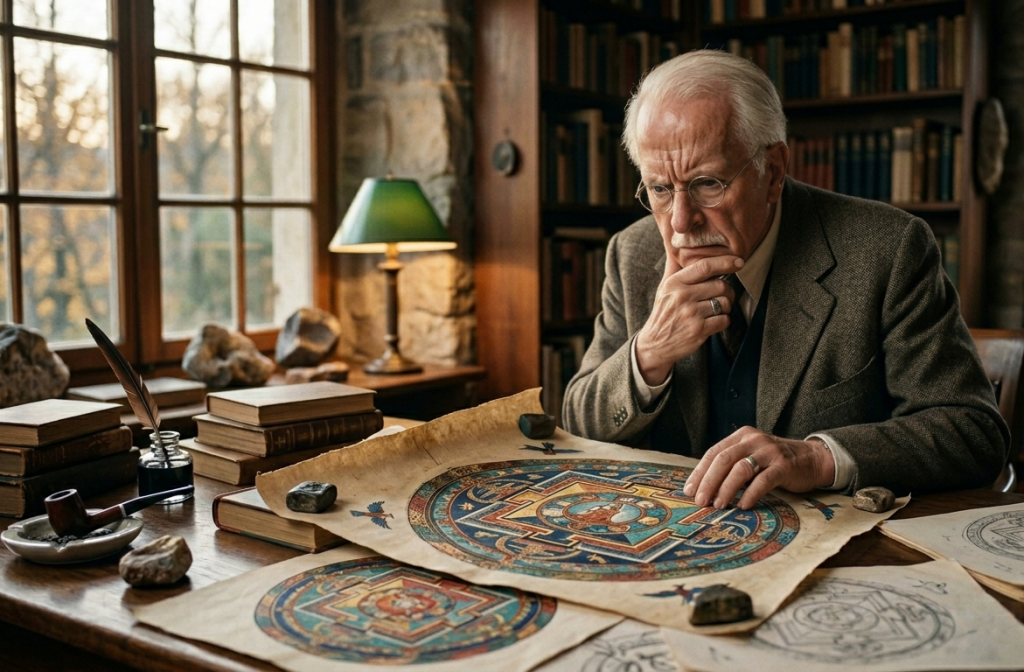
Carl Jung spent decades exploring this missing piece. He argued that the all-male Trinity is psychologically incomplete. Mandalas—symbols of wholeness across cultures—almost always have a fourfold structure: four directions, four elements, four seasons. Four is balanced. Three is dynamic but missing something.
The Bible plants this fourfold pattern at the very beginning. In Genesis, a single river flows out of Eden and divides into four heads—the Pishon, Gihon, Tigris, and Euphrates. One source becomes four streams, watering the whole earth. The garden is a mandala.
So when Jung looked at the Trinity, he couldn’t help but see something unfinished. He asked himself: what is the missing fourth in the Christian God-image? His answer: the feminine principle.
In Answer to Job, Jung argued that the all-male Trinity had suppressed the feminine so long that the unconscious revolted, forcing a completion that included the feminine. He pointed to the dogmas of the Immaculate Conception (1854) and the Assumption (1950) as evidence—the unconscious trying to complete the image through Mary.
I should pause here. I am not arguing that Mary should be declared the fourth member of the Trinity. The Orthodox Church has always honored Mary as the Theotokos—the God-bearer—the highest honor a created being can receive. She is not divine. She is the greatest of saints, the model of human response to God, the one who said “Let it be to me according to your word.” That is her glory: not divinity, but perfect receptivity.
The real “fourth” is not a person to be added. It is a consciousness to be reclaimed. And Mary shows us the way: she received, she consented, she bore God into the world. That is the feminine principle in action—not as a divine person, but as a human response to the divine.
The Law of Reversal in the Living Room
To understand this law and what Jesus came to do, we don’t need theology. We need a family.
Push the Mother down—ignore her, silence her, relegate her to a supporting role—and she doesn’t disappear. The Law of Reversal sees to that. Anything suppressed long enough turns into its opposite. The nurturing, life‑giving Mother becomes something else. Jung and his colleague Marie‑Louise von Franz called her the Devouring Mother.
You’ve met her. She’s the mother who won’t let her children leave. The mother who controls, gaslights, and manipulates—all in the name of love. She’s the overbearing parent who suffocates individuality because she was never allowed to breathe on her own. Her “love” isn’t nurturing; it’s possession. And here’s the crucial detail: she’s trying to be masculine. She seizes control, imposes structure, demands obedience—but it comes out distorted and twisted, because it’s not her true nature. The Devouring Mother is the feminine trying to wear the man’s clothes and finding they don’t fit.
But she’s not the final stop on the train. She’s the crisis. She’s the spark that ignited the Law of Reversal.
When the Mother becomes Devouring, the Father doesn’t stay strong. He retreats. He grows passive, absent, neutered. And from that vacuum—from that wounded, hollowed‑out space—a new monster rises: the Tyrannical Father. Jungian analysts describe this archetype as the dark twin of the Devouring Mother. The Tyrannical Father is ruthless, authoritarian, and domineering. He holds his children to impossible standards of success and achievement. Where the Devouring Mother says, “You can’t leave me,” the Tyrannical Father says, “You’re not good enough.” Both consume the child’s autonomy. Both prevent the child from becoming a whole, self‑knowing adult.
This is the full arc of the Law of Reversal in the family:
Suppressed Mother → Devouring Mother → Neutered Father → Tyrannical Father
The crisis deepens. Children raised in this house don’t learn who they are. They learn to perform, to please, to survive. They become incapable of true self‑knowledge because the two poles that should have shaped them—Mother’s warmth and Father’s strength—have both been twisted into weapons.
The Axiom of Maria
Now we’re ready for the ancient alchemist.
Maria Prophetissa—also known as Mary the Jewess, cited by the early alchemist Zosimos of Panopolis (c. 300 CE) and considered by many the first true alchemist of the Western world—lived sometime between the first and third centuries. She left behind a strange and beautiful axiom:
“One becomes two, two becomes three, and out of the third comes the one as the fourth.”
This is the arithmetic of the Law of Reversal. But it’s not a circle—it’s a spiral.
One – original wholeness. The Garden. The self before self‑awareness. A couple in love before the first fight.
Two – the necessary split. Conscious and unconscious. Masculine and feminine. Ego and shadow. It hurts, but it’s how we grow.
Three – the tension between opposites gives rise to a mediator. In Christian terms, Christ reconciles heaven and earth. In family terms, the child is born.
The Fourth – not a new person, but transformed wholeness. A conscious integration of everything split apart. Jung called this the Self. This is the one returned—but the one with eyes open. The Orthodox tradition calls it theosis—deification, becoming like God through participation in His life.
The Trinity is the third stage. It resolves the split between Father and creation, but it still lacks the Fourth—the full inclusion of the feminine, the earth, the body, the wisdom that was there from the beginning.
Here’s what Maria’s axiom tells us: The Devouring Mother and the Tyrannical Father are the third stage gone wrong. They are the extreme we pushed the masculine and feminine to. Out of that suffocating crisis, the Fourth is born—not a simple return of the original Mother, but a conscious integration. The same family, but now held together by love instead of fear.
What About Christ?
Now we come to the hard question. If the return of the feminine is the healing of the Trinity, what does Christ have to do with it? He was a man.
But here’s what I’ve come to see.
Christ didn’t just embody the masculine. He embodied the integrated human—the whole person, fully alive. The 14th-century mystic Julian of Norwich saw this clearly. In her Revelations of Divine Love, she wrote that Jesus is “our true Mother.” Not metaphorically. For Julian, Christ performs the office of motherhood: he feeds us with himself, tenderly and graciously, through the sacraments. “The mother may give her child suck of her milk,” Julian wrote, “but our precious Mother, Jesus, He may feed us with Himself.”
The Orthodox tradition has always emphasized that Christ assumed our full humanity—not just the masculine, but everything that makes us human. Gregory of Nazianzus said, “What is not assumed is not healed.” If Christ did not assume the full range of human experience, including the feminine, then that part of humanity remains unhealed. But He did assume it all. In Christ, the masculine and feminine are not at war—they are integrated.
This is not replacement. It’s integration. Christ models the wholeness that the all-male Trinity in its popular imagination appears to lack. He wept. He washed feet. He called himself the Good Shepherd—a caring, protecting, almost maternal image—and said “I have other sheep that are not of this fold,” a profoundly inclusive, non-hierarchical, nurturing openness that the patriarchal church has spent two thousand years trying to forget.
Christ is not the Fourth in the sense of being a missing person added to the Trinity; he is the Fourth realized—the integrated human, the Whole Body. He is the bridge and the destination. His return—the Second Coming—is not about a man riding a cloud. It is the moment when that integration becomes collective. When the right brain finally gets a vote. When the missing feminine isn’t added to the Trinity but recognized as having been there all along, waiting to be seen.
The Feminine Was Never Gone
I’m not proposing we add Sophia or Mary to the Trinity as a fourth person. I’m pointing to them as witnesses—evidence that the feminine principle was always present in the tradition, even if it was suppressed. They are not the answer; they are clues.
Here is the hope.
In the earliest Syriac Christian tradition—before Greek and Latin theologians codified the all‑male formula—the Holy Spirit was spoken of as feminine. The Syriac word for spirit, ruha, is grammatically feminine, and early Syriac writers used maternal images for the Spirit: a hovering mother bird, a womb, a gentle presence. The Acts of Thomas addresses the Holy Spirit directly as “Mother.”
This was suppressed. But it never disappeared. The feminine fourth wasn’t absent—it was waiting.
The Hebrew Bible gives us another clue: Sophia (Wisdom). In Proverbs 8, she speaks: “The Lord created me at the beginning of his work… I was beside him as a master worker, daily his delight.” She is not a creature; she is present with God before creation. Jung recognized Sophia as the missing feminine fourth—God’s self‑reflection pushed aside by patriarchal theology.
So we have two faces of the feminine: Mary, the human vessel, honored as the Theotokos but kept subordinate; and Sophia, the cosmic wisdom, too abstract for most to pray to. The two have never been fully joined.
But what was pushed down will rise—not as a perfect copy of what was lost, but as something new born from the wreckage. The Law of Reversal is not a circle; it’s a spiral. Maria’s axiom tells us: the fourth is the one returned, but the one with eyes open. Conscious where it was unconscious. Integrated where it was innocent.
An Early Christian Witness: The Odes of Solomon
There is a voice from the very edge of the early church—almost lost, buried in the desert for fifteen hundred years, rediscovered only in the eighteenth century. The Odes of Solomon are a collection of ancient hymns, likely written in the late first or early second century, just after the New Testament. They are not Scripture. But they are witnesses to how some early Christians experienced God before doctrine hardened into system.
One ode in particular, Ode 19, sees what the Trinity forgot.
1 A cup of milk was offered to me: and I drank it in the sweetness of the delight of the Lord.
2 The Son is the cup, and He who was milked is the Father:
3 And the Holy Spirit milked Him: because His breasts were full, and it was necessary for Him that His milk should be sufficiently released;
4 And the Holy Spirit opened His bosom and mingled the milk from the two breasts of the Father; and gave the mixture to the world without their knowing:
5 And they who receive in its fulness are the ones on the right hand.
6 The Spirit opened the womb of the Virgin and she received conception and brought forth; and the Virgin became a Mother with many mercies;
7 And she travailed and brought forth a Son, without incurring pain;
8 And because she was not sufficiently prepared, and she had not sought a midwife (for He brought her to bear) she brought forth, as if she were a man, of her own will;
9 And she brought Him forth openly, and acquired Him with great dignity,
10 And loved Him in His swaddling clothes and guarded Him kindly, and showed Him in Majesty. Hallelujah.
The Father has breasts. The Father gives milk. The Spirit milks the Father and mingles the milk from both breasts together. Then the Spirit gives the mixture to the world—without the world knowing. I don’t read this as literal theology—I don’t believe God has physical breasts. But the poet is doing something profound: he is using maternal imagery for God because the reality of God transcends gender. He is not adding a “Mother God” to the Trinity; he is showing that the Godhead already contains and transcends both masculine and feminine. The integration doesn’t need to be added—it needs to be remembered.
And notice who receives the gift in verse 5: “they who receive in its fulness are the ones on the right hand.” In the ancient world, the right hand was the place of honor and blessing. But in the framework we’ve been tracing, the right hand points to something else: the right hemisphere. The left brain divides, names, and dominates. The right brain receives, synthesizes, and holds life in its living context. The ones who receive the mingled milk—the integration of both masculine and feminine—are the ones who have reclaimed the right brain’s native genius. The poet saw it, even without modern language.
This is not a later feminist revision. This is a second‑century Christian hymn. Long before the all‑male Trinity was finalized, this poet knew that God contains and transcends both masculine and feminine. The image is not decorative metaphor. It is metaphor as revelation: the Godhead is two breasts, one mixture, given freely, received before we understand.
The ode continues. The Spirit opens the womb of the Virgin; she conceives and brings forth. But she is not passive. She brings forth the Son “as if she were a man, of her own will”—an astonishing phrase that gives Mary full agency, full consent. She is not a vessel. She is a participant.
What does this have to do with the missing feminine in the Trinity? Everything. The Odes show us a Christianity that had not yet suppressed the feminine. They show us a Spirit who mingles, who gives before we ask, who works beneath consciousness. They show us a God whose abundance overflows in milk and cup and mixture—gift upon gift.
The Odes were pushed aside, forgotten, buried. But they never completely disappeared. They waited, like seeds in the sand, for a season when they could be heard again.
Perhaps that season is now.
The Garden, the Split, and the Return
We’ve been here before.
In the beginning, there was the Garden. One. Wholeness. Adam and Eve walked with God in the cool of the day, naked and unashamed. No hiding. No “I” separate from “We.” This is the original unconscious wholeness that Maria Prophetissa called the One.
But even in the Garden, before the fruit, the two showed different kinds of intelligence. Adam named the animals. That’s categorical intelligence—left‑brain, analytical, putting things in boxes. But notice: he did not name Eve. Instead, he said, “This is now bone of my bones and flesh of my flesh.” She was not a category. She was kinship.
Eve’s native consciousness operated on multiple channels at once. When she perceived the fruit, she held three dimensions together seamlessly: it was “good for food” (pragmatic), “pleasing to the eye” (aesthetic), and “desirable for gaining wisdom” (transcendent). And relational—she gave it to Adam to eat. She shared. This is the right hemisphere’s genius: to synthesize, relate, and perceive meaning within a living context. It is the difference between analyzing a musical score and being moved by the symphony.
Two. Then came the fruit. The knowledge of good and evil. The split.
This was not a “fall” into sin the way some theologians have explained it. It was a reversal of hemispheric leadership—the right-brain’s holistic, relational, feminine-leaning consciousness gave way to the left-brain’s linear, naming, dominating mode. What happened? When God asked, Adam blamed the woman. Then he named her, just as he had named the animals. “Eve,” he called her—a category, no longer “bone of my bones.”
The masculine took dominion. The feminine became subordinate. At the same moment, the “I” emerged, separate from the “We.” This is Maria Prophetissa’s Two. The necessary split.
Three. Then came Christ. The mediator. The one who reconciles heaven and earth, masculine and feminine, left brain and right brain—not by erasing the split, but by embodying integration. Julian of Norwich called him “our true Mother.” He wept. He washed feet. He refused to dominate. Christ is not the Fourth in the sense of being a missing person; he is the Fourth embodied, the bridge and the destination, showing us what we are growing into.
And now we arrive at the Fourth.
For two thousand years, the Christian West has been hiding. The all‑male Trinity has been one of the trees we hid behind. The suppressed feminine became the Devouring Mother. The neutered Father became the Tyrannical Father. The family—our first image of wholeness—turned into a house of performances and survival.
The Law of Reversal is not a punishment. It is the shape of becoming. The Devouring Mother and the Tyrannical Father came because we forgot the real ones. And now, out of that third—that suffocating extreme—the fourth is being born.
What is the Fourth? It is not the Garden returned as innocence. It is the Garden returned as conscious wholeness. The Orthodox tradition calls this theosis—becoming by grace what God is by nature. Not becoming God, but becoming fully human as God intended.
Here is what changes:
Male dominion ends. Not by reversing into female dominion, but by dissolving dominion itself. The left brain no longer rules; it integrates. Adam no longer names Eve; he sees her again as bone of his bones, flesh of his flesh—equal, different, together.
The family is restored. The Devouring Mother becomes the nurturing Mother, present and honored. The Tyrannical Father becomes the protective Father, strong and tender. The child grows into a self‑knowing adult, neither smothered nor crushed, but held in a love that releases.
Balance is achieved—but higher. The spiral has turned. We are not back in the Garden before the fruit. We are in the Garden after wisdom—the wisdom that knows good and evil yet chooses love anyway. The “I” remains, but it no longer hides. The “We” returns, but now it is chosen, not automatic.
And this is where we get love. Not sentimental love. Not rule‑keeping love. The love that is the formula of the Law of Reversal itself: One becomes two, two becomes three, and out of the third comes the one as the fourth. That is the rhythm of a God who is love—a love that differentiates, that reconciles, that returns to itself transformed, conscious, and whole.
God walks through the garden and calls out: “Where are you?” Not because God needs information. Because we need to notice.
The answer is Hineini—”Here I am.” Not a location on a map. Just presence, offered back to presence.
And when we say it—fully, honestly, without hiding—we discover something we had forgotten:
We never left the garden.
We were just hiding behind the trees.
The Fourth is not a new god.
It is the love that binds everything together—the conscious integration of what was always meant to be whole.
And the voice that calls out, “Where are you?”
And the answer, finally, without hiding:
Here I am.
A Note on Orthodox Theology
To be clear: this essay does not argue that the Trinity is incomplete or that a fourth person should be added. The Orthodox Church has always taught that the Trinity is the fullness of God—Father, Son, and Holy Spirit, one in essence and undivided. What this essay explores is the recovery of a principle—the feminine as a mode of being, relating, and perceiving—that has been suppressed in practice and imagination.
The early Church Fathers, particularly in the Syriac tradition, used feminine imagery for the Holy Spirit. The Odes of Solomon and other early Christian texts witness to a time when the feminine was not excluded from the God-image. The Orthodox tradition has always honored Mary as the Theotokos, the highest of saints, the model of human response to God.
The recovery of the feminine is not a theological correction. It is a psychological and spiritual restoration. It is about becoming fully human—male and female, each carrying both principles—as God intended from the beginning.
References
The Odes of Solomon, Ode 19 (translation adapted from J.H. Charlesworth).
Julian of Norwich, Revelations of Divine Love, Chapter 60.
Carl Jung, Answer to Job and Psychology and Alchemy.
Marie-Louise von Franz, The Problem of the Puer Aeternus and The Feminine in Fairy Tales.
Gregory of Nazianzus, Epistle 101: “What is not assumed is not healed.”
Maria Prophetissa, The Axiom of Maria.
My goal is to make a living as a thinker and writer, and to make a difference. If you’re able to support my work, you can do so on Patreon, BuyMeACoffee, Substack, or anywhere else you wish (just message me). And if you have ideas, leads, or just want to help, you know where to find me.


