



A Three-Part Mini-Series — Part Three
“Truly I tell you, unless you change and become like little children, you will never enter the kingdom of heaven.” — Matthew 18:3
In Part I, we met the Builder—not a single person but an archetype, a pattern of thinking that has shaped Western civilization from the beginning. Through Jungian psychology, we saw his Persona: the visionary genius who appears self‑made, in control. And we saw his Shadow: the dependency he cannot admit, the void he fills with more data, more wealth, more power, and the terror of ordinariness that drives him to build without end. We diagnosed his Control Complex: control as a defense against vulnerability, which becomes a prison. And we saw that the Builder’s psychology is our own, writ large—our ambition, our impatience, our fear of mortality, projected onto a screen.
In Part II, we examined one of his greatest towers: real estate. We traced how a structure built on exclusion—from purity of blood to racial covenants—was later inverted, repurposed, and turned into a debt sponge of staggering proportions. We followed the emotional arc of promise, delay, anxiety, forced fulfillment, and collapse—only to discover that the collapse of 2008 was not a resolution but a postponement. We are still living in that tower. It was propped up, not torn down. And now it stands taller than ever, saturated with credit, leaning on policy, and waiting for the winds to shift.
Now we turn to the wider empire itself. A tower, no matter how tall, only makes sense as part of the ground beneath it, the laws that govern it, and the machinery that keeps it standing. The Builder’s empire is a city—sprawling, intricate, like Rome. To understand why its towers eventually collapse, we must walk its streets, inspect its foundations, and trace the connections between its institutions. The Builder builds in parts, but the city is a whole.
Dissecting the Builder’s Empire
This empire rests on certain pillars. Each is engineered with left‑brain brilliance—optimized for control, efficiency, extraction—without relational intelligence.
1. Foundation: Land as Dollar Credit
Land has been turned into debt. To stand on a plot means servicing a mortgage. To walk the streets is to walk atop a foundation of interest payments.
But “land” is almost too bland. Think instead of a digital garden. The air here smells of ink and ozone, of fresh bond paper and hot servers. The “soil” is a lattice of glowing green numbers that crawl like roots. Instead of flowers, the garden grows ledgers, each bloom a different shade of liability: pale yellow for reserves, deep crimson for balances due, silver-gray for promises, black for obligations never quite paid off. The paths are paved with interest rate ticks, and every few steps you hear a soft ding—another transaction settled somewhere in the cloud.
You cannot touch anything solid, but you feel the weight. The garden is beautiful in the way a casino at 3 a.m. is beautiful: all light and no shadow, until you look down and realize the ground is made of other people’s futures.
The dollar itself is fiat—a claim on a promise, not on anything real. Once, vaults full of metal backed the currency. Now the vault holds only confidence: bonds, collateral, and the legal authority to say what value is. Most of us never see that vault, yet every transaction quietly depends on it.
This foundation is metaphysical, held together by collective agreement. That allows the city to expand without physical limit. But the ground trembles whenever the agreement wavers. And on a quiet night, if you press your ear to the ledger-soil, you can hear the interest compounding in the dark.
2. Law and Order: The Federal Reserve
Every city needs someone to enforce the rules. Here, that someone is the Federal Reserve—the central nervous system. It is unelected and unaccountable, yet it wields power over life and death.
The Fed controls the flow of dollar credit. It decides how many dollars exist and how much they cost to borrow. When it wants the city to expand, it makes credit cheap and abundant—dollars flood out, towers rise. When it wants to slow things down, it makes credit expensive and scarce—dollars dry up, towers tremble.
Its law is called monetary policy, but you can think of it as the faucet and the brake. The Fed turns one or the other, and the whole city lurches accordingly. It is the empire’s high priesthood.
3. Mechanism: Treasuries and Interest Rates
If the Federal Reserve is the high priest, the Treasury market is the altar, and interest rates are the sacrificial blade.
The city sustains itself by issuing debt—Treasuries, or “bonds”—and then controlling the price of that debt through interest rates. Lower rates encourage borrowing and speculation, inflating the towers and giving the illusion of growth. Higher rates tighten the noose, pulling dollar credit back to the center.
Beneath the visible towers run the aqueducts: the bond markets. These channels carry future tax payments into present power. The government borrows now, and you—or your children—will pay later. Bonds look dull beside the gleaming towers, but structurally they matter more. If the aqueducts fail, the upper city loses pressure.
This mechanism ensures that the city depends on perpetual expansion. If no one buys the debt—or if interest rates lose their power to steer behavior—the city’s heart stops beating.
4. Energy: Belief Powered by Media
What keeps the lights on? Not electricity. Belief.
The fiat system is faith‑based, and the media is its power plant. The media filters reality: cracks in the foundation vanish, interest rates become too complex to question, and the high priests glow with infallible expertise. When belief wavers—during a bank run, a currency crisis, another war—the media manufactures confidence. Without this constant broadcast of legitimacy, the city would be revealed as a paper castle.
But narrative is not just a tool of the media. It is the atmosphere of the empire. It is invisible and unavoidable, but every tower depends on it. A tower rises not only because capital is available, but because enough people accept the story: housing is security, markets always recover, tomorrow belongs to those who enter early.
Before a structure can absorb credit, it must absorb belief. A story always arrives before the expansion.
5. Military: The Geopolitical Enforcer
Every city needs walls and guards. The Builder’s city has no single border—its jurisdiction is global.
The military’s job is to enforce the dollar’s rule. It makes sure other nations stay inside the dollar’s sphere. If a country tries to build its own foundation—selling oil for gold, trading in another currency—the military, or the threat of it, shows up to protect the ledger.
That’s the foreign job. At home, the military serves other purposes: it soaks up excess production, drives technological innovation, and acts as a jobs program. It siphons young people from struggling communities—the same communities that might otherwise resist the empire.
6. Education: The Apprenticeship
Every city forms its citizens. In this city, education is not about awakening wisdom. It is about producing compliant participants.
It fragments knowledge into silos, rewards linear problem‑solving, and drills in the core virtues of the empire: punctuality, obedience, the normalization of debt, and the equation of self‑worth with productivity.
The university, in particular, is the ordination ground for the priesthood—economists, lawyers, bankers—who will later run the city’s mechanisms.
7. Legal System: The Grid
If the Federal Reserve sets monetary law, the legal system sets the rules of property and contract that make fiat credit enforceable.
Central to this system is the fiction of corporate personhood—liability abstracted away from actual humans. Contract towers above covenant. Debt must be honored even when honoring it destroys families, communities, or ecosystems.
The courts serve as the grid. They decide who can build, who can own, and who gets left outside.
8. Tax System: The Tithing
Every empire needs to extract resources from the periphery to the center. Taxes do that—but they also do something more subtle: they create perpetual demand for the currency.
Because taxes must be paid in dollars, every citizen and every business is forced into the dollar economy. Taxation is the whip that keeps the population laboring to acquire the very credit the empire creates.
Fail to pay, and you are excommunicated: asset seizure, imprisonment, expulsion from the city’s protection.
9. Credit Rating Agencies: The Oracles
In this city, you cannot know the health of a person, corporation, or nation without consulting the oracles. Moody’s, S&P, Fitch—they speak the sacred language of “creditworthiness.”
Their pronouncements determine interest rates, investment flows, and who is deemed trustworthy. They sit alongside the Federal Reserve as high priests—translating the abstract into the authoritative, their ratings a modern form of augury.
10. Prison‑Industrial Complex: The Dungeons
Every city has a place for those who refuse to abide by its laws. In this city, the prison system is not just for violent crime. It is increasingly the enforcement arm for debt and social noncompliance.
When education fails to produce a compliant citizen. When the legal system issues a judgment that cannot be paid. The dungeons await.
Privatization turns punishment into profit—just another extension of the logic that monetizes everything.
11. Healthcare‑Pharmaceutical Complex: The Healers
In a holistic system, healing is relational and integrated. In this city, health is a commodity.
The healthcare system is a massive debt-extraction machine. Medical bills are the leading cause of bankruptcy. Pharmaceuticals manage symptoms, not root causes—creating lifelong dependency. The body, like the land, becomes another asset to be monetized, another source of perpetual payment streams.
12. Two‑Party Political System: The Theater
Every city needs governance. The Builder’s version looks like choice—but preserves the underlying architecture.
The two-party duopoly is controlled opposition. Debates rage over cultural issues while monetary policy, central banking, and the military-industrial consensus stay untouched. This theater gives the illusion of consent and channels dissent into harmless, pre-approved boxes.
13. Entertainment Industry: The Opium
If media is the energy of belief, entertainment is the sedative. The empire floods its citizens with distraction—spectacle, celebrity, sports, algorithmic feeds—keeping the relational mind pacified and the analytical mind busy with trivia. An entertained populace does not ask foundational questions. The entertainment industry also normalizes debt and the fragmentation of community—keeping us distracted while the ties that bind us quietly dissolve.
14. Philanthropic‑Industrial Complex: The Indulgence
In medieval systems, indulgences allowed the wealthy to buy forgiveness. In this city, massive foundations—Gates, Rockefeller, and others—serve a similar function. They allow wealth accumulated through the empire’s mechanisms to be rebranded as benevolence, while often advancing the same market‑based, technocratic solutions that sustain the underlying system.
15. The Towers: Sponges for Credit
Scattered throughout the city are towers that rise above the rest. Real estate is the largest, but others join it.
Every tower depends on the same hidden forces: leverage, confidence, liquidity, and story. Leverage gives height—borrowed power magnifying construction. Confidence convinces builders and buyers that tomorrow’s value will exceed today’s cost. Liquidity allows movement—easy in, easy out. And story may be the most important: without a narrative strong enough to attract belief, even a sound tower stays empty.
The stock market is a tower of claims on future earnings, ownership reduced to tickers and algorithms. Cryptocurrency promised escape—a tower built on the illusion of decentralization—but it has become just another sponge, absorbing fiat credit into speculative vaults.
The Black Hole: Why AI Is Different
The other towers—real estate, stocks, crypto—soak up credit. But AI soaks up more than credit. It soaks up humanity.
Consider what AI consumes. First, energy. Training a single large model uses electricity equivalent to a small town’s annual consumption. The data centers that run AI require land, water, rare earth minerals, and cooling systems that strain local grids. The physical footprint is staggering, yet the value produced is largely speculative.
Second, jobs. The Builder promises that AI will free us from drudgery. But look honestly at who is being replaced: writers, coders, translators, customer service representatives, legal researchers, medical transcribers—the entire class of cognitive labor that once formed the middle. Not because AI does these jobs well, but because it does them cheaply enough to satisfy shareholders. The displaced are discarded as surplus population, destined for the dungeons or the opioid prescription pad.
Third, attention and meaning. AI generates text, images, and conversations at near-zero marginal cost. It floods every channel with plausible noise. When you cannot tell whether a video, a news article, or even a personal message was written by a human or a machine, something fundamental erodes: trust. And without trust, relationship becomes impossible.
Fourth, and most insidiously, AI is a sponge for agency. The more we delegate thinking to machines, the more we forget how to think. The Builder’s tools control, but AI replaces the need for control altogether. Why learn a skill when the machine can do it? Why deliberate when the algorithm can decide? The end result is not human creativity, it is human replacement.
Unlike real estate or crypto, AI does not just sit there absorbing credit like a sponge. It actively transforms the society that hosts it. It hollows out the very capacities—judgment, discernment, relational presence—that would be needed to resist the Builder. This makes it not a sponge, but a black hole, pulling credit, energy, jobs, attention, meaning, and agency from human beings.
How the Components Fit Together
These fifteen components, along with AI, do not operate in isolation. They form a self‑reinforcing ecology.
The Federal Reserve creates credit. The towers absorb it. The media celebrates the rising towers as prosperity. The entertainment industry keeps citizens distracted while their equity inflates.
The education system trains future participants to accept debt as normal. The legal system ensures that debt is enforceable. The tax system ensures that everyone must earn dollars to pay their tithe, forcing participation.
The credit rating agencies pronounce certain entities worthy, directing the flow of capital. The military ensures that no external power disrupts this flow.
When the system produces casualties—people crushed by debt, addiction, or imprisonment—the healthcare‑pharmaceutical complex manages symptoms (often creating lifelong dependencies) and the prison‑industrial complex houses the surplus population. Philanthropy offers palliative care while preserving the underlying structures.
The two‑party theater gives the illusion that the people are steering the city, while the real decisions about money, war, and infrastructure remain hidden behind the scenes.
The Old Story
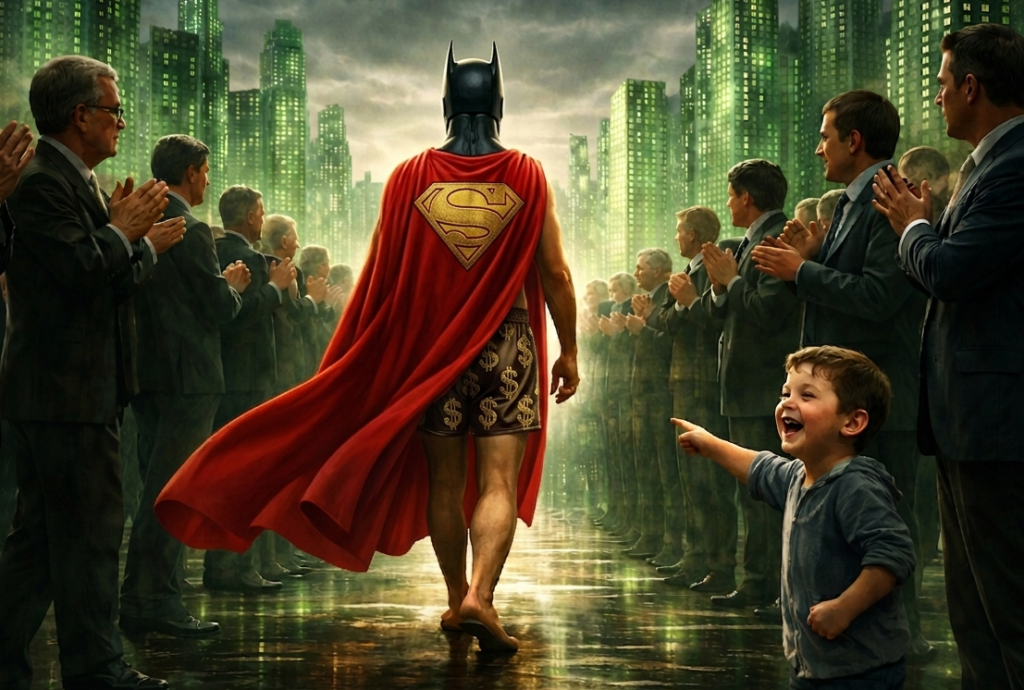
There is an old story about an emperor who paraded through town wearing “invisible clothes.” In my story he wears dollar sign underwear, a Superman cape, and a Batman hat. No one wants to admit he is exposed, for fear of being called a fool, perhaps punished for stating the obvious. So everyone praises the magnificent outfit—until a child shouts, “But he’s naked!”
That is where we are now. Everyone knows, somewhere deep down, that real estate cannot rise forever, that the stock market cannot grow faster than the economy indefinitely, that crypto is pure speculation, that the dollar is backed by nothing but faith. But no one wants to be the child who points it out, because the whole system depends on everyone pretending.
How long can the world pretend that we can print money to prop it up forever?
The child is right about the emperor. And Jesus was right about us: “Unless you change and become like little children, you will never enter the kingdom of heaven.” Children haven’t been trained to admire invisible clothes. They point at the naked truth because they haven’t yet learned to see anything else but the truth. The child asks: Why is that tower so tall? Why do we call debt ‘wealth’?
We spend our whole lives learning not to ask those questions. The way out is not a new city, not a blueprint, not a revolution. It is something smaller and harder: unlearning. Becoming, in some quiet way, like the child again. Seeing what is actually in front of us. Saying it out loud.
The Builder will keep building. The towers will keep swaying. The sponges are already leaking. But the child is still calling our bluff, and laughing. The question is: will you join him? Or keep on pretending?
End of Series
If this work matters to you, please consider sharing it with others. For those able to support my research and writing, paid subscriptions are available on Patreon, BuyMeACoffee, or Substack. Your support doesn’t just sustain me; it sustains a rare and necessary conversation, especially now.
Thank you for being here.


 “Outstanding, sophisticated, and mesmerizing…a spiritual intrigue similar to Dan Brown’s The Da Vinci Code.” —ForeWord Reviews