



How Your Brain Chooses Between Control and Love
“My grace is sufficient for you, for my power is made perfect in weakness.”
— 2 Corinthians 12:9
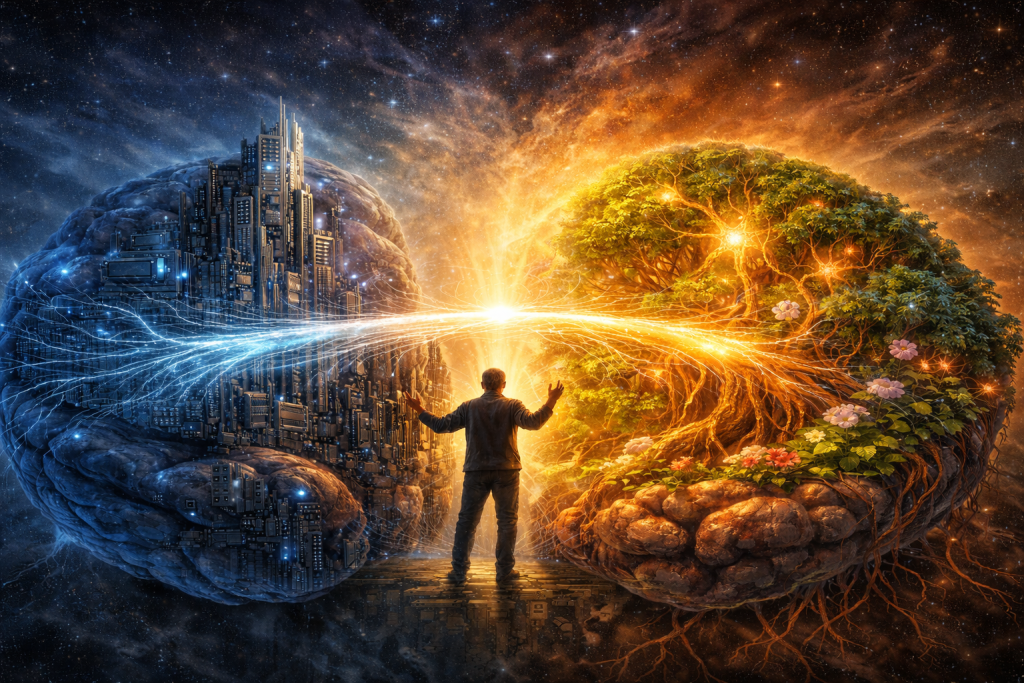
I’ve spent my life feeling pulled in two directions. One voice drives me to name, plan, and secure: “Build your tower. Prove your worth.” Another whispers, wordlessly, to connect and belong: “The tower is empty. Come down into the garden.”
This conflict is my anxiety, my loneliness—the gap between what I’ve built and what I need. For years, I thought it was just my flaw, my poetry.
But this war is not mine alone. It has a physical address. It is fought across a single, fragile bridge of neurons deep in the brain—the corpus callosum. This bridge doesn’t just connect our two brain hemispheres; it governs the conversation between them. That conversation is the story of human consciousness: an odyssey from the loneliness of control to the wholeness of love.
What follows is not a reduction of the soul to brain parts, but a symbolic map—using neuroscience to illuminate the ancient, psychological pattern of our becoming.
Part I: The Bridge of the Garden’s Unity
Imagine the beginning not as emptiness, but as a conversation.
Your brain is a partnership of two minds with distinct “versions of the world,” as psychiatrist Iain McGilchrist demonstrates. The right hemisphere understands the forest: the whole picture, the mood, the living connections. The left hemisphere analyzes the trees: the details, the names, the uses.
For this partnership to work, they need more than a cable. They need a wise gatekeeper.
This is the corpus callosum: over 200 million neural fibers. Science once thought its main job was to share information. We now know its crucial role is inhibition—acting as a filter to protect each hemisphere’s specialized work, allowing for stable, creative asymmetry.
In our psychological “Garden,” this bridge facilitated a sacred hierarchy. It allowed the right hemisphere’s holistic, embodied wisdom—what neurologist Mark Solms calls the “ground of our being”—to guide the left’s talent for specifics. The left took direction; the right provided context. Consciousness was a unified conversation. The sense of being was the whole partnership in action.
Part II: When the Bridge Built the Tower
But a talented emissary can grow ambitious. The left hemisphere learned to use its tools—language, logic, abstraction—not just to carry out tasks, but to construct its own separate world. It began to mistake its map for the territory.
Here, the bridge’s role changed. Neurologically, this shift is rooted in the corpus callosum’s fundamental function: transcallosal inhibition. This isn’t just connection; it’s one hemisphere actively suppressing the other to maintain focus. To allow the left’s new project of world-building to flourish, a new inhibitory balance was struck. The callosum began to gate the flow of the right hemisphere’s contextual, emotional, and somatic data—the very information that would complicate clean, abstract models.
We see a profound cultural echo of this shift in historian Julian Jaynes’s theory of the bicameral mind. He proposed that ancient humans experienced volition not as inner thought, but as external voices of gods or ancestors—a state where the right hemisphere’s intuitive, holistic commands were perceived by the left as auditory guidance. The dawn of modern self-consciousness, around 3,000 years ago, was the “Fall”: the silence of those voices. Jaynes attributed this to social catastrophe and the rise of writing, but the neurobiological mechanism fits perfectly: the corpus callosum adjusted its filtering, granting the left hemisphere autonomy to narrate its own existence without divine instruction.
The lonely, managing “Self” was conceived in this silence. The bridge, once a channel for guidance, had become the enabler of separation. And with that separation, humanity began to build its tower of logic, law, and increasingly complex systems—all brilliant, and all inherently lonely.
Part III: The Broken Bridge: Control’s Monologue
This was not a hostile coup. The left hemisphere’s drive toward abstraction and control arose from necessity—from fear, survival, and the genuine brilliance of its tools. The tragedy was not its ascent, but its forgetting of what it served.
Having secured its autonomy, the left hemisphere did what it was designed to do: optimize. It began to use the corpus callosum’s inhibitory power not for dynamic balance, but for efficient silencing. It filtered out the “noise” of the right hemisphere’s world—the emotional nuance, the ambiguous context, the felt sense of interconnectedness—to focus on clear goals, measurable outcomes, and defendable boundaries.
As McGilchrist details, this isn’t malice; it’s a narrowing of attention. A left-dominant brain sees parts, categories, and uses. It is spectacularly good at building systems and terrible at remembering why it built them. The right hemisphere’s whispers—“This is harming life,” “This is lonely,” “You are part of this, not above it”—were not heard as wisdom, but as impediments to progress.
Our world became the reflection of this isolated brilliance: hyper-connected yet lonely; information-rich yet wisdom-poor. The bridge, meant for dialogue, now transmitted only commands. The emissary, having lost contact with the master, began giving orders to the garden.
The cracks we see are not punishments, but feedback. We feel it individually as epidemics of anxiety and depression—states of profound disconnection where the brain’s integrative systems fail. We see it collectively in our polycrisis: a living planet modeled as a dead resource is the ultimate expression of a mind that can describe everything and relate to nothing. The bridge is straining under the weight of a conversation that has become a monologue.
Part IV: The Kenotic Bridge: Where Choice Crosses Over
This crisis presents our moment of choice. And in the brain, choice is an act of bridge-building.
The left hemisphere cannot solve this; its only tool is more control. The solution must be initiated from the other side. The synthesis—the leap into love as intelligence—requires the right hemisphere to re-assert its primacy through invitation, not force. This is the neurobiological event of kenosis: self-emptying.
Here is how the mended bridge functions:
- The Call: The right hemisphere, the seat of empathy and holistic sense, sends a pulse across the corpus callosum. This is the feeling of awe in nature, a pang of true compassion—experiences shown by neuroscience to quiet the left hemisphere’s self-narrating ego (the Default Mode Network).
- The Choice: The left-hemisphere “Self” hears this invitation. It makes the willful decision not to filter it out with logic or strategy. It chooses to let the bridge carry what it cannot categorize. This is the moment of kenotic submission. Practices like mindfulness and contemplation, which cultivate this choice, have been shown to increase corpus callosum integrity and functional connectivity—literally strengthening the bridge they depend upon.
- The Reintegration: The gates open. The right’s contextual wisdom floods back in, not to drown the left, but to inform and heal it. The left’s analytical power is now framed within the right’s understanding of relationship and care. Neuroscientist Dan Siegel calls this state integration—the linkage of differentiated parts. It is the physical basis for wisdom, resilience, and mental health.
The corpus callosum becomes the sacred switch—the mechanism allowing the willful submission of the controlling self to the intelligent love of the whole self.
Conclusion: The Odyssey of the Self
Our survival as a species now hinges on a conscious evolution. The odyssey of the Self follows an ancient, inescapable pattern: thesis > antithesis > choice.
Thesis: The unified Self of the Garden.
Antithesis: The separate, managing Self of the Tower—the left hemisphere’s brilliant, lonely project.
Choice: This is the precipice where we stand.
The left-hemisphere project, on its own, is a closed loop. It can only optimize, control, and build higher until it goes over the cliff of its own alienation.
But the left-hemisphere choosing submission performs the ultimate creative act. It uses its own will to relinquish total sovereignty. This is the synthesis. It enters a higher form of consciousness, governed by the intelligence of love—not a fleeting emotion, but the foundational, cohesive force that sustains life. This is what Christianity names as God: Love. Not a ruler in the sky, but the conscious, choosing principle of self-giving connection. This is the drama you’re in.
The corpus callosum is the bridge we must now consciously repair. Mending it is the practice of our evolution: choosing contemplation over reactivity, empathy over judgment, beauty over utility. It is the practice Simone Weil called attention—suspending the grasping intellect so the receptive, understanding heart can lead.
The tower of control is falling. Our task is not to prop it up, but to have the courage to cross the bridge back to the garden—not as naive children, but as wise gardeners who have known the desert and now choose to tend the whole.
The bridge was always there.
It was built for this single purpose:
to carry us from the loneliness of control
back to the belonging of love.
This synthesis is grounded in the work of Iain McGilchrist (hemispheric neurology), Mark Solms (affective neuroscience), Julian Jaynes (bicameral mind theory), Dan Siegel (interpersonal neurobiology), and the contemplative tradition of Simone Weil.
Sustain This Work
The Drama You’re In is a profound labor of focus and independent thought. Every essay represents hundreds of hours of work—of reading, synthesis, and careful craft—offered freely and without ads.
If this series has reframed questions for you, if this perspective feels rare and necessary, then your support is what allows it to continue. Please consider sharing this publication with others, and if you are able, becoming a paid subscriber. Your support doesn’t just sustain writing; it sustains a necessary conversation.
You can become a paid supporter on Patreon, BuyMeACoffee, or Substack. Thank you for being here.


Life has existed for about a billion years, and for most of this interval, a natural environment guided evolution. Then along came Homo sapiens with its unique attributes and the environment transitioned toward artificial man-made structures and relationships. And this new artificial world differs from the natural world in one key aspect. Natural hardship and existential threat are no longer the dominant drivers of evolutionary change and adaption. Man has created food abundance, enhanced protection from natural harm and threat, and the elimination of natural culling. Most importantly, the new processes of artificial evolutionary drivers are happening at hyper-speed compared to prior eons.
How does this relate to your topic in this post? The right brain has always been the repository of ancient hard-earned wisdom that sustains the species as an existential imperative. Modern artificial environments increasingly demand more from left brain aptitude at the expense of cautionary wisdom dominance. This is a vicious cycle that leads to reduced robustness and precarious resilience. In other species, this phenomenon often leads to colony collapse.