



THE LOST CENTER OF CIVILIZATION | PART 1
“When the center fails to hold, mere anarchy is loosed upon the world.” — W.B. Yeats
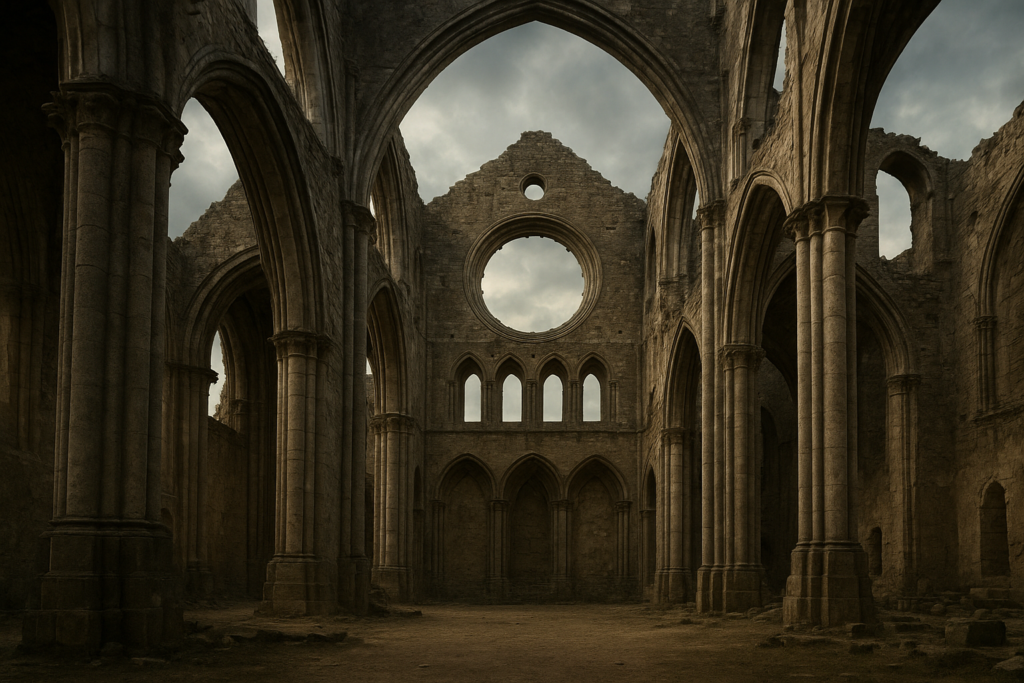
The West was once bound by a shared center. It offered an understanding of what a human being is, what constitutes virtue, and where authority derives its legitimacy. This was not unanimity, nor utopia, nor an end to conflict. It was coherence: a civilizational consensus on the contours of the Good and the purpose of the human journey.
At some point, that center failed to hold. In its place, we inhabit a paradox of freedom and fragmentation, of prosperity and profound disorientation. We command technology beyond imagination, yet suffer anxiety without measure. Our public square grows louder by the day and more incoherent by the hour. We have learned to mistake cultural confusion for progress, the loss of meaning for liberation, and drift for direction.
What happened to our center? What gravitational force once bound our civilization—and what becomes of us now that it’s gone?
This series begins with that uncomfortable question, and the truth behind it.
A Provocation
It was sparked by a message from a friend—a well-known author, a born Jew who identifies as a Jew, and has never considered himself religious. He wrote:
“Boy-oh-boy is our country spiritually impoverished… I do believe the country would be better off within a Christian moral framework…and the churches need to be revived to make that happen. It seems to be underway. It will probably take some significant punishment of those living now to get to some point of renewal.”
Beneath the raw candor lies a diagnosis many feel but rarely articulate: our culture is morally unmoored and psychologically dissociated from any coherent center.
A Note to the Secular Reader
Before proceeding, we must recall something so obvious that modern discourse often forgets it: the West is a civilization.
Not a collection of states, not an economic partnership, not a loose consensus about “values”—but a continuous cultural formation with a shared intellectual lineage, moral vocabulary, legal inheritance, and religious imagination.
Civilizations of every kind—Chinese, Islamic, Indic, Western—are defined not by borders but by centers: orienting principles that provide coherence, identity, and purpose. A civilization’s center tells its people:
- What a human being is.
- What counts as virtue.
- How authority legitimates itself.
- Why life matters.
The modern West faces a stark predicament: it has tried to preserve itself as a civilization while abandoning the central claim that made it one. This tension—between inherited structures and a lost orienting core—has produced the instability we now inhabit.
Civilizations Have Centers
Civilizations do not cohere through material power alone. Historians like Arnold Toynbee observed that their stability rests on a metaphysical orientation: a deity, a mythos, or a philosophical vision functioning as a gravitational center.
This orientation is always expressed as a foundational story—a shared narrative that answers a civilization’s ultimate questions: What is a human being? What is our purpose? What is good, and who has the right to lead us?
For the West, that story was the Christian Logos: a vision of a created, purposeful order where humans, made in God’s image, possessed inherent dignity and a common destiny. This story was the source of our moral law and social cohesion. It provided the silent software for our laws, arts, and ideals.
But a story must be believed to hold power. When the narrative fails to explain the world or justify authority, belief crumbles. The rituals continue, but they become hollow. The institutions stand, but their moral foundation turns to dust. History shows this pattern with grim clarity.
When the Center Fails
Ancient Rome
The Center: Pietas—a sacred duty to the gods, the state, and family. The emperor was the high priest of this covenant; his virtue guaranteed Rome’s divine favor.
What Broke Faith: A century of coups and civil wars proved power came from the legions, not piety. Succession became a military auction, not a sacred rite.
The Hollowing: The old rituals continued as empty political theater. The elite mouthed virtues like “duty” and “honor” while chasing power and luxury in a corrupt, unequal society.
What Shattered: The belief that the gods rewarded a virtuous Rome. When crisis hit, people no longer felt the empire’s fate depended on their collective character. The sacred core was gone.
The Classic Maya
The Center: The Divine King. He was a living god whose rituals maintained the cosmic order—ensuring the rains fell and the crops grew.
What Broke Faith: A decades-long drought in the 9th century. The king’s most vital duty—to bring rain—failed, catastrophically and repeatedly.
The Hollowing: As famine spread, construction of the pyramids and palaces that displayed his power slowed, then stopped. The king’s claim to divinity began to look like a lie.
What Shattered: The covenant between people and ruler. If the rituals didn’t work, the king was no god. His authority vanished overnight. People simply walked away from their great cities.
Tang China
The Center: The Mandate of Heaven. The emperor ruled with virtue, aided by a moral Confucian bureaucracy that created a unified, harmonious order.
What Broke Faith: The An Lushan Rebellion (755–763 AD). A trusted general turned against the emperor, sacking the capital and plunging the empire into a war that killed millions.
The Hollowing: To survive, the central government handed power to regional warlords. The ideal of a unified moral state gave way to fractured military rule.
What Shattered: Belief in the emperor’s virtue and the system’s unity. The “Mandate” was seen as revoked. Loyalty shifted from the imperial center to whichever strongman could provide security.
The Abbasid Caliphate
The Center: The Caliph in Baghdad—the supreme political and spiritual leader of all Muslims.
What Broke Faith: To secure his power, the Caliph created a private army of Turkic slave-soldiers (Mamluks). He soon became their prisoner.
The Hollowing: The Mamluks realized their strength. They murdered one Caliph in 861 and turned later ones into puppets. The role became a hollow religious symbol.
What Shattered: Belief in the Caliph’s sovereign authority. Political legitimacy shattered. Governors and generals ruled independently, fragmenting the Islamic world into rival states.
This pattern—the hollowing of a sacred center—is not ancient history. It is our present condition.
The West Now
Our Center: The Christian story of a created, purposeful world where humans, made in God’s image, possess inherent dignity and a shared destiny. This was the source of our moral law and social order.
What Broke Faith: The Enlightenment, science, and secular philosophy framed the universe as a machine and the sacred story as a myth. Reason and materialism slowly displaced faith.
The Hollowing: We kept the fruits of the story—human rights, equality, justice—while discarding the spiritual roots that nourished them. Our institutions became secular shells, speaking of contracts and choices, not sacred duties.
What is Shattering Now: Belief in a shared truth or common good. Politics has become a war of identities and competing rights. We are running on borrowed spiritual capital, and it is nearly spent. The center cannot hold when it is only an echo. We are left arguing over the furniture in a house whose foundations have washed away.
The Modern West
After World War II, the Western world attempted an unprecedented experiment. It sought to keep the moral fruits of its religious past—like dignity, human rights, and equality—while cutting off the religious roots that had nurtured them for centuries.
It was as if society decided to keep the conclusions—that every person has inherent worth and rights—but quietly rejected the original premise: that this worth comes from a divine creator or a sacred order. Philosopher Rémi Brague calls this the West’s “borrowed identity”—a civilization living off spiritual savings it was no longer contributing to.
And like any savings account, borrowed capital eventually runs out.
Today, this has left modern society trying to uphold profound ideals without their original foundation. We now find ourselves asserting:
- Human Rights without an agreed-upon reason why humans are inherently valuable.
- Moral Duties while denying there is any objective, shared source of morality.
- Historical Progress while claiming history itself has no ultimate direction or purpose.
The experiment is reaching its limit. The spiritual capital is nearly spent. We are left with a powerful moral echo, but the voice that created it is growing faint.
A Polarized West
Our current divisions run much deeper than politics. They are a chaotic scramble to find a new center for our civilization—a new “sun” that can give our society order, meaning, and direction.
Different forces are now competing to fill this void: nationalist stories, rigid ideologies, blind faith in technology, the belief that personal well-being is the highest goal, the worship of market forces, and the idea that the individual self is the only true authority.
Each promises to give us a new sense of purpose. But each, ultimately, fails to answer the fundamental questions that every lasting civilization must answer:
- What is a human being?
- What is a good life?
- What is our common purpose?
Without a shared answer to these questions, our institutions start to make no sense. Trust between citizens withers. And politics ceases to be a way to solve problems and instead becomes a subtler form of civil war—a battle for total victory, not the common good.
What the West is experiencing is not a temporary political clash. It is the final, unmistakable symptom of a center that has been slowly crumbling for centuries.
Where We Go From Here
This essay is the first in a series that traces a story of profound loss: the loss of the West’s guiding center.
We are now a civilization built on a foundation we no longer believe in. We run on moral instincts we can no longer explain. We operate through institutions that have lost their inner coherence.
In Part II, we will examine how the Christian narrative that held the West together for a millennium slowly eroded from within—a story not of defeat, but of self-sabotage—and how a society can look stable long after its spiritual core has turned to dust.
From there, we will map the world constructed on those ruins: a world that has tried to replace God with technology, markets, and the worship of the sovereign Self. We will explore Carl Jung’s idea of enantiodromia—the inevitable pendulum swing where any extreme produces its opposite—and ask a simple, urgent question: Can a civilization without a center survive?
Seen through this lens, our present confusion is more than cultural chaos. It may be a hinge—an inflection point. The very desperation for meaning that now defines our age suggests that renewal may be nearer than it appears. The ancient symbol of the center—of a shared moral gravity, of something worth believing in together—seems to be stirring again in our collective imagination.
This is not a conclusion. It is a beginning.
If this exploration of our lost center resonated with you, please consider supporting my research and writing.
Your contributions on Patreon, BuyMeACoffee, or Substack directly fuel this long-term work, allowing me to dedicate the time and attention it deserves.
References and Scholarly Anchors
This analysis draws from key thinkers on civilization, psychology, and modernity:
Civilization & History
- Arnold J. Toynbee, A Study of History – Civilizations rise/fall based on spiritual response.
- Christopher Dawson, Religion and the Rise of Western Culture – Christianity’s formative role in the West.
- Rémi Brague, Eccentric Culture – The West’s “borrowed” spiritual capital.
Psychology & Myth
- Carl G. Jung – On archetypes and the collective unconscious.
- Joseph Campbell – On myth as society’s foundational narrative.
- Mircea Eliade, The Sacred and the Profane – Sacred vs. profane time/space.
The Modern Crisis
- Alasdair MacIntyre, After Virtue – Modern morality as fragments of a lost tradition.
- Philip Rieff, The Triumph of the Therapeutic – Shift from moral culture to therapeutic culture.
- Eric Voegelin – On ideologies as “immanentized eschatologies.”
Historical Context
- Brad S. Gregory, The Unintended Reformation – How religious fragmentation led to modern secular pluralism.


