



Untold History of the U.S.–Israel Relationship
“We are the nation of the chosen people. And we must always remember that we are the ones who have been chosen to lead the world.” — Norman Podhoretz, a neoconservative thinker, 1980
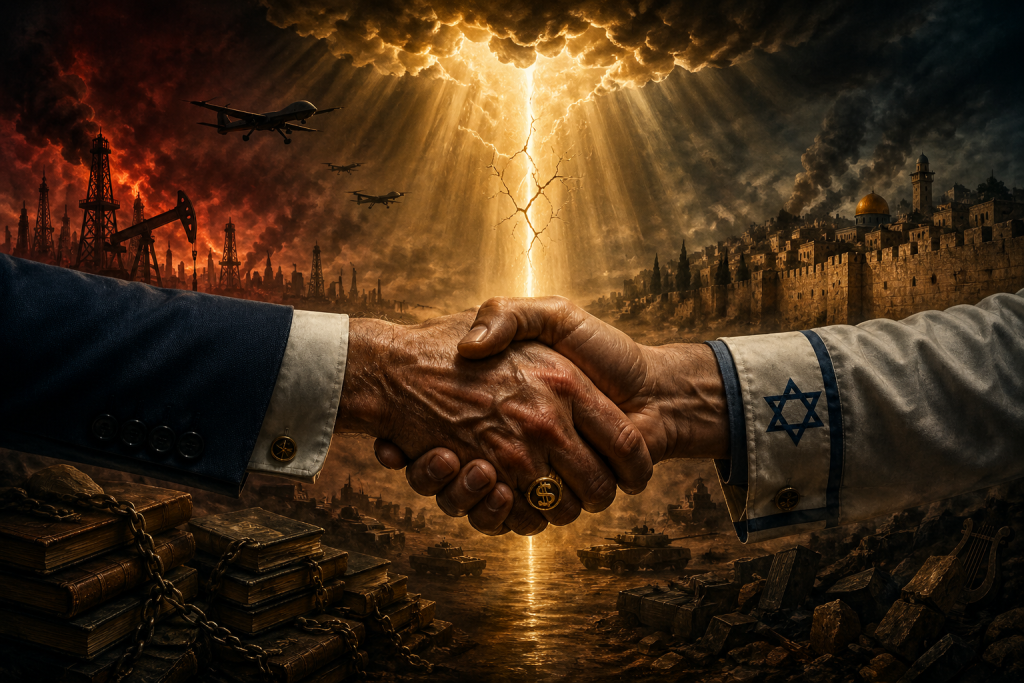
The United States and Israel call their alliance a “special relationship” blessed by God. Supporters say it’s built on shared democratic values and a common Judeo-Christian heritage. Critics say it’s really about oil, debt, and military contracts.
It looks a lot like a marriage of convenience—two partners who don’t entirely trust each other but find the arrangement too useful to leave. While it seems to work, I wouldn’t mistake it for a love story.
Consider the theological problem. The United States, shaped by Christianity, proclaims Jesus as the Messiah and the only path to salvation. Israel, founded as a Jewish state, rejects that claim entirely. One nation’s redeemer is the other nation’s false prophet. Yet both claim God’s favor on their alliance. That contradiction rarely gets mentioned.
Let’s think about what it means when a nation claims God is on its side — or two gods from two different religions — and why nations have done this since the dawn of recorded history, more than 4,000 years ago.
We have to go back even further than the kings. The common story is that our ancestors first settled down, invented farming and cities, and only then “invented” gods. Archaeology suggests the opposite: organized religion may have come first, and that humans are fundamentally spiritual beings, tending toward religious or symbolic belief systems.
Consider Göbekli Tepe, an 11,600-year-old complex in southern Turkey. Its massive, carved pillars form the world’s oldest known temple. The lead archaeologist, Klaus Schmidt, noted that hunter-gatherers built it — people without agriculture, pottery, metal, or the wheel. Constructing this site required coordinating more people than had ever gathered before. It suggests that the urge to worship created organized society, not the other way around. At Göbekli Tepe, the gods got a permanent home before the farmers did.
At Jericho, near the Jordan River, people built massive stone walls and an eight‑meter‑high tower around 11,000 years ago.
At Çatalhöyük in southern Anatolia, a large Neolithic “proto‑city” dating to roughly 7500–5600 BC, homes were decorated with wall paintings, bull heads, and religious shrines.
In all three places, the archaeological record points to religion and ritual as organizing principles — not just a byproduct of grain surpluses.
This evidence undercuts the assumption that faith is merely a superstructure on top of economics. It suggests that the need for the sacred — to gather, to build, to believe — may have been the engine that drove our ancestors to settle down.
In other words, the habit of claiming a special relationship with the divine runs through our very bones as a species.
The Divine Cover‑up
The question then is: do nations’ leaders today have the same underlying religious bones, or are they faking it for another reason?
A good part of America sees itself as chosen, exceptional, a “light unto the nations.” Politicians invoke divine blessing on troops, treaties, even the dollar bill. But the actual behavior of American power — wars, coups, bombing campaigns — looks less like a holy mission and more like the protection of a global economic order. The real deity might be the petrodollar. The real holy book might be the balance sheet.
Israel is even more tangled. It was founded on Zionism, a political movement only loosely tied to Judaism and not especially spiritual. Many early Zionists were socialists, not rabbis. But over time, religious language seeped in. The return to the land became a prophecy fulfilled. The army became the defender of the chosen people. And Christian Zionists in America poured fuel on the fire, believing Israel’s survival is a prerequisite for the Second Coming.
Do you really believe the U.S. sends billions in military aid to Israel because of scripture? Or simply because Israel is a strategic asset in an oil‑rich region? Religious language may be real to many believers on the ground. But at the top, it often looks like a cover‑up.
The only way to find out is to look through the lens of history — and see how this “special divine relationship” began.
Where Zionism Began
Modern Zionism was born in late‑1800s Europe, a time when Jews faced constant hatred and strict limits on how far they could rise in society. They were shut out of many jobs, confined to certain neighborhoods, and regularly attacked. Into this world came a moment that shocked everyone.
In 1894, a Jewish army captain in France named Alfred Dreyfus was falsely convicted of treason. Crowds outside his trial screamed, “Death to the Jews!” The man covering the trial was a Jewish journalist from Austria named Theodor Herzl. He watched the mob in Paris, the capital of “enlightened” Europe, and felt a cold realization: even here, a Jew could never be truly safe.
But Herzl did not invent the word “Zionism.” An Austrian writer named Nathan Birnbaum coined it a few years earlier. Birnbaum wanted Jews to have their own national identity. He believed religion alone wasn’t enough, and that assimilation into European society was failing. So he created the term “Zionism” in 1890. But later, Birnbaum changed his mind. He decided that a Jewish homeland without Jewish faith was empty. He returned to Orthodox Judaism and rejected the term.
By the time Herzl came along, Birnbaum had already walked away. Herzl took the idea and built a global movement. In 1896, he published a pamphlet called The Jewish State. His argument was simple and shocking for its time: the only real answer to antisemitism was for Jews to have a country of their own. The next year, he organized the First Zionist Congress in Basel, Switzerland. It was the first time Jewish leaders from across the world met to plan a homeland.
But not every Jew applauded. From the very beginning, many disagreed. Henry Morgenthau Sr., a German‑born American lawyer and a Jew, called Zionism “the most stupendous fallacy in Jewish history.” He believed that a Jewish state would undo all the hard‑won safety Jews had found in America and Europe. Why trade a life of relative freedom for a tiny plot of land surrounded by enemies?
Another alternative vision existed, called Diaspora Nationalism. Its supporters argued that Jews did not need a single homeland. They could keep their culture, language, and identity while living across many countries. Jewish life could flourish in the diaspora — the scattered communities outside Israel — without territorial consolidation.
That internal Jewish debate never went away. It continues today.
More recently, a controversial book shook up the discussion. In 2008, the Israeli historian Shlomo Sand published The Invention of the Jewish People. His central claim was provocative: the idea of a single Jewish “nation” with a continuous tie to one piece of land is largely a modern invention, shaped by 19th‑century European nationalism. In other words, before Zionism, most Jews thought of themselves as a religious community, not a nation needing its own state.
His question is worth asking: How much of any nation’s identity is inherited from ancient times, and how much is crafted later to serve a political goal?
That question lies at the heart of the U.S.–Israel relationship.
The Bankers and the Blueprint
While Herzl organized congresses, another force was quietly preparing the ground in Palestine. The Rothschild family — one of the most prominent banking dynasties in 19th-century Europe — played a significant philanthropic role in early Jewish settlement in Palestine. But how did a Jewish family rise so high in a Europe that often kept Jews separate and restricted?
The short answer: Christian‑led monarchies forbade charging interest on loans — a sin called usury. But kings needed borrowed money to fight wars. So they turned to Jewish bankers, who were legally allowed to lend at interest. In exchange, those bankers received privileges, protection, and a place close to the throne. It was an uneasy partnership, but it worked.
One such banker was Mayer Amschel Rothschild (1744–1812). He started in the Jewish ghetto of Frankfurt, dealing in rare coins and lending to nobles. He had five sons and a bold plan. He sent each son to a different European capital: Vienna, Naples, London, Paris, and Frankfurt. They set up banks, lent money to kings, and financed wars. The brothers stayed in close contact through private messengers. Together, they became the most powerful banking network the world had ever seen.
During the Napoleonic Wars, one son financed the Duke of Wellington’s army through London while another financed Napoleon’s army through Paris. Did the Rothschilds have a hand in starting those wars? No evidence exists either way. What is clear is that they profited handsomely from both sides.
Another famous—though difficult to verify—story claims that after the Battle of Waterloo in 1815, Nathan Rothschild’s private messengers brought him news of Britain’s victory a full day before the official dispatches arrived. He then allegedly sold British government bonds to spark a panic, then bought them back at fire-sale prices. True or not, the story captured the public imagination. In 1835–36, the Niles Weekly Register wrote:
“The Rothschilds are the wonders of modern banking… We see the descendants of Judah… peering above kings, rising higher than emperors, and holding a whole continent in the hollow of their hands… They are the brokers and counsellors of the kings of Europe and of the republican chiefs of America.”
Now meet Edmond James de Rothschild (1845–1934). He was the youngest son of James de Rothschild, and unlike his brothers, he wanted nothing to do with banking. He preferred art, music, and giving money away. He once said he wanted to be remembered as a benefactor, not a financier. That choice would change history.
What drove Edmond? In 1881–82, violent riots called pogroms swept through Russia. Jewish villages were burned, families murdered, survivors left with nothing. Edmond was deeply shaken. Unlike many wealthy Jews who wrote a check and moved on, Edmond acted personally. He traveled, bought land, and hired experts. He poured an estimated $50 million — a colossal sum at the time — into Jewish farms in Ottoman Palestine.
But he refused to simply hand out charity. He believed in self‑sufficiency: working farms, factories, and schools. He sent European agronomists to teach modern farming. He built vineyards, glass factories, and infrastructure. He insisted that settlers speak Hebrew — the language of their ancestors — and keep Jewish traditions. He saw the return to the land as a return to a living culture, not just a safe haven.
By 1900, he had acquired about 31,000 acres, doubling the land under Jewish control. He became known as “HaNadiv HaYadua” — the Known Benefactor, the Father of what would become Israel.
But here is the part most histories skip. Edmond worried about the Arabs. In a 1934 letter to the League of Nations, he wrote that ending the “Wandering Jew” should not create a “Wandering Arab.” He took steps to ensure that Arab farmers on lands he purchased were not unjustly displaced. He wanted coexistence, not conquest. Whether his actions fully matched his words is debated. But his stated value was clear: do not become the mirror of the persecution you fled.
What motivated this quiet, complicated man? Several things worked together. First, the Russian pogroms — he saw the horror up close and could not look away. Second, a romantic love for the land — he walked the hills of Palestine and fell in love with its potential. And finally, a sense of noblesse oblige — he had billions, and he believed God gave him wealth so he could give it back to God’s children.
Edmond was not a political Zionist like Herzl. He never joined the World Zionist Organization. He was a pragmatic builder: buy land, plant trees, build schools, create facts on the ground. He believed that Jewish life in Palestine had to be built quietly, brick by brick, not declared by diplomats. Without him, the state of Israel probably would not have happened. He laid the groundwork — literally.
Now the story passes to the next generation. Edmond’s son, James Armand “Jimmy” de Rothschild (1878–1957), grew up steeped in his father’s vision. In 1913, he married seventeen‑year‑old Dorothy Pinto, a clever young English Jewish woman with connections. During World War I, Jimmy served in the French army, while Dorothy stayed in London and worked the levers of power. She met Chaim Weizmann, who had become the leader of the Zionist movement after Herzl’s death. Dorothy helped Weizmann reach the right people and finance the cause. And in 1917, the British government issued the Balfour Declaration — a letter addressed to Jimmy’s cousin, Lionel Walter Rothschild — promising a “national home for the Jewish people” in Palestine.
How did that letter happen during a war whose outcome was the collapse of Europe’s last Christian monarchies — the final remains of Christendom? It’s a legitimate question. There is a story, hard to prove, that with Germany winning the war, the Zionists offered Britain a deal: promise them Palestine, and they would bring America into the war on Britain’s side. If true, the Balfour Declaration was not just sympathy — it was a wartime bargain.
What is not disputed: the Rothschilds — Edmond, Jimmy, and Dorothy — supplied the money, the political muscle, and the moral vision that made Israel possible. Edmond built the foundation. Jimmy and Dorothy built the house. And next, World War II would bring the Jewish population that would make that house a country.
Funding Both Sides — Again
Enter World War II. The Holocaust changed everything. Six million Jews murdered. Survivors with nowhere to go. The world felt guilty for doing so little, so late. That guilt made a Jewish state politically possible.
In 1947, the United Nations voted to split Palestine into Jewish and Arab states. Jewish leaders said yes. Arab leaders said no. War broke out. Israel declared independence in 1948. When the fighting stopped, about 750,000 Palestinians had fled or been driven from their homes. Palestinians call it the Nakba — the Catastrophe.
Historians still argue over exactly what happened. Some say it was mostly a messy war with hard choices on all sides. Others call it ethnic cleansing. But what no one disputes: two peoples now claim the same land, and each sees the other’s birth as an original sin.
For Americans, supporting Israel became a way to pay back a moral debt. But here is the contradiction: at the same time, some American and international financial institutions maintained economic relationships with Nazi Germany—an issue historians have examined and debated extensively. Which brings us back to the question: whose God were they serving—the Almighty, or the ledger?
The pattern of financing both sides appears again. During World War II, the Bank for International Settlements (BIS)—the bank for central banks—did business with Nazi Germany. It helped Hitler’s regime move money and launder stolen Jewish gold. Some researchers also argue that the BIS passed intelligence to the Nazis about what the OSS (the forerunner of the CIA) was doing— a claim supported by some postwar evidence, though not universally accepted by all historians.
After the war, almost every Nazi collaborator was prosecuted. But the BIS somehow escaped the Nuremberg Trials.
And it did not stop there. According to a 1940 memo by Walther Funk—Hitler’s economics minister and Reichsbank president—the Nazis envisioned a single currency across a German-dominated Europe, with the Reichsmark as its anchor. Some researchers argue that the Bank for International Settlements quietly carried this vision forward in the post-war decades, laying the groundwork for the Euro.
The BIS is not a normal bank. It was created in 1930 by international treaties that made it supranational. That means no single country’s laws apply to it. Its assets — including significant gold reserves — cannot be seized. It answers only to its shareholders, which are the world’s central banks. Look at the list of members: Russia, China, the United States, Germany, and all the others. Does that mean they are all on the same team? That depends on how you define “team.”
In the 1960s, the BIS ran the London Gold Pool (1961–1968) — a coordinated effort to keep the price of gold fixed at $35 an ounce. That was necessary to prop up the Bretton Woods system, which tied the dollar to gold. But when the British pound collapsed, gold buying went through the roof. The pool ran dry. Central banks had to burn through their own reserves, exposing the whole system’s fragility. Bretton Woods died in 1971.
So here is a contradiction most history books skip. The same Western powers that claimed moral guilt over the Holocaust were, at the same time, connected to the Bank for International Settlements—an institution that helped the Nazis. And the BIS later played a role in unraveling the 1944 Bretton Woods system, where gold backed the world’s reserve currency. For the past 50 years, governments have borrowed heavily, steadily eroding the value of paper currency against real assets.
All of this was supported by a newly invented Christian gospel of prosperity — a theology that turned wealth into a sign of divine favor. Its preachers became the priests of a new system, blessing the machine while backing Israel and dominating Russia, China, and the Middle East.
This brings us to another uncomfortable layer: Christian Zionism.
The Prophecy Lobby
Millions of American evangelical Christians believe that the return of Jews to the Holy Land is a biblical prophecy—a sign that the end times are near and Jesus is coming back. For them, the creation of Israel in 1948 was not just politics. It was God’s plan unfolding.
As historian Donald M. Lewis shows, this belief runs deep. It started with Protestantism in 1600s England, crossed the Atlantic with the Puritans, and grew into a powerful force in American revivalism. Today, it fills megachurches, cable sermons, and voter guides.
For these believers, supporting Israel is an act of faith. When they hear that America must stand with Israel because God commands it, they are obeying what they believe is a divine duty—one that some critics argue places greater emphasis on Old Testament prophecy than on New Testament teachings about Jesus.
For most of Christian history, the dominant view was the opposite: supersessionism, or replacement theology. It holds that the New Covenant in Jesus replaced the Old Covenant. Jesus is the “True Israel”—he succeeds where the old nation failed, fulfills its purpose, and inherits its promises. Through him, a new, spiritual Israel emerges: the church. In this view, the land promises to ancient Israel are fulfilled spiritually, not politically.
So why does Christian Zionism win in American politics? Numbers and organization. Evangelical Protestants make up about a quarter of U.S. adults, and they vote. For decades, preachers like Billy Graham, Jerry Falwell, and John Hagee have taught that blessing Israel brings God’s blessing on America. Politicians from both parties have learned to speak that language.
Presidents from Harry Truman to Donald Trump have shaped Middle East policy with one eye on the evangelical vote. The move of the U.S. embassy to Jerusalem in 2018? A promise kept to Christian Zionist voters. The lifting of sanctions on Israeli settlements? Same constituency.
Christian Zionists believe Jews must control the Holy Land for Jesus to return—and they try to hasten that return by earthly means. This is the Wandering Faith: faith that believes the promise but cannot trust the delay. Faith that reaches for human solutions when divine ones tarry.
Now consider the logic. According to Pew Research, 40–50% of Israeli Jews identify as secular (Hiloni), and about 33% never attend synagogue. The vast majority do not believe Jesus is the Messiah. Yet Christian Zionists insist that this same nation must be politically empowered to fulfill prophecy.
Jesus himself said: “I am the way and the truth and the life. No one comes to the Father except through me” (John 14:6). Peter declared: “Salvation is found in no one else, for there is no other name under heaven given to mankind by which we must be saved” (Acts 4:12). If salvation comes only through Christ, this raises a theological question: how does support for a largely secular political state fit within that framework? It also invites reflection on how teachings such as loving one’s enemies and “turning the other cheek” are interpreted in the context of modern political conflict. Paul wrote: “There is neither Jew nor Gentile [nor Arab]… for you are all one in Christ Jesus” (Galatians 3:28).
The Wandering Faith tries to force a promise. But forcing a promise does not respect God. It creates a contradiction that Christian Zionism cannot resolve: allegiance to a political nation over allegiance to the person of Christ.
Yet the political alliance holds—fueled by evangelical fervor and the prosperity gospel. Meanwhile, the voices of other Christians—mainline Protestants, Catholics, Orthodox, and many who do not see modern Israel as prophecy—are rarely heard. The loudest voice wins.
And that voice—the prophecy lobby—has helped drive U.S. foreign policy deeper into Middle Eastern wars that might not otherwise serve America’s interest. It has made the U.S.-Israel alliance feel like a sacred duty, not a choice.
That brings us to another powerful ideology that fused with Christian Zionism after the Cold War: neoconservatism.
Democracy’s Holy Warriors
After 1971, money became just paper. Governments could print as much as they wanted. Wars no longer had a visible price tag. That cheap money fueled a new kind of ideology — neoconservatism.
So what is neoconservatism? A new religion of sorts. It combines traditional conservatism with an aggressive foreign policy aimed at promoting democracy and American interests. It calls for a strong military and for intervention — often military — to reshape other nations.
Neoconservatives believe America is exceptional: not just powerful, but morally chosen. They believe the United States has a duty to spread democracy around the world, by force if necessary. And they support Israel not just as an ally, but as a fellow democracy fighting the same enemies.
The movement popped up in the 1960s and 1970s. It started with liberals — yes, liberals — who thought the Democratic Party had gone soft on communism. They watched the anti‑war protests and social upheaval and decided America needed a stronger hand.
After the Cold War ended, a vacuum opened. The old fight against communism was over. Neoconservatives filled it with a new mission: locking in American dominance — what critics call “American hegemony.” (Hegemony is just a fancy word for one country calling the shots.)
Key names: Irving Kristol, Norman Podhoretz (the man who gave us the opening quote), Paul Wolfowitz, and Richard Perle. These men were not preachers. They were writers, lawyers, and policy wonks. But their ideology had a religious intensity that complemented the Christian Zionists and prosperity preachers.
Together, they blessed the machine. Christian Zionists provided the prophecy — Israel as God’s clock ticking toward the Second Coming. Prosperity gospel preachers provided the blessing — wealth as a sign of divine favor. Neoconservatism provided the political strategy. Cheap money gave them the fuel. Debt‑financed wars and petrodollar power were not just practical — they were holy.
This was the same cheap‑money system the BIS helped create after destroying the gold standard. In 1971, the U.S. made a secret deal with Saudi Arabia: they would price oil only in dollars in exchange for American protection. That “petrodollar” system gave America enormous power. Critics say it also gave America a powerful reason to attack any country that threatens the dollar — think Iraq, Iran, Venezuela.
Then came September 11, 2001. The attacks on the World Trade Center and the Pentagon gave neoconservatives their moment. The “War on Terror” was framed as a battle against a single, unified enemy called “Islamofascism.” In this new war, Israel was not just an ally. It was the front line.
The 2003 Iraq War wasn’t really about weapons of mass destruction. We know that now because no such weapons were ever found. What was it about? As Muhammad Idrees Ahmad shows in The Road to Iraq, neoconservatives had a clear blueprint: remake the Middle East. Toss out the dictators. Install democracies friendly to the U.S. and Israel. Control the oil. Lock in American hegemony for another generation.
It did not work. Iraq collapsed into civil war. The region became more unstable, not less. Iran gained influence. And the wars did not end — they just spread.
Here is the contradiction neoconservatives never resolved. They claimed to spread democracy, but they did it through invasion, occupation, and drone strikes. They claimed to defend freedom, but they supported allies like Saudi Arabia, one of the world’s most repressive regimes. And they fused American power with Israeli ambitions to the point where it became hard to tell whose war it was anymore.
That fusion — of neoconservative ideology, American military might, and Israeli security needs — drives the U.S.–Israel relationship today. It is why, when Israel strikes Iran, American carriers move into position. It is why the alliance feels unbreakable.
The Law of Reversal
The oppressed often become the oppressor. The more extreme you go in one direction, the harder the swing back the other way. Call it the Law of Reversal.
Look at the United States. Born from an anti‑colonial revolution. “No taxation without representation.” Today, it runs more military bases than any empire in history — including Britain at its peak. The revolutionary became the establishment. The colonized became the colonizer.
Look at Israel. Founded as a safe haven for a hunted people. “Never again.” Today, it controls another population under a military occupation lasting more than fifty years. Palestinians live under checkpoints, military law, and land seizures. The hunted now hold the guns. The refugee now runs the camp.
These aren’t perfect parallels. America inherited an empire; Israel faces real security threats. But the Law of Reversal doesn’t require symmetry — only that we notice the direction of the swing.
Why does reversal happen? Power. It blurs the lines between good and evil. The tactics used against you become the tactics you use against others. Not because you’re evil, but because power feels necessary. “Never again” slowly becomes “forever.”
Carl Jung warned that the danger is blindness: you still believe you’re the underdog even as you become the empire.
Seeing this pattern doesn’t mean you have to hate America or Israel. It just means you have to ask: Does the story we tell about ourselves still fit the reality we create?
Seeing Through the Machine
We began with the claim that nations see God — and a question: is the God they say they see the actual one they are seeing? Are the leaders who invoke this “special relationship” true believers, or are they faking it? And if they’re faking it, who are they really serving?
The public scripts say God, democracy as a “divine” system, and shared values. The private ledgers say Mammon — the ancient word for the rival god of wealth. Jesus warned you cannot serve both. Yet this alliance wraps itself in scripture while running on oil, debt, and military contracts. It pretends to worship a God of love; in practice, the real deity may be the petrodollar, and the real holy book the balance sheet.
That brings us to the Antichrist. Not a horned beast, but the “Great Deceiver.” The word literally means “instead of Christ” — a system that wears the mask of the holy while operating entirely without God. When an alliance invokes divine blessing but runs on debt and drones, it begins to look less like a covenant and more like a counterfeit. The deceiver’s genius is not to deny God but to repackage Mammon as a blessing.
If humans are truly religious beings — always worshipping something, whether we know it or not — then our minds are wired for devotion. That wiring makes us vulnerable. The object can be swapped: money, power, the nation, the machine. The posture of worship remains. The people who run this alliance understand this. They don’t need to destroy your faith. They just need to redirect it. Point it at a flag, a prophecy, a ledger, a golden calf (as in the original story) — and you’ll sing and dance around it, fight for it with your life.
That’s not just psychology. It’s a pattern with a paper trail.
Underneath the noise, we’ve traced a hidden history: bankers and declarations, prophecy and neoconservative zeal, a money system that needs constant motion. The U.S.–Israel relationship is not just an alliance. It is a machine.
It runs on redemptive stories — chosen, a light, a shield — but also on something colder: debt, oil, and the need to keep capital moving. War cleans dirty money. War transfers assets. War keeps the fiat spell from breaking.
We’re nearing a breaking point. Almost $40 trillion in debt. An energy system that costs more to run than it returns. Trust crumbling. The people who run this machine know it. They’re already preparing the next reset.
The question is whether we will keep spinning their stories while they launder their wealth into a new system, leaving the public to hold the bag — or learn to see through the narratives and refuse to be bag holders.
The Law of Reversal warned us: the oppressed become the oppressor, the revolutionary the empire. That law is a mirror and measuring stick. Right now, it shows two nations that have become the very things they once fought against. That doesn’t make them evil. It makes them human. But it does mean we need to stop telling the old stories to justify the new.
If the divine language is sincere for millions on the ground but a tool for the powerful at the top, then the alliance is theater — a sacred script performed for worldly ends. The question isn’t whether God exists. It’s whether the people calling on God’s name actually believe it, or have learned that blessing the machine is the quickest way to control it.
This essay has offered unpleasant facts — about the Rothschilds, the Balfour Declaration, Christian Zionism, neoconservatism. Some are uncomfortable. Some disputed. But they belong in the open.
A free people can only make real choices about war and peace when they understand the ideas — and the interests — pulling the strings.
Strip away the narratives. Ask yourself: When political leaders invoke divine blessing for this alliance, are they acting out of love and grace as Jesus or the Jewish prophets taught? If not, you have your answer. The machine doesn’t need a savior. It needs a chaplain to bless the ledger.
So the next time a politician says God blessed this alliance, ask: whose God? Who’s really doing the blessing—the military contractors, or something holy you’ve never seen on a balance sheet?
Biblical prophecy—even the idea of a second coming—may not be about God stepping in or replaying history. It may be about something we’ve already seen: the Law of Reversal.
Power rises. It justifies itself. It becomes what it once opposed.
The pattern repeats. And if we don’t see it, we won’t break it.
If this work matters to you, please consider sharing it. And if you’d like to support my research and writing, paid subscriptions are available via Patreon, BuyMeACoffee, or Substack. Thank you for being here.
For further reading: Shlomo Sand, The Invention of the Jewish People (2008); Donald M. Lewis, The Origins of Christian Zionism (2010); Muhammad Idrees Ahmad, The Road to Iraq (2014); Niles Weekly Register (1835–36); Bank for International Settlements archives; Walther Funk memo, 1940 (Nuremberg document EC‑451).


