



When the Revolutionary Becomes the Empire
“It is in the nature of political bodies always to see the evil in the opposite group.”—Carl Jung
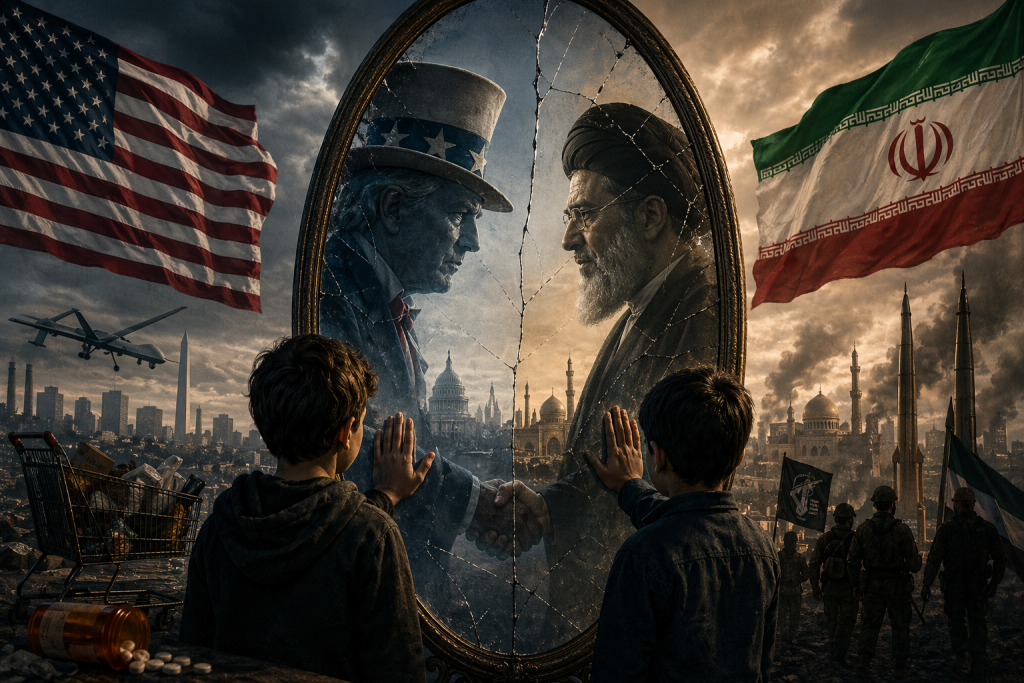
The conflict between the United States and Iran is usually framed in terms of nuclear programs, sanctions, and regional power. That’s the visible layer. Beneath it is something less discussed and more uncomfortable.
Each country sees in the other a reflection of traits it refuses to recognize in itself.
America looks at Iran and sees religious dogmatism, suppression of dissent, and hostility to individual freedom. Iran looks at America and sees empire, moral hypocrisy, and power without restraint. Both images are distorted—but neither is entirely wrong.
The psychologist Carl Jung called this tendency “projection”: pushing unwanted parts of ourselves onto others, then treating them as enemies. It’s not just an individual habit. Nations do it too.
This doesn’t replace geopolitics—it shapes it. And it helps explain why the U.S.–Iran relationship has been so resistant to change.
To understand how this pattern took hold, you have to start with history.
The First Crack: 1953
For much of the early twentieth century, Iran wasn’t a rival to the United States—it was aligned with it. That changed in 1953.
Iran’s prime minister, Mohammad Mossadegh, was democratically elected and widely popular. His defining move was to nationalize Iran’s oil industry, which had been controlled by the British-owned Anglo-Iranian Oil Company. He argued, simply, that Iran’s resources should belong to Iranians.
In response, the United States and Britain orchestrated a coup. The Central Intelligence Agency and MI6 helped remove Mossadegh and restore the Shah to power, securing Western access to oil and influence in the region.
At the time, Washington saw this as strategic necessity. But the long-term cost was profound. A democratic movement was overthrown in the name of stability and profit, leaving behind a deep and lasting distrust.
For many Iranians, 1953 became proof that American rhetoric about freedom did not apply when its interests were at stake. That memory didn’t fade—it hardened into a national narrative.
The mirror didn’t exist yet, but the first crack had formed.
1979: Trauma and Transformation
By 1979, resentment toward the Shah’s regime—and the foreign powers that supported it—boiled over into revolution.
What began as a broad-based uprising against authoritarian rule quickly consolidated into an Islamic Republic under clerical leadership. For Americans watching from afar, however, the revolution became defined by a single event: the hostage crisis.
For 444 days, American diplomats were held in Tehran. The crisis dominated U.S. media, with figures like Walter Cronkite counting the days on national television. It was experienced not just as a geopolitical incident, but as a national humiliation.
That moment left a deep imprint on the American psyche. Iran came to symbolize chaos, fanaticism, and defiance of international norms. The lesson many drew was simple: never again allow the United States to appear weak in the face of a smaller, ideologically driven adversary.
But the story doesn’t end there.
In the decades that followed, the United States adopted policies shaped by that trauma—prioritizing control, deterrence, and preemption. Sanctions expanded. Surveillance increased. Military interventions and covert operations became more normalized.
The U.S. did not become Iran. But at times, it adopted a similar logic: that certain threats justify bending or suspending ordinary rules.
This is where the reflection sharpens.
Echoes of Power
The United States and Iran are not equal in power or global reach. But they often mirror each other in behavior.
America condemns Iran’s use of proxy forces—groups like Hezbollah or regional militias—while maintaining its own network of allies and armed partners across the globe. Iran calls its network the “Axis of Resistance.” The U.S. calls its network “allies.” The language differs; the underlying strategy can look similar.
America criticizes Iran’s suppression of dissent. Iran points to surveillance, mass incarceration, and past programs like COINTELPRO as evidence that the U.S. struggles with its own forms of internal control.
Each side highlights the other’s contradictions while downplaying its own.
This dynamic is reinforced by deeply rooted national narratives. The United States often sees itself as a defender of global liberty. Iran sees itself as a resister of foreign domination and moral corruption. Both identities contain truth. Both can also become rigid, blinding each country to its own excesses.
When that happens, the conflict stops being purely strategic. It becomes psychological.
The Weight of Memory
History doesn’t just inform policy—it shapes perception.
In Iran, memories of foreign intervention, especially the 1953 coup, contribute to a persistent suspicion of outside influence. In the United States, the hostage crisis remains a defining image of Iran, reinforcing a view of it as unpredictable and hostile.
These experiences function like emotional reflexes. They make compromise harder, because each side interprets the other’s actions through the lens of past injury.
Sanctions, for example, are presented by the United States as a tool to pressure the Iranian government. In practice, they target financial systems and oil exports, which can indirectly restrict access to essential goods, including medicine. For many Iranians, this reinforces the perception of the U.S. as indifferent to civilian suffering.
Iran, in turn, uses strategies designed to create leverage—advancing its nuclear program within ambiguous limits, supporting regional militias, and signaling its ability to disrupt global trade routes. These actions confirm American fears, strengthening the case for continued pressure.
Each move validates the other side’s worst expectations.
The Trap of Escalation
This is the central problem: both countries are responding not just to each other’s actions, but to the meanings they attach to those actions.
Sanctions harden attitudes within Iran, often empowering more hardline factions. Iranian resistance, in turn, reinforces American arguments for containment and deterrence.
Neither side can easily step back without appearing weak. And for both, weakness carries political and symbolic costs.
Over time, this creates a closed loop. Even genuine attempts at diplomacy are viewed with suspicion. Trust erodes to the point where every gesture is interpreted as a tactic rather than an opening.
The conflict sustains itself.
When Opposites Converge
There’s a broader pattern at work here. Nations, like individuals, can drift toward the very traits they once defined themselves against.
The United States was born from a revolution against empire, yet became a global superpower with extensive military and economic influence. Iran was once a close Western ally under the Shah, but transformed into one of the most prominent opponents of American power.
Each became, in some ways, a version of what it once resisted.
This isn’t a moral judgment—it’s a recurring historical tendency. Identities built in opposition can, over time, absorb aspects of what they oppose.
And when that happens, it becomes easier to project those traits outward rather than confront them internally.
Stepping Out of the Reflection
If this conflict is partly sustained by projection, then resolving it requires more than policy adjustments. It requires a shift in perspective.
For the United States, the greater power carries greater historical responsibility. That could begin with a more open acknowledgment of the 1953 coup—not as a strategic footnote, but as an act of force that shaped a nation’s trajectory for decades. It would also mean reassessing how sanctions, even when legally targeted, disproportionately affect civilians. A superpower can afford such self-scrutiny; the cost of not doing so is perpetual enmity.
For Iran, the mirror turns inward. The revolution’s original promise of justice and independence cannot be squared with the realities of political repression, restricted freedoms, and the cynical use of anti-Americanism to deflect from internal failures. Confronting this gap is Iran’s own burden—not because the U.S. is innocent, but because no external enemy can be blamed forever for a government’s choices about its own people’s rights.
These steps are difficult. They challenge national narratives and political incentives on both sides.
But without them, the pattern holds.
Conclusion
The U.S.–Iran conflict is often described as a clash of ideologies or interests. It is that—but it is also something more reflective.
Each country sees in the other a distorted image of itself: its fears, its contradictions, its capacity for control and overreach. That image is easier to confront at a distance than at home.
But a conflict rooted partly in reflection can’t be resolved through force alone. It requires recognition—of history, of perception, and of the ways nations, like individuals, externalize what they struggle to accept internally.
The challenge is not simply to change the other side’s behavior. It is to understand how each side helps sustain the dynamic it opposes. Until that happens, the reflection remains—and so does the conflict.
If this work matters to you, please consider sharing it. And if you’d like to support my research and writing, paid subscriptions are available via Patreon, BuyMeACoffee, or Substack. Thank you for being here.


