



“Paper money eventually returns to its intrinsic value: zero.” — Voltaire
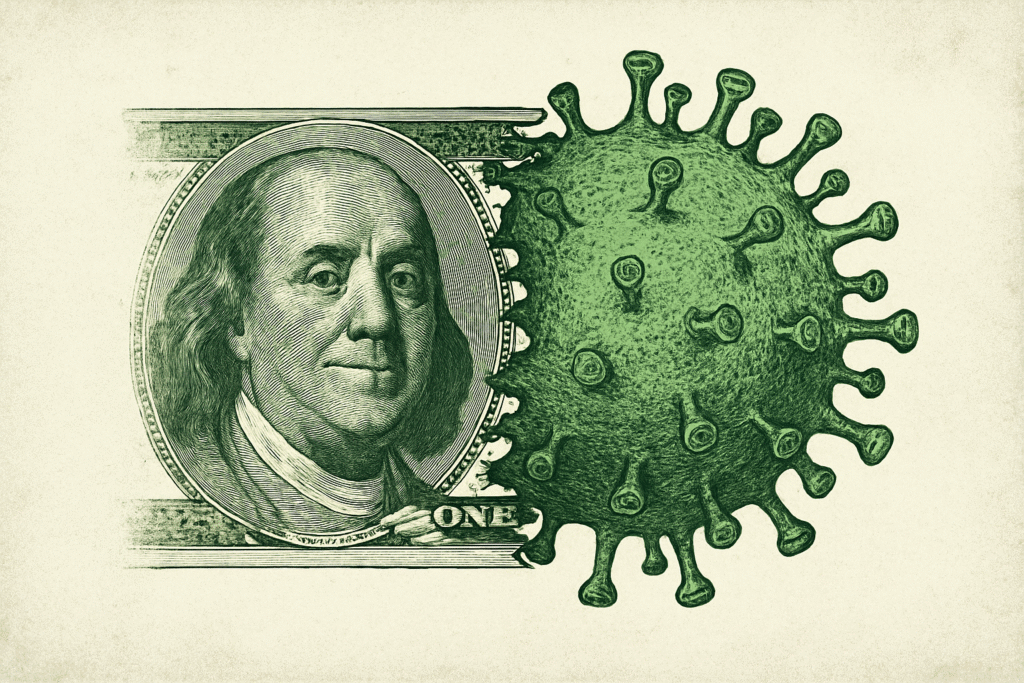
Last week, I read Scott Bessent’s paper, “The Fed’s ‘Gain of Function’ Monetary Policy,” which presents a striking critique of the Federal Reserve’s unconventional monetary strategies. Bessent argues that over the past decades—particularly following the 2008 financial crisis—the Fed has engaged in what can metaphorically be described as “gain-of-function” interventions. By expanding its role into areas like large-scale asset purchases, bank supervision, and direct market support, the central bank has pushed itself beyond its original mandate. The result, Bessent warns, is a dangerous combination of systemic risk and an erosion of institutional independence.
What struck me most was not the logic of Bessent’s analysis but his rhetorical choice. By deliberately borrowing a loaded scientific term and applying it to economics, he invokes the cultural shadow of the COVID-19 years. In biology, “gain of function” refers to experiments designed to enhance a pathogen’s abilities—making a virus more transmissible, more virulent, or capable of infecting new hosts. Those who called the pandemic a “PLANdemic” are precisely the audience he is signaling to. His implication is clear: the Fed has been hijacked, and the artificial engineering of monetary policy is leading to the controlled demolition of our economy.
In science, the stated purpose of gain-of-function is prophylactic: to anticipate future mutations and develop treatments before they occur naturally. The Fed’s gain-of-function, we are told, has a parallel goal: to anticipate crises and prevent recessions before they spiral into collapses. Yet the analogy holds most forcefully in its risks. An engineered pathogen, more virulent than nature would likely produce, eventually escapes the lab. Likewise, a hyper-managed economy, pushed beyond its natural rhythms of expansion and contraction, eventually slips from the control of its architects. It is laughable to imagine that scientists and economists are unaware of this inevitability. Over time, “gain of function” has come to symbolize high-risk tinkering with systems we do not fully understand—a perfect metaphor for the Fed’s increasingly experimental approach to monetary policy.
Where I diverge from Bessent is in his framing. He guides his audience toward the conclusion that the Fed has been misguided, that it has strayed from its mandate and needs reform. My view is more radical: the Fed was a mistake from the beginning. The dangers of artificially boosting an economic system beyond its natural limits can be illustrated by one of ecology’s most dramatic cautionary tales: St. Matthew Island, Alaska.
In 1944, the U.S. Coast Guard introduced 29 reindeer to the island, which had an abundance of lichen and no natural predators. The population exploded to over 6,000 by the early 1960s, overshooting the island’s carrying capacity. When the food was gone, the population collapsed almost overnight, plummeting to just 42 animals. What had seemed like an unstoppable boom turned out to be a trap engineered by the initial conditions. This parable of unsustainable growth mirrors the fate of any artificially enhanced system, whether biological, ecological, or financial.
The Federal Reserve was established in 1913 in response to recurring banking panics that destabilized the U.S. economy. Its original mission was modest: provide an elastic currency, act as a lender of last resort, and maintain stability in the banking system. Its early toolkit—adjusting the discount rate, regulating reserves, and intervening sparingly in money markets—appeared harmless, even prudent. But appearances can be deceiving. From its very inception, critics warned that the Fed was not a neutral stabilizer but a cartel mechanism for banking interests, cloaked in the language of public service. Far from correcting the natural cycles of the economy, it institutionalized a form of gain-of-function engineering—artificially enhancing credit, concentrating power, and laying the groundwork for systemic fragility.
The Fed as Engineered Fragility: A Century of Parasitic Gain-of-Function
From the beginning, the Federal Reserve was sold to the public as a stabilizer, a necessary intervention to prevent the chaos of recurring bank panics. But as critics from across the political spectrum have pointed out, this narrative conceals a darker reality. Rather than correcting instability, the Fed institutionalized it, transforming the economy into a laboratory for monetary engineering. Like gain-of-function research on viruses, the Fed’s interventions enhanced the “pathogenicity” of financial cycles while consolidating control in the hands of a small elite.
Edward Griffin, in The Creature from Jekyll Island, describes the founding of the Fed not as a noble act of public service but as a cartel arrangement crafted in secrecy by powerful bankers on Jekyll Island in 1910. Its structure was designed to protect private banking interests under the guise of public oversight. Murray Rothbard, in The Case Against the Fed, sharpened the point: the central bank is not a neutral arbiter but a mechanism to enable inflationary credit expansion, benefiting government and financial elites while eroding the value of ordinary citizens’ savings. Ron Paul echoed this in End the Fed, calling for the outright abolition of the institution on the grounds that it is both unconstitutional and parasitic.
Later scholars have carried this critique forward into the present. Jacobs and King, in Fed Power, argue that the Fed has become one of the most powerful unelected institutions in American life, wielding authority far beyond its original mandate. Karen Petrou, in Engine of Inequality, demonstrates that the Fed’s policies have disproportionately benefited asset owners and the wealthy, creating an artificial economy where capital is rewarded and labor is punished. In her view, the Fed’s “gain-of-function” tinkering has not merely failed to solve inequality—it has actively engineered it.
One of the most striking recent contributions comes from The Roots of the Federal Reserve: Tracing the Nephilim from Noah to the US Dollar by Laura Sanger. Unlike the economic critiques, this book grounds its argument in a deep Biblical study, tracing the Fed’s origins through ancient patterns of corruption, parasitism, and domination. It interprets the Federal Reserve not as a mere historical accident, but as a continuation of a much older spiritual struggle: a Nephilimic lineage of exploitation that stretches from the post-Flood world of Noah to the modern system of fiat currency. Its thesis is breathtaking in scope: that financial systems like the Fed are not only economic tools but also instruments of an ancient parasitic power structure designed to enslave nations.
The pattern is unmistakable. Just as virologists enhance pathogens in the name of prevention, the Fed enhances the financial system in the name of stability. But both processes share the same parasitic logic: risks are socialized, rewards are privatized. When banks fail, the Fed absorbs losses into the public balance sheet, devaluing currency and taxing the public invisibly through inflation. When markets overheat, Fed liquidity flows to Wall Street rather than Main Street. Like an engineered virus that thrives on its host’s weakness, the Fed’s gain-of-function monetary policy extracts vitality from the real economy to sustain a system that exists primarily for its own perpetuation.
Gain-of-Function as a Universal Mechanism of Parasitism
When viewed through the Biblical lens of The Roots of the Federal Reserve, the Fed ceases to appear as merely a misguided experiment in monetary policy. It becomes the modern incarnation of a much older pattern: a Nephilimic strategy of parasitism. In the Hebrew Scriptures, the Nephilim were described as giants, hybrids who preyed upon human communities, consuming resources and corrupting societies until they collapsed. They embodied a form of “gain-of-function” in flesh—unnatural enhancements of strength, size, and domination that ultimately destroyed the very societies that hosted them.
Seen in this light, the Federal Reserve’s role in the economy is not accidental but archetypal. Its monetary engineering mirrors the same parasitic logic: artificially enhancing certain powers (banks, elites, speculative capital) while draining the life force of the host (the broader public). Just as the Nephilim consumed the earth until the Flood, the Fed engineers cycles of credit and debt that consume the economic vitality of nations. Its interventions appear as salvation but function as enslavement.
The resonance with viral gain-of-function is profound. In both biology and finance, unnatural enhancements create short-term power but long-term fragility. The enhanced virus eventually escapes the lab; the enhanced financial system eventually destabilizes and collapses. The parasite always extracts more than it returns, until the host is left weakened or destroyed. Whether in Biblical mythology, ecological parables like St. Matthew Island, or the structure of modern central banking, the pattern repeats with eerie consistency.
This is why the gain-of-function metaphor is so powerful: it transcends any single domain. It describes a universal mechanism of parasitism—an unnatural tinkering with the foundations of life, society, or economy, in which the “gains” accrue to a small elite while the risks and losses are borne by the many. Whether through Nephilim giants, engineered viruses, or central banks, the principle remains the same: fragility masquerades as strength, and the host pays the ultimate price.
Conclusion: The Final Cost of Gain-of-Function
Whether we examine it in the laboratory, in history, or in Scripture, gain-of-function emerges as the same pattern: the unnatural enhancement of systems to produce short-term power at the expense of long-term survival. In biology, it is the virus made more transmissible in the name of science, until it escapes and ravages the world. In ecology, it is the reindeer of St. Matthew Island, flourishing unnaturally until their boom becomes a death trap. In the financial sphere, it is the Federal Reserve engineering liquidity, debt, and credit to inflate growth that cannot be sustained. And in the deepest Biblical sense, it is the Nephilimic logic of parasitism: unnatural power feeding upon humanity until the host can no longer endure.
The danger is not simply in the interventions themselves, but in the arrogance they embody. Gain-of-function presumes mastery over systems we do not fully understand—life, ecology, or economy—and in doing so, it sets in motion forces that spiral beyond control. Fragility is engineered into the very foundations. The parasite always thrives first; the host always pays later.
Bessent’s warning about the Fed’s “gain-of-function” monetary policy, then, is more than an economic critique. It is a glimpse into a universal pathology of collapsing systems. The Fed is not an aberration; it is an expression of a recurring mechanism that has haunted civilizations from Noah’s day to our own. We are living inside a vast experiment, where the short-term gains of a few are purchased with the long-term stability of the many.
The lesson is as stark as it is urgent: what is artificially enhanced will eventually collapse. The only true antidote to parasitic gain-of-function is restraint, humility, and a return to natural limits. Without that recognition, whether in science, in finance, or in governance, the pattern will repeat—until the host is consumed and nothing remains for the parasite to feed upon.
And this brings me to why I write: to expose the hidden patterns of fragility and parasitism that shape our world, and to challenge the myths that keep them in place. Independent voices matter because they resist the engineered narratives of power. If this work helps you see more clearly, consider supporting it—through Patreon, BuyMeACoffee, or Substack. Your contribution, however small, strengthens a community committed to truth-telling outside the machinery of controlled narratives.


